Thierry Damilano and his team of Tuareg guides will take you on a trek in the Algerian Sahara, to discover the local culture with a mandatory visit to the hermitage of Father de Foucauld facing Assekrem, then climbing the legendary peaks of the Hoggar massif.
Sepp Holzer explains some of the innovative, labour-saving agricultural techniques he applies at his farm in the Eastern Alps of Salzburg, Austria.
In 1966, John Harlin II died while attempting Europe's most difficult climb, the North Face of the Eiger in Switzerland. 40 years later, his son John Harlin III, an expert mountaineer and the editor of the American Alpine Journal, returns to attempt the same climb.
Behind every breakthrough in the progression of climbing, there's a true story of doubt and determination, perseverance in the face of failure. From boulders, to big walls, to competition podiums, the climbers at the top of the game share a commitment to do whatever it takes to achieve their vision.
Explore Mont Blanc
La Montagna di Ilio
The true story of Wanda Rutkiewicz, the first woman in the world and the first person from Poland to climb the highest peaks on earth, told by herself.
Bravo Marcel
The story of Enrique Herreros (1903-1977), cartoonist, advertiser, poster designer, talent manager, actor, producer and filmmaker, and the most daring of mountaineers; the man who, along with his companions from the so-called “other Generation of '27,” brought Hollywood to Madrid's Gran Vía, turning a grey and sinister post-war city into the capital of an incipient and ambitious cultural industry.
“Annapurna III – Unclimbed” is an award-winning 12-min documentary featuring the 2016 expedition to the Himalayas of Nepal led by David Lama together with Austrian alpinists Hansjörg Auer and Alex Blümel. Join the team in their feelings of fatigue, anxiety, exposure and ordeal during their 5 weeks attempting one of the world’s greatest, unsolved puzzles of alpinism: The unclimbed south-east ridge of Annapurna III.
Trinité
For nearly three years, director Dina Khreino interviewed world-class mountain climbing athletes, listening to what compels them to leave behind families, friends, and everyday comforts to risk everything for a fleeting glimpse into the unknown. What she found was a tribe, a diverse group of professional adventurers and amateur philosophers forged by the ultimate test of body, mind, and spirit. In the face of shifting winds, sheer granite cliffs, and impossible odds, they climb. Each for their own reason, but every one connected by the vertical world. In this rarefied air, these athletes are fundamentally changed, not just as climbers, but as human beings.
The biggest stories from the climbing world, told with humor, heart, and mind-bending action. Featuring Alex Honnold in Honnold 3.0, Chris Sharma and Adam Ondra in La Dura Dura, Conrad Anker, Jimmy Chin and Renan Ozturk in Shark's Fin, The Wide Boyz, Sasha DiGiulian, Daila Ojeda and more.
Nicolas Jaeger, a French physician specializing in sports and high-altitude physiology, conducted an experiment by spending two months on the highest peak in the Peruvian Andes, Huascarán. From July to September 1979, Nicolas Jaeger lived alone for 60 days at an altitude of 6,700 meters and studied the effects of hypoxia on his body. He documented his experience on film and later in his book, "Carnet De Solitude," published in 1979.
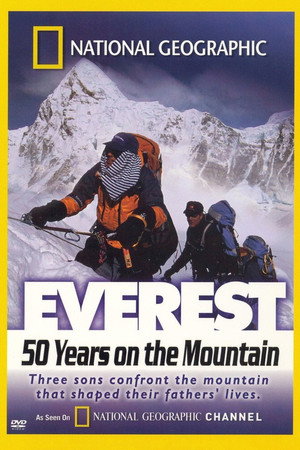
In 1983, three climbers became the first French people to reach the summit of Everest. Among them were expedition leader Pierre Mazeaud and a promising 25-year-old climber, Jean Afanassieff. Twenty years later, the two legends, accompanied by mountain guide Michel Pellé, retrace the steps of their exploit and make the trek from Kathmandu to the foot of the roof of the world. This is an opportunity to retrace the history of the successive assaults on Everest and to assess the current situation of a mountain that has become a victim of its own success: while Sherpas have been able to take advantage of Western enthusiasm and thus enrich themselves and equip the summit to make it more accessible, the site's attendance poses numerous problems, both human and ecological.
Participants' account of Wanda Rutkiewicz's last expedition.
It is a fact that our winters are less and less cold. Therefore it is harder and harder to get the conditions for ice-climbing. Fortunately, man adapts to his environment and makes progress: this is how dry-tooling was born. This movie will make you discover this discipline: its history, its evolution and the current practice. You will also see how much excitement dry tooling can bring. Dry-tooling now allows to free-climb some routes which were impossible to climb without aid in the past.
Postwar life of eight remaining inhabitants of Strmec, a village located in the very corner of Slovenian Alps near Italian border. When local partisans killed a German officer, the Nazi occupiers shot all males in the village as an act of revenge; those who remained are seven women of different age who traditionally wear black scarves, and young boy who hasn't any friends to play with.
In southern Germany, winter can still be admired in all its glory every year. With its white coat of snow and icicles and myriads of small crystals that look like geometric works of art. In the valleys and on the slopes the snow is still so thick every year that the alpine huts are snowed in up to the windows. Cows and dairymen are safe in their farms at lower altitudes. But not the wild creatures of the mountains! They need strategies to survive the cold season and to defy snow masses, cold and ice. And some seem to do it so easily that they even raise their young in the middle of winter. But how do animals, plants and fungi cope with the annually recurring ice age, which from our perspective is a time of need? The many adaptations in nature prove that winter is an integral part of the natural cycle of the year and the living environment of species. They are adapted to cold and frost. That is why the animals and plants at the edge of the Alps suffer particularly from climate change!
Verdon Vertical Mile