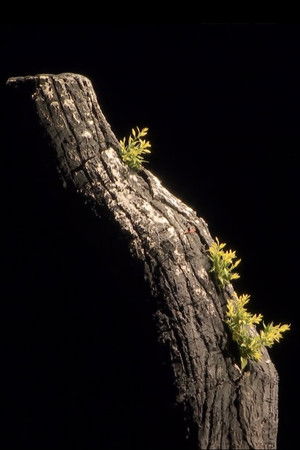
Alone in the woods, a young man is pursued by a horrifying specter and by visions of his deceased sisters. A meditation on the precarious uncertainty of the American Dream and the role that uncontrollable forces play in our lives, The West is a Land of Infinite Beginnings is inspired by a harrowing scene from the opera Proving Up, by composer Missy Mazzoli and librettist Royce Vavrek.
Simon Keenlyside smolders dangerously in the title role of Mozart’s version of the legend of Don Juan, creating a vivid portrait of a man who is a law unto himself, and all the more dangerous for his eternally seductive allure. Adam Plachetka is his occasionally unruly servant Leporello. It’s when Giovanni tangles with Donna Anna (Hibla Gerzmava) that things start to unravel, aided by the reappearance of Donna Elvira (Malin Byström), who is determined not to let her seducer go. With Paul Appleby as Don Ottavio, Donna Anna’s eternally steadfast fiancé. Principal Conductor Fabio Luisi leads the Met Orchestra and Chorus.
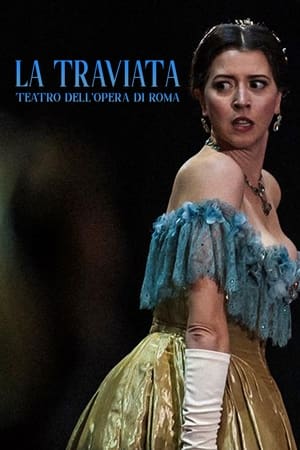
A collaboration between award-winning American filmmaker Sofia Coppola and Italia haute couture king Valentino comes in the form of a revival of Giuseppe Verdi's classic opera, La Traviata. Captured live from the Teatro dell'Opera di Roma.
With their “musical comedy” in the spirit of Mozart, Richard Strauss and his brilliant librettist Hugo von Hofmannsthal created the most popular of all their works and one of the most frequently performed operas of all time. Disguised as a refined comedy, light as a feather and extremely entertaining, “Der Rosenkavalier” tackles universal themes such as love, sexuality, marital fidelity, and the changes that human relationships undergo over time. All set to music of the most sumptuous kind. With its prestigious cast under the inspired direction of Harry Kupfer, the 2014 Salzburg Festival production of *Der Rosenkavalier* was one of the most internationally acclaimed interpretations of the work since the start of the new millennium.
Composer Thomas Adès conducts the Met premiere of his powerful opera based on Shakespeare’s last play, in Robert Lepage’s brilliantly inventive production. Simon Keenlyside is the magician Prospero, who conjures the storm that shipwrecks his enemies and sets in motion the course of events. Rising Met stars Isabel Leonard and Alek Shrader are the young lovers, Miranda and Ferdinand, Alan Oke sings the sinister Caliban, and Audrey Luna gives a memorable performance as the sprite Ariel.
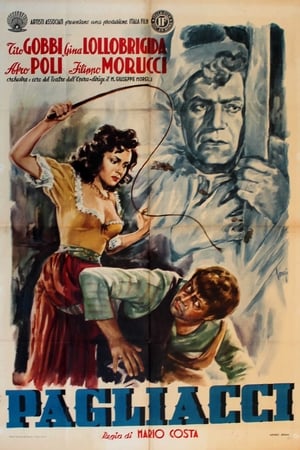
Director David McVicar’s new production brings opera’s favorite double bill to new life, setting the two operas in the same Sicilian setting, separated by two generations. Marcelo Álvarez takes on the rare feat of singing both leading tenor roles. In Cavalleria, he is Turiddu, the young man who abandons Santuzza (Eva-Maria Westbroek) in his pursuit of the married Lola (Ginger Costa-Jackson)—and ends up being killed in a duel with her husband, Alfio (George Gagnidze). In Pagliacci, Álvarez is Canio, the leader of a traveling vaudeville troupe. Patricia Racette sings Nedda, his unfaithful young wife, whose plans to run away with her lover are foiled by her spurned admirer Tonio (George Gagnidze)—with equally tragic consequences. Met Principal Conductor Fabio Luisi is on the podium.
In February 1972, the American president Richard Nixon went to China to meet Mao Zedong. In the context of the war in Vietnam and the cold war, this encounter marked a turning point in Chinese‑American relations. John Adams, a major musical figure of the last forty years, made this event of contemporary history the subject of his first opera. Nixon in China tackles the political thaw instigated by ping-pong diplomacy, begun by the invitation of the American table tennis players by their Chinese counterparts, one year before the presidential visit. A mesmerising work in which the pulsations and repetitions typical of minimalism are combined with melodic lines of great lyricism. For its entry into the Paris Opera repertoire, this work has been entrusted to the director Valentina Carrasco, who underlines the importance and the mediating power of Chinese national sport in history.
France, 1792. Chenier is an idealistic poet, in love with the aristocratic Maddalena. While Chenier supports such notions as "liberte, fraternite egalite," his sympathies do not extend to the current Reign of Terror. Likewise, the Revolutionary Tribunal has no need for poets or their girlfriends, especially those judged to be an Enemy of the State. Heads will roll.
A collectively made filmic opera in 35 parts. The Black and predominantly queer art collective, an evolving line up of poets and artists from across the world, abstracts and reimagines opera in any traditional conception. Set to hip-hop, blues, noise, R&B and electronica, the piece uses the voice (chanting, singing, screaming; written by poet and activist Dawn Lundy Martin) as its primary tool, verbalising centuries of alienation, vulnerability and protest in the global African diaspora through its disruptive libretto.
Although he is unanimously credited with having democratised opera, making it accessible to the greatest number, focus is rarely put on the strategy he devised and implemented in order to carry out his actions, nor what his actions reveal of the man and artist, and of the resulting metamorphosis from opera singer to pop artist. Through this angle, this film sets out to pay tribute to the man who summed up his credo, obsession and life’s work, in the following way: “They led the public to believe that classical music belonged to a restricted elite. I was the way to prove to the world that was wrong.
The opening work of the 2019-2020 season of the Teatro dell’Opera di Roma was Verdi's grand opera based on a historical uprising Sicily in 1282. Conducted by Daniele Gatti and directed by Valentina Carrasco. Given in the original French version as "Les Vêpres Siciliennes.”
A young woman, married to a wealthy man, but miserably lonely; trapped within a world ruled with an iron fist. Katerina is driven by a lust for life and for love. Her husband, though, is impotent; her father-in-law a tyrant. No wonder, then, that she longs to free herself from this yoke. When Sergei starts work on the family estate, she sees in him a chance for salvation. However, their subsequent affair marks the beginning of a descent into crime.
An Egyptian military commander, Radamès, struggles to choose between his love for the enslaved Ethiopian princess Aida, and his loyalty to the Pharaoh. To complicate the story further, the Pharaoh's daughter Amneris is in love with Radamès, although he does not return her feelings.
When Barbe-bleue loses his fifth wife, the turbulent Boulotte is selected at random to be the next one. But Barbe-Bleue falls in love with Hermia – who loves the shepherd Saphir – and soon wearies of Boulotte. So, he asks his alchemist to concoct for him an “anti-wife” philtre. But, as on the previous occasions, it is merely a sleeping potion and Boulotte wakes up the other five “dead” wives. They reappear, dressed up as gypsies and bring the truth to light.
With an illustrious career spanning five decades: over 150 stage roles, 11 Grammy Awards and his iconic performances alongside Luciano Pavarotti and José Carreras as one of the Three Tenors, the legendary Plácido Domingo continues to astound audiences with a vocal talent unmatched in power. For one very special night, Plácido Domingo returns to the breath-taking Arena Di Verona amphitheatre, 50 years after his debut, to revisit three of his greatest ever roles.
One night in Judea, a disabled shepherd boy-turned-beggar and his mother are visited by three strangers. They are the Three Kings, and they are on their way to Bethlehem to visit the Christ Child, who has just been born.
As Blanche’s fragile world crumbles, she turns to her sister Stella for solace – but her downward spiral brings her face to face with the brutal, unforgiving Stanley Kowalski. This is the world premiere performance by the San Francisco Opera on September 19, 1998.
Franco Zeffirelli directs these two legendary La Scala productions telling tragic tales of jealousy. Mascagni's Cavalleria Rusticana features performances by Elena Obraztsova, Plácido Domingo, and Renato Bruson. Leoncavallo's I Pagliacci stars Teresa Stratas, Plácido Domingo, and Juan Pons. Both are conducted by George Pretre. This production of Pagliacci earned director Franco Zeffirelli the coveted Emmy as Best Director in the category of Classical Music Programming.
The life and career of Italian opera singer Farinelli, considered one of the greatest castrato singers of all time.
Anna Netrebko und Rolando Villazón singen "La Traviata"