Masters of stone I is a documentary about rock climbing that takes place in City Of Rocks and American Fork Canyon. It was directed by Eric Perlman in 1991 and produced by Perlman Productions. It is a part of the series Masters of stone (1/6). It features Ron Kauk, Tony Yaniro, Dan Osman, John Bachar, Todd Skinner, Boone Speed and others.
Andrzej Bargiel and Jędrek Baranowski roam through Karakoram to create history. This movie is a journey full of passion and love for big mountain skiing told by two friends across 6,000m of descent.
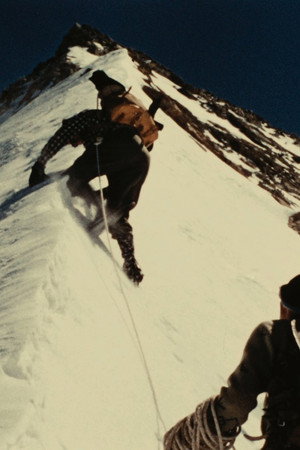
"Leo Dickinson’s re-editing of the classic first ascent of the Central Tower of Paine in Patagonia, filmed by Vic Bray. The 44-year-old original footage was salvaged from a loft and shows Chris Bonington and Don Whillans in action. Readings from Don’s journal add depth and a recreation of a double rope snapping incident adds the necessary spice. What marks this film apart is the film stock which makes the image seem to glow and the leisurely pace Leo has treated the edit. It makes a refreshing contrast to many contemporary films and modern digital filmmakers could be well served by taking note."
The ascent of the Wetterhorn by Frank Ormiston-Smith accompanied by the guide Christian Bergner, Rev. H. J. Heard, Mr. E Burchell-Rodway from the Alpine Club, and the hotelier Herr Fritz Boss from Grindelwald. The film consists of 24 scenes including a final scene of the team on the summit. The film starts with the climbers and the guide leaving the Bear Hotel, at Grindelwald. Later the party arrives at the Wetterhorn Hotel, at the mountain base. They climb the Milchbach Ladders to gain the top of the glacier, cross the Seebach Platte and the upper glacier, and pass the night at the Mountain Inn. Next morning they overcome the Great Coulvu and gain the arete to finally reach the summit. Sections of the film are tinted to give the effects of dawn, sunset and rose-glow actually experienced during the climb.
In 1910, the Parisian Albert Chapon and the Genevan Louis Arlaud filmed the ascent of Portjengrat (3,654 m) in the Penine Alps. The resulting film was a short 172 meters long produced by the Société Française des Films et Cinématographe Eclair. The film was released in UK by the Tyler Film Company under the title of 'Ascent of Portjengrat'.
Every spring, tens of thousands of men, women and children leave their villages for a dangerous trek to the high Himalaya to collect Yarsagumbu, a mysterious transmutation between plant and insect. Used in Chinese medicine, it is worth up to 60 000 USD a kilo, more than gold.
The first winter ascent of Nanga Parbat was achieved in 2016 by Pakistani Muhammad Ali Sadpara and Spaniard Alex Txikón, accompanied by Simone Moro and Tamara Lunger. Alex Txikón made headlines again by attempting K2 in the winter of 2019, then Everest in the winter of 2020 (each time unsuccessfully); but also by participating in the search operations led by Tom Ballard and Daniele Nardi on Nanga Parbat in March 2019, even claiming to have spotted two figures on the face. Confined during the Himalayan season, the Basque climber took the opportunity to work on a film recounting his own adventure on Nanga Parbat four years earlier.
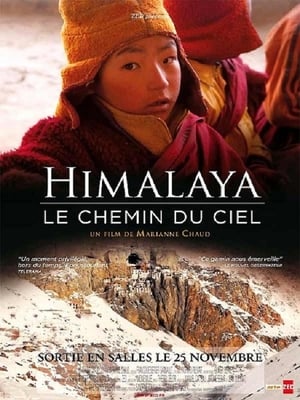
Each year, groups of Tibetan children secretly flee their homeland over the Himalayas to reach schools in India founded by the government in exile. Entrusted to smugglers, they are risking their lives by illegally crossing the great Himalayan range, a towering rampart between Tibet and India. The director will take us in the Mussorie school, in North India, where two thousand four hundred children have been rescued. They have left behind their family childhood and are now considered as orphans. We will discover the itineraries of Sonam, aged nine, and Dholma, the little new girl of the school. Here in India, they are taught about Tibetan culture and will find out about the history of their country and their ancestors. Sonam and Dholma's story is that of thousands of Tibetan children. Are they orphans of a lost country or bearers of hope who will save an endangered culture?
A man walks in more or less familiar places, walks there as if crossing unknown lands, never encountered before. At each step, he observes the world before his eyes, forcing him to fix it and freeze it in an “other” space and time, on the celluloid of his old camera. This man is Kurt Diemberger, climber and filmmaker of high peaks and distant lands. He is 82 years old, but he lives in the "now" rather than the past, continually exploring the land beneath his feet, in places dear to him in Austria, Italy and the Dolomites, as if he continued his research through the eye of the camera he uses for the observer.
Satyajit Ray's poetic documentary was commissioned by the Chogyal (King) of Sikkim at a time when he felt the sovereignty of Sikkim was under threat from both China and India. Ray's documentary is about the sovereignty of Sikkim. The film was banned by the government of India when Sikkim merged with India in 1975. The ban was finally lifted by the Ministry of External Affairs in September 2010. Preserved by the Academy Film Archive in 2007.
L'alpinisme au Népal
Eric Escoffier, la Fureur de Vivre
Tibet: The Survival of the Spirit
In 1954, a German-Austrian expedition led by Mathias Rebitsch set off for the difficult-to-access Karakoram Mountains, geographically north of the Himalayas. They come across the Hunza, a people who live in the valley of the same name and believe they are descended from the soldiers of Alexander the Great. The documentary conveys impressions of the poor life of the Hunza people, the harvest, a court hearing, festivals and the children's everyday school life. Finally, the expedition sets off again and sets up its main camp on the moraine ridge of a glacier, where they measure the glacier and the earth's magnetic field. Finally, some men from the research community set off for a sub-peak of Batura.
Les Etoiles de Midi is an engaging docudrama about some of the more spectacular exploits of French mountain climbers over the last several decades. In one re-enacted story, there is a wartime escape through the mountains, and in another, a daring rescue of a pair of climbers who had been missing. The actors themselves are adept at the sport of climbing, and they give the scenes an immediacy and real daring that brings the stories alive. A combination of their acrobatics and skill and the outstanding episodes in the history of French climbing creates a winning 78 minutes.
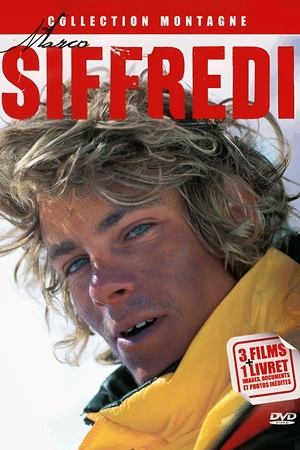
Avid for steep slopes, Marco Siffredi (1979-2002) obeys only one rule: not to fall. This gifted kid with hair sometimes blond peroxidized, green or blue clashed in his valley: Chamonix, mecca of mountaineering. His thing was to go up and down on a snowboard. . 90 minutes September 8, 2002, altitude 8848 meters, rare oxygen, his head already brushing the sky and his snowboard running, Marco Siffredi, 23, rushes from the summit of Everest in the Horbein corridor and its slopes at 50 degrees . A year earlier, he had already made the first descent of the mountain on a snowboard. But there remains another corridor… more direct. It's not a challenge, just a reason to be... However, that day, at the top of the roof of the world, his trace is lost...
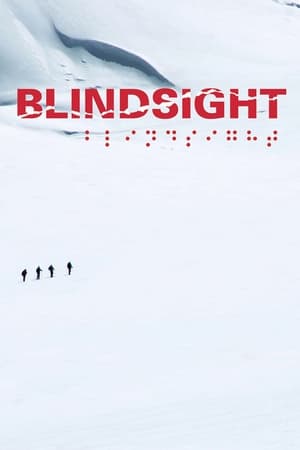
Six blind Tibetan teenagers climb the Lhakpa-Ri peak of Mount Everest, led by seven-summit blind mountain-climber Erik Weihenmayer.
An adventure of extreme skiing in the Mont Blanc area
It is 1 p.m. on June 30, 1982, when Christophe Profit, 24, shows up at the foot of Les Drus with his pof bag, his climbing shoes and nothing else. He will try the west face of Les Drus in "solo", in the Mont Blanc massif by "Directe Américaine", 1100 meters of vertical and smooth rock. Christophe will achieve the feat of climbing the wall in free solo, without using a rope or any belaying technique. At 4:10 p.m., barely more than three hours after the start of his ascent, the new climbing star can embrace the Virgin of the Drus at the same time as the career of a high-level mountaineer. Three years later, on July 25, 1985, he climbed the north faces of the Matterhorn, the Eiger and the Jorasses in the same day. Awarded at many mountain film festivals, this great documentary is a magnificent testimony to one man's passion for climbing, the mountains and adventure.
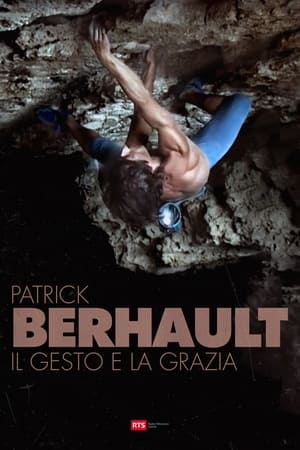
On the Thessalian plateau, a place famous in ancient Greek history, enormous and steep rocks rise, almost representing an epic clash of giants. In this mystical environment, Meteora once served as an aerial refuge for hermits and then for nuns of strict orders, who, renouncing the world, lived in the celestial peace of the peaks. This area is today a silent and fantastical climbing site, and some caves carved into the rock face remain inaccessible. Mountaineer Patrick Berhault and his French partner Patrick Cordier, one of the classic leaders of modern climbing, have set out to conquer these peaks steeped in history, which will never cease to be "The Pillars of Dreams."