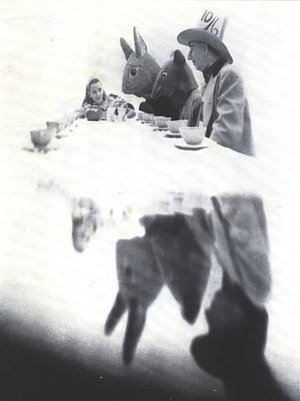
Thought to be the first full-hour television adaptation of 'Alice's Adventures in Wonderland' and 'Through the Looking-Glass', broadcast on the CBS Ford Theatre.
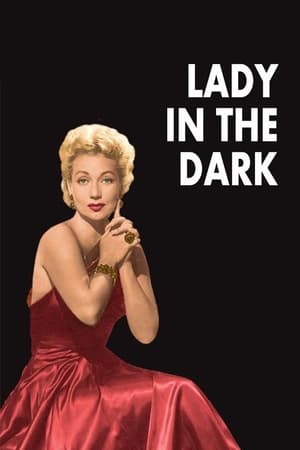
The unhappy female editor of a fashion magazine is undergoing psychoanalysis.
Although Dave (LeVar Burton) and his family are poor sharecroppers in the Deep South in the 1930s, this 15-year-old's problem is shared by teenagers today: he stands with one foot in adulthood and the other in childhood. "Almos' A Man", yet still treated like a child, he struggles for an identity. There's one thing, one symbol of manhood, Dave thinks, that could guarantee him instant respect: a gun.
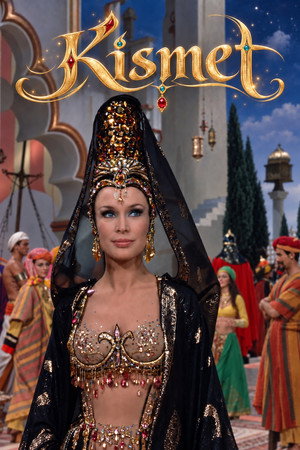
The story follows one fateful day as a beggar-poet and his daughter cross paths with a wicked wazir, a wily temptress, a handsome prince, a magical curse, opulent sets and exotic adventure. Adapted from the Broadway musical.
The story is about a lawyer who believes that capital punishment is terrible, and that imprisonment, if forever, remains a compassionate punishment, then he engages in a bet with a businessman, if he can stay in prison for fifteen years exchange for any wealth, and they hold a bet that if he holds, he will get two million rubles.
Viesnīca Tanatos
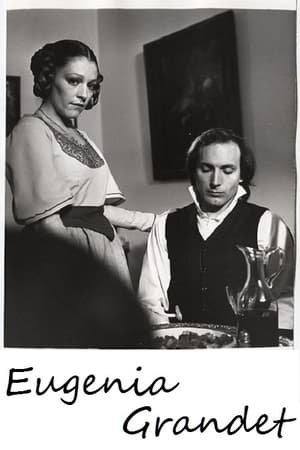
Adaptation of the famous Balzac novel
Edgar Bergen and his dummy, Charlie McCarthy, join Alice on her adventure in Wonderland.
Standing in front of her bedroom mirror, Alice reflects on the young girl she will soon become. The inverted world she sees there suddenly arouses her curiosity. Is everything different? In reverse? Alice can't resist the temptation to find out for herself by going through the mirror... This itinerary follows the rules of a life-size chess game... Most of the people Alice meets in "Mirrorland" are unkind, cowardly and selfish. This is the worrying image that children can sometimes have of adults. Alice decides what she wants to become: a free and fulfilled young girl. "De l'autre côté du Miroir" describes the path Alice takes to leave childhood behind and become herself.
Frank Groothof tells and sings the story of Ulysses' homecoming. He is accompanied musically by the saxphone ensemble Sax et Plus. The Dutch peninsula of Schiermonnikoog forms the backdrop for the story, in which Groothof himself plays almost all carachters.
Kadiyam Babji is an ageing man angry with the way society functions. He decides the best payback is to kidnap some high-profile people. But NIA officer Ira is hot on his heels.
Francesca Brabaut, who married an artist against her father's advice, regrets her decision when her husband Antoine, in debt, sends her to his misanthropic uncle to plead for money.
Kabayan undergoes a long journey to get his soul mate, Nyi Iteung, since Abah, the latter’s father, does not agree to have a son-in-law from the village. Kabayan has to go to the city to find his luck, assisted by his friend, Joni Kemod and his master, Nora Nori. Now, Kabayan, as a city person, is coming home to propose to Nyi Iteung. The film ends with Abah's acceptance of Kabayan for what he is.
Roberta is a young girl who cares for her ailing mother. When her mother dies, she is forced to live with her irresponsible father and his wicked girlfriend.
The story of the efforts of the military commanders of the Singosari Kingdom to prevent the influx of Khubilai Khan’s forces from Mongolia. Five well known warriors, Larang Jagad (Baron Hermanto), Banggokantera (Atin Martino), Kuda Merta (Luthi Tambayong), Galigo (Jack Maland) and Rangga Sakti, who are collectively known as the Five Tigers, or Lima Harimau Nusantara, are called in to help. They go to battle against Penyebar Racun (Risma Salmon), Jubah Merah (Arthur Kaunang) and Kodok Salju (Jabol Mora). The Five Tigers are so powerful that Khubilai Khan’s forces are beaten back and return to their homeland in defeat.
A young couple, Rodrigo and Aimé, who love each other deeply and possess everything to achieve full happiness, are hit by fate: She suffers an accident and becomes paralyzed.
A director of a television series on the history of cinema, who has been grappling with the screenplay of his first feature film, receives an assignment to oversee the installation of a television relay station in a remote region of Zahedan province. He has already hired Turkmen tribespeople for his film and selected his filming location. Meanwhile his wife, who is working on her Ph.D. dissertation about the Mongol invasion of Iran, attempts to dissuade him from accepting the assignment. One night, while working on his history of the cinema series, the director fantasizes a diegetic world that consists of clever juxtapositions of his different worlds: the history of cinema, the history of the mongol invasion, his own film idea and his imminent assignment to the desert.
This satiric comedy concerns a documentary filmmaker (Ken Finkleman) who has brought a camera crew into the home of a typical couple (Robert Cait and Karen Hines) to record the drama of their daily lives. However, the filmmaker soon discovers their daily lives aren't especially interesting, and soon he finds himself deliberately throwing chaos into their path in hopes of making for a more exciting movie. Married Life: The Movie was originally produced as a weekly television series, with four episodes re-edited into this feature; the show's director and star, Ken Finkleman, later went on to create the award-winning Canadian sitcom The Newsroom.
Early 1960s realist drama following a day in the lives of two London flatmates. Sylvia Syms and June Ritchie star as Billa and Ginnie, two singletons sharing a London flat who both work as night club hostesses in the same Soho club. Tensions arise when Ginnie becomes romantically entangled with rich married businessman Bob Shelbourne (Edward Judd), causing Billa to become jealous of their relationship.