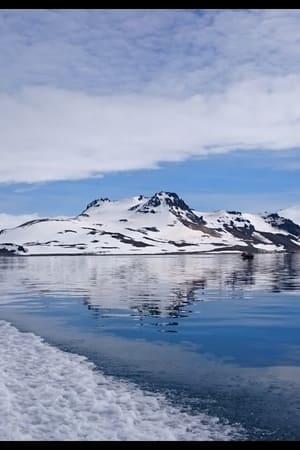
In Tacony Creek Park, home to one of Philadelphia's lesser-known watersheds, Julie Slavet and Malcolm Bundy reflect on their involvement with and love for the park, made bittersweet by the continuous and increasing amount of pollution that flows into its river. Combined wastewater and stormwater sewage outfalls have affected Philadelphia's rivers for years, but as one innovative program mitigates this for the Schuylkill and Delaware, Tacony gets left behind. Scientist Laura Toran educates the audience on green infrastructure and its potential positive impacts, while Slavet and Bundy discuss how they're still waiting—not without hope—for those impacts to reach their community.
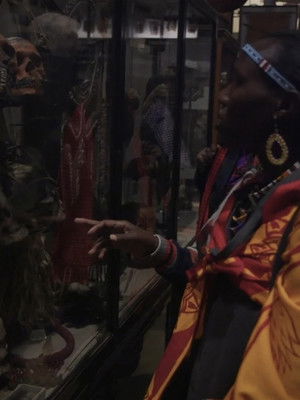
Decolonising the Curatorial Process is a forty-minute documentary which explores decolonial strategies in an academic and curatorial context. The film features academics, activists and practitioners, and contains case studies of institutions that are deploying critical, self-reflective forms of curatorial practice. The Museum of London Docklands exhibition on slavery and the sugar industry is examined as an example of how an institution can decolonise the curatorial process, utilise the work of artists in a museum context, and critically examine East London's imperial history. The Pitt Rivers museum in Oxford, who are working with Maasai activists from Kenya and Tanzania on a project centred on repatriating the museum's collection of sacred Maasai artefacts, also features in the film.
When an alien visitor discovers it can communicate with Earth’s oceans, it becomes the only intermediary between humanity and a vast marine intelligence whose patience with the human race is running out. Part survey, part discovery, the film explores a stretch of the wilderness that has largely slipped through the cracks of human attention, and in some places, bears the marks of human failure. The alien encounters a force both beautiful and terrifying, a voice as old as the planet itself, carrying memories, warnings and a power beyond human control. The film is a parable about nature on Earth by establishing an unidentified alien as interacting with the planet. By way of subtle messages the sea warns the alien that the existence of the planet is at stake. The alien discovers a controlling city but does not interfere with it and hopes that the sea will find a way to survive.
Echoes from the Tian Shan
Take to the sky and come face-to-face with Washington states majestic mountains, including one of the Pacific Northwests most well-known symbols: Mount Rainier. Celebrate the diversity of the states landscapes in Over Washington, from the glittering Puget Sound in the west to the rolling Palouse in the east. Stunning aerial cinematography and original music bring these spectacular images to life.
A portrait of free diver Kathryn Nevatt, former World Champion and current New Zealand record holder in all three disciplines.
How would natural habitats develop without human interference? In this documentary we follow an international team of scientists and explorers on an extraordinary mission in Mozambique to reach a forest that no human has set foot in. The team aims to collect data from the forest to help our understanding of how climate change is affecting our planet. But the forest sits atop a mountain, and to reach it, the team must first climb a sheer 100m wall of rock.
The River of Life and Death captures the slow time in the well-known Indian pilgrimage place of Benares, the act of purification by water, the burning funeral pyres, and the dandling snakeheads under the temple stairs.
The interview, held on January 4, 2001, was the last given by Professor Milton Santos, who died from cancer on June 24 of the same year. The geographer is gone, but his thoughts remains. Its political and cultural ideals inspire the debate on Brazilian society and the construction of a new world. His statement is a true testimony, a lesson that the world can be better. Based on geography, Milton Santos performs a reading of the contemporary world that reveals the different faces of the phenomenon of globalization. It is in the evidence of contradictions and paradoxes that constitute everyday life that Milton Santos sees the possibilities of building another reality. He innovates when, instead of standing against globalization, proposes and points out ways for another globalization.
Host Peter Greenberg explores the hidden gems of Turkey's Aegean coast. Some of the stunning destinations include Bodrum, Izmir and the ancient city of Troy.
An homage to the weird and wonderful world of B-movies, this short fauxdocumentary by film artist Chris Gerrard splices together classic clips with some new footage to tell the ludicrously fake story of the mysterious people (and things) lurking beneath us in the eerie River Tay. Feast your eyes on this unique archaeology of aquatic-themed film.
In 2013, the world's media reported on a shocking mountain-high brawl as European climbers fled a mob of angry Sherpas. Director Jennifer Peedom and her team set out to uncover the cause of this altercation, intending to film the 2014 climbing season from the Sherpa's point-of-view. Instead, they captured Everest's greatest tragedy, when a huge block of ice crashed down onto the climbing route...
“…this documentary capturing important aspects of Thoreau’s life and writings is highly recommended.” Video Librarian, May 2018 Made over the course of 13 years, Henry David Thoreau: Surveyor of the Soul tells the story of Thoreau in his time and the story of the impact Thoreau’s writings and lifestyle have in our time. Surveyor of the Soul has interviews and commentary by: Laura Dassow Walls (author, Henry David Thoreau: A Life), Bill McKibben, Howard Zinn, Richard Primack, Megan Marshall, Rep. John Lewis, Robert Bly, Wai Chee Dimock, Spencer Crew, Darren Ranco (Penobscot), Rochelle Johnson, and more. “If you are not yet a Thoreau enthusiast, this beautiful, engrossing documentary just might turn you into one. If you already are, it will remind you of the many reasons why.” Lucille Stott, Appalachia, Winter/Spring 2019
Minnesota: A History of the Land vividly brings to life the epic story of the people and landscapes of Minnesota. From the retreat of the last ice sheets to the growth of today’s suburbs – the series seeks to entertain as it enriches our understanding of Minnesota’s past, present, and future. A visually stunning and groundbreaking 4-part documentary series featuring nature videography from across the state, never before seen historic images, state-of-the-art animations and historic recreations. Original soundtrack by award-winning composer, Peter Ostroushko.
When the Tanana River bridge was installed in Salcha, Alaska, the community worried about the levee's effects on fish wildlife. Salcha Elementary School, along with the help of Tanana Valley Watershed Association, conducted a 10-year scientific project with students to study the effects the levee had on Piledriver Slough. Tori Brannan - the filmmaker's mother - is a retired principal at Salcha Elementary and was the project's centerpiece. She shares her experiences with the project, the community, and how her daughter's involvement strengthened their relationship.
The Balkans cradles Europe's last wild rivers and supports abundant wildlife and healthy, intact ecosystems. These rivers are "The Undamaged" – clean, pristine, and undammed. With over 2,700 small and large hydro power plants planned or under construction in the Balkans, corruption and greed are destroying the last free-flowing rivers of Europe. Follow the Balkan Rivers Tour, a rowdy crew of whitewater kayakers, filmers, photographers and friends who decided to stand up for the rivers, travelling from Slovenia to Albania for 36 days, kayaking 23 rivers in 6 countries to protest the dams and show the world the secret wild rivers of the Balkans. The film honours everyday people and local activists who are fighting to defend rivers and aims to spread the word of the plight of these rivers, showing a new style of nature conservation that is fun, energetic and effective.
Yaku: water; aya: essence, blood. Yakuaya is a non-verbal documentary about the descent of water and life that follows the journey of a drop of water from its birth on a glacier until its arrival at the sea. Along the way, water influences the life of a peasant, locks himself in the rhythm of a bottling factory, brings people together in the city, transforms the life of a woman, leads a river navigator, awakens hope in a desert and welcomes the innocence of two children in the sea.
Der Rhein - Strom der Geschichte
A portrait of Toronto, as defined by the spaces its queer residents inhabit and the memories they’ve created there.
Explores the plans for the construction of the monumental dam on China's Yangtze River, the structure that when completed in 2009 will become the Three Gorges Dam. It is slated to be 610 feet high, 1.3 miles across, creating a reservoir 400 miles and the largest power plant in the world.