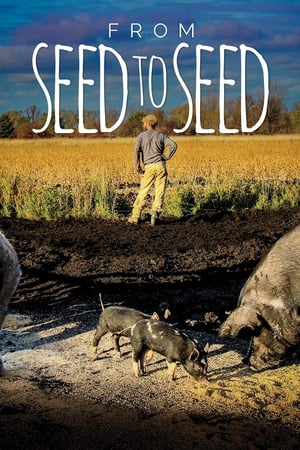
24 years ago, Nick's parents started a small vegetable farm in Sperryville, Virginia, and he spent his childhood among the farm's fields and flowers. This summer, Nick is back at the farm to visit for a month and a half. And he's trying to make a movie about it.
This feature-length educational film teaches you how to set up your own permaculture orchard at virtually any scale. We recognize the limitations of the organic model as a substitute to conventional fruit growing, and want to propose a more holistic, regenerative approach based on permaculture principles. Based on 20 years of applied theory and trial and error, biologist and educator Stefan Sobkowiak shares his experience transforming a conventional apple orchard into an abundance of biodiversity that virtually takes care of itself. The concepts, techniques and tips presented in this film will help you with your own project, whether it is just a few fruit trees in your urban backyard, or a full-scale multi-acre commercial orchard.
King Corn is a fun and crusading journey into the digestive tract of our fast food nation where one ultra-industrial, pesticide-laden, heavily-subsidized commodity dominates the food pyramid from top to bottom – corn. Fueled by curiosity and a dash of naiveté, two college buddies return to their ancestral home of Greene, Iowa to figure out how a modest kernel conquered America. With the help of some real farmers, oodles of fertilizer and government aide, and some genetically modified seeds, the friends manage to grow one acre of corn. Along the way, they unlock the hilarious absurdities and scary but hidden truths about America’s modern food system in this engrossing and eye-opening documentary.
A documentary about the history of scrapie in Iceland.
Patrick Kielty explores the untold story of Harry Ferguson and Henry's Ford's remarkable handshake agreement and how it led to a $250 million lawsuit.
A fascinating archaeological and scientific investigation on the world's best-selling book. When was the Bible written ? Who wrote it? Under what circumstances ? For what purpose ? These questions have long remained unanswered. With the discovery of the Dead Sea Scrolls in 1947, the thorough study of the texts, the advances in science, and the recent archaeological discoveries, one of the greatest historical mysteries is gradually being unveiled. Meet the most eminent specialists in the Bible who try to unearth brand new information and answer the enigmatic and fundamental question : who wrote the Holy Book ?
During the rice sowing season, Jun, a young Catalan of Chinese origin, works as a seasonal worker in the Ebro Delta. This ancient labour will make him confront his own roots and the distance that separates him from his family.
The daily schedule is rational and step by step the farmer's tasks are carried out both in the household (ironing, making beds, raising children, making food) and in the yard (feeding animals, analyzing milk samples, making cheese, churning milk, work in the vegetable garden, collecting eggs). In the evening, she puts the children to bed and has some time left for some relaxing activities such as knitting or reading.
Beneath the harvest sun and the cicada song, Mónica Martins Nunes builds a touching portrait of Serra de Serpa, an arid region in the south of Portugal affected by rural exodus. The poems sung by the shepherds and market traders resonate like the last gesture of a human landscape which resists sinking into oblivion.
The Heroes of the Massacre River is a powerful documentary that chronicles the stories of the pioneers behind the construction of the historic Canal of Ouanaminthe, a project that united Haitians across the nation and the diaspora. This film celebrates the groundbreaking efforts of key figures, centering on Dr. Bertrhude Albert, Dr. Naismy-Mary Fleurant, architect Wideline Pierre, economist Etzer Emile as well as dedicated canal workers Milourie Sylfrard, Theodore Johnson and Joseph Pressoir — all guided by the investigative journey of Max Angie Clervil. It also serves as a commentary on the complexity of colonialism and borders, tracing the role that the Massacre River continues to play in the history of Ayiti.
Paul and Phyllis van Amburgh, believing that a small, family farm is the best place to raise their children, take their life savings and buy a defunct dairy. With three children and a fourth on the way and armed only with their principles and determination, they fight to defy the odds as they become full time farmers. THE FIRST SEASON, through an intimate, cinema verite style, bears witness to the Van Amburgh's struggle as they fight against relentless toil, financial ruin and the harsh reality of diary farming to achieve their version of the American dream.
In rural Alabama, Freedom Farm Azul stands as a sanctuary for nourishment, education, and healing. Through intimate interviews and lush imagery, this poetic documentary explores how land stewardship becomes an act of resistance, restoration, and collective care.
The film tells the story of how Hong Kong rice farmers use their crops to pour time and strength into connecting Hong Kong people and their land. To stand up to the challenges Hong Kong nature offered, the farmers put effort into farming their own rice and spread their contribution in agriculture in order to enable Hongkongers to taste the rice from the very soil they stand on. The countless stories behind a bowl of local rice, which embeds the inseparable relationship between the land and its people, are told through this film.
Farmers alone cannot make our food system thrive - it’s up to all of us. That is the message of this enlightening and encouraging film. The good stewardship efforts being made by farmers, consumers and policy makers in the rapidly growing county of Ventura, California will inspire any community interested in preserving agricultural resources.
In a world drifting further away from participatory food production, relying instead on large corporations to feed us, this film asks “What do we lose by giving up our responsibility to produce food?”
This short film serves as a cautionary tale to farmers who recklessly cut down trees on their land. When prairie farmers engaged in this practice to facilitate plowing, they discovered that the trees had served as windbreaks protecting top soil from erosion. The Dominion Department of Agriculture's experimental station at Indian Head, Saskatchewan, cultivated acres of young trees for distribution to farmers.
El año del relevo
Die Bio-Revolution - Die Karriere der ökologischen Landwirtschaft
1972 in Haute-Savoie (France) : the Bertrand's farm, with a hundred dairy cows owned by three bachelor brothers, is filmed for the first time. In 1997, they were the subject of Gilles Perret's first movie, as they let their farm to their nephew Patrick and his wife Hélène. Nowadays, 25 years later, Gilles Perret take another look at this farm, managed by Hélène who will step down. Through their words, an intimate, social and economic history of the rural world.
A look at man's relationship with Dirt. Dirt has given us food, shelter, fuel, medicine, ceramics, flowers, cosmetics and color --everything needed for our survival. For most of the last ten thousand years we humans understood our intimate bond with dirt and the rest of nature. We took care of the soils that took care of us. But, over time, we lost that connection. We turned dirt into something "dirty." In doing so, we transform the skin of the earth into a hellish and dangerous landscape for all life on earth. A millennial shift in consciousness about the environment offers a beacon of hope - and practical solutions.