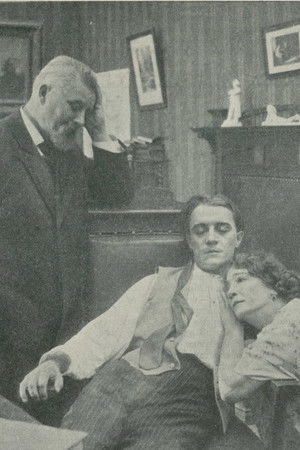
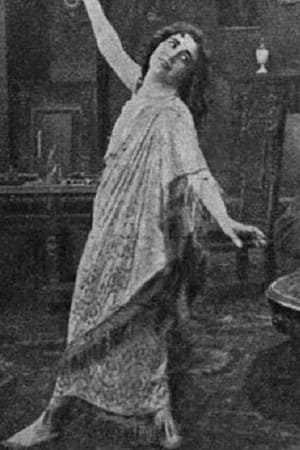
Howard Peyton served two years for forgery. Jerry Grafton, a genteel crook, is on the lookout for him when Howard comes out of prison. He is met at the jail door by his young wife. Jerry also meets him and offers him help, but urged on by his wife, Howard refuses it. When they reach home, his wife, who has a little money, induces him to go to New York and start life anew, and send, for her when he has a position. In New York, he manages to obtain a position in the office of Arthur Jamieson, an importer. Howard sends for his wife to join him. While he is waiting, Grafton finds him and insists that he forge his employer's name, or he will expose his past offense. Naturally weak, Howard yields.
Lulu Leach is a reader of dime novels. One day she is reading a terrifying tale of anarchists. A foreign-looking man enters the office and asks to see her employer, who is out. He hands her a card and strangely enough bears the same name as the anarchist in her novel. She at once imagines him a nihilist. He is joined by a friend and together they look at the next office and rent it from Pearson, Lulu's employer. When they are gone, Lulu warns her boss, but he only laughs at her. It happens that Lulu's employer goes away for a day or two and leaves the office in her charge. This is her chance.
The night of the grand reception and dance finds Belle Oakley in high glee as she leaves for the reception. She arrives at the reception and discovers that she is without her dancing shoes. She announces her loss and immediately all the young men volunteer to go in search of them. Harry Brown, who was not as quick as the others, is left behind and sits dejectedly on the curb while the others drive away.
Sir Brian, an irascible old gentleman, who suffers from gout, receives a note saying his son Gerald is very ill at college, and asking him to come to Dublin. He is too ill to go so he gets his friend, Captain Jenks, to go instead of him. Jenks finds Gerald being nursed by a pretty girl and soon discovers that Gerald is in love with her.
Irene and Helen are worshipers at the shrine of Frangiapani, the tenor of the hour. When he sings at a concert, they meet in Irene's room, take the printed program of the concert, and one of them plays the accompaniment of the song he is actually singing. Irene sees an advertisement for a maid and waitress at Madame Frangiapani's home. The wild thought enters her brain that if she applies and gets the position, she will be nearer her adored. She puts the plan into execution, gets the position, and is waiting for the signor to appear. He does appear in a towering rage, at an adverse criticism in a paper which he is holding in his hand. His wife tries to soothe him and treats him like a little, unreasonable, bad-tempered child.
On Wall Street a strong-willed and arrogant stockbroker, one of those successful men who feels no one else knows anything, exasperates his son, a broker as well. The son goes into business for himself successfully. When a panic comes, his father is brought to the verge of ruin by speculating against him driving a further wedge between them. In time a reconciliation is forged by the women in their lives.
Everybody's ordered out on a strike when Benjamin Cohen, proprietor of a sweat-shop, reduces the employees' wages ten per cent. Rebecca Barish, a young Jewess, and her father, reluctantly go out with the rest. Unable to find other work, their circumstances become so reduced that Rebecca is obliged to go to the pawnshop with some of their belongings, and while there, Jacob Stattler, the pawnbroker, takes a fancy to her, and offers her father, through a schatehen, five hundred dollars to give her to him in manage.
In the college play, Tom and his room-mate, "Bunch," take prominent and successful parts, Tom as the hero and "Bunch" as the heroine, in which he is an excellent female impersonator. The day after the performance, "Bunch" makes an engagement to take a real chorus girl to dinner. Unexpectedly his mother comes to college to visit him and he makes Tom take the girl.
Glory Quayle, a natural-born mimic, leaves her country home, reaches London, goes on the stage, gains fame and affluence. John Storm, her country sweetheart, believing he has lost Glory forever, enters a monastery, tries to forget her, cannot kill his love, returns to the world, becomes a famous slum worker and friend of the poor.
Irene, a young girl from a small town, arrives in New York City determined to make it on the Broadway stage. She meets up with Cookie, a worldly chorus girl who takes Irene under her wing. When Irene falls for young Ronald, his rival Crane sets out to break up the pair so he can have Irene for his own--and he doesn't much care how he does it.
Austin Starfield has his greedy eye on a steel mill belonging to Eve Burnside. He persuades an impoverished count, Leon Molnar to marry Eve so he can then gain control of her fortune.
A crook and his gang plan to con a young woman out of a cache of stolen loot they, and the police, believe she's hiding. The situation changes, however, when he falls in love with her and he sets out to save her from being imprisoned for a crime she didn't commit.
In a wealthy society family, the mother is forced to sit by and watch while her husband and son both compete for the affections of a pretty young temptress.
Mabel is in love with John, the country boy, but her father wants her to marry a Baron. She is locked up in a room, and her father watches her. John takes a bundle of cloth and makes a big firebrand which he throws into the window, at the same time yelling, "Fire." Dad runs for his life and Mabel jumps through the window into the arms of John, who hurries her to the minister's house. The ceremony is about to take place when Dad and the Baron rush in, and Mabel is led home again.
Si marries a guileless country maid, and receives among his wedding presents a bottle of liquor. The bride samples it in Si's absence, and being unaccustomed to drink, is overcome and falls on the table in a stupor. Si discovers her just as a party of neighbors are coming to congratulate the young couple and hides her in the yard, laying her on a bench. An inquisitive visitor finds her and reports to the constables that Si has killed his wife, and he is apprehended.
Three rivals are aspirants for the hand of Mabel. Dad falls asleep in a rowboat and is set adrift by one, who tries to win favor as a hero by rescuing him, using a motorboat going at lightning speed. He is exposed, however, and his work goes for naught, as Mabel clings to the man of her choice.
The story centers on a sordid love triangle involving a woman and two men. Their personal tensions and romantic complications reach a breaking point just as the local infrastructure fails. The climax of the film occurs when a massive dam bursts, unleashing a catastrophic flood. This disaster serves as the ultimate resolution for the characters' interpersonal struggles, forcing a conclusion to their conflicting relationships through the life-and-death stakes of the inundation.
When Arthur Gilpin, a black night watchman, finds young Myrtle Gunsaulus mysteriously murdered in the basement of a factory, he is charged with the crime. The film is now believed to be lost.
Myrtle Downing, an African-American woman, is coerced into marrying a corrupt would-be politician named Gyp Lassiter, even though she is really in love with Stephen Cameron, a young lawyer. When she discovers that her husband has conspired to support segregationist policies in exchange for support by white political power brokers, she objects to his crooked dealings and gets herself imprisoned in a secret dungeon where her husband had murdered his previous wives. Presumed to be a lost film.
Deceit (sometimes referred to as The Deceit) is a 1923 American silent black-and-white film. It is a conventional melodrama directed by Oscar Micheaux. Like many of Micheaux's films, Deceit casts clerics in a negative light. Although the film was shot in 1921, it was not released until 1923. It is not known whether the film currently survives, which suggests that it is a lost film. The 1922 film The Hypocrite was shown within Deceit as a film within a film.