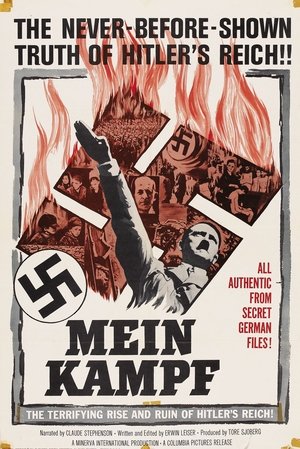
On April 30, 1945, while the Russian Army surrounded Berlin, Hitler committed suicide in his bunker. His body was discovered a few days later by the Soviets. He would be positively identified after a top secret inquest in which Hitler's personal dentist would play a central role. And yet, at the same time, Stalin publicly declared that his army was unable to find the Führer's body, choosing to let the wildest rumors develop and going so far as to accuse some of his Allies of having aided the monster's probable escape. What secrets were hidden behind this dissimulation? What happened then to the two ladies involved in the identification of Hitler’s body?
Matriarcas da Serra
In 1944, two prisoners miraculously escaped from Auschwitz. They told the world of the horror of the Holocaust and raised one of the greatest moral questions of the 20th century.
The incredible story of Lucrezia Borgia (1480-1519), daughter of Pope Alexander VI (1431-1503), deliberately used politically by her powerful family and historically slandered as a poisoner and incestuous femme fatale. But who was the real Lucrezia?
Forty years after the death of Pierre Mendès France, Yves Jeuland and Alix Maurin reveal another side to this figure: the story of his life, told through the pages of his private notebooks. PMF led a romantic and extraordinary life as a French politician and Jew, both loved and hated.
Documentary covering the current state of both the theoretical and practical development of the various scientific basic principles that served, as per Gene Roddenberry's dictum, as a believable basis at the time for The Original Series. Several real-world scientists are interviewed, not a few of them unabashedly admitting they went into their chosen field of profession because of Star Trek: The Original Series.
After the defeat of 1940, and faced with the unexpected collapse of French power, all eyes turned to a horizon of both hope and uncertainty: the colonies. France had suddenly become an empire without a metropolis, reduced to two-thirds of its former size. Pétain saw the colonies as a "consoling myth" after the defeat, while de Gaulle considered them essential strategic locations for the Resistance. The two clashed in a propaganda war.
For decades, pupils at the children's village of Riaumont, in northern France, run by Catholic monks and priests, were abused: until 2019, thousands of children suffered beatings, forced labor and sexual violence.
On 16 July 1212, a Crusader army made up of Castilians, Aragonese and Navarrese (but also French, English and Germans) confronted the army of the Almohad Caliph an-Nasir at the foot of the Sierra Morena mountain range. The Battle of Las Navas de Tolosa, as the battle is known, is considered the most important battle of the Middle Ages on the Iberian Peninsula and is a key event in the history of Spain. More than 800 years later, a group of archaeologists and specialists have begun an archaeological study of the battlefield. Is everything that has been said about the battle true? What secrets does the terrain hide? And, above all, what can we learn today about events that took place hundreds of years ago and that pitted tens of thousands of people against each other in the south of our country?
Coffee is the second most important commodity in the world after oil. The drink has a long history and what's more, its effect seems to be stimulating in two senses.
Through interviews with key AIDS Healthcare Foundation (AHF) stakeholders from over the years coupled with archival video footage culled from AHF's 30 years of advocacy, care and activism, 'Keeping the Promise' tells a compelling story of AHF's history while offering a glimpse of, and road map to its future.
Since the invention of the automobile, women have distinguished themselves by their daring: the history of women in motor sport.
By decoding ancient hieroglyphic texts, Jean-François Champollion gave voice to an enigmatic civilization, but behind his legendary feat is a mysterious brother who made it possible. The recent discovery of correspondence between Jean-François Champollion and his brother Jacques-Joseph now allows us to fully understand how a young, self-taught genius was able to make one of the most important discoveries of the 19th century. Without the ingenuity and unfailing support of his older brother, Jean-François would never have succeeded in solving this enigma, which had international repercussions. With animated sequences of their private correspondence, and with the help of archives and expert analysis, this film revisits this unique scientific, human and intellectual adventure to celebrate the bicentenary of the decoding of hieroglyphics.
From the plains of the Troade, to the cellars of a Nazi bunker, to the dark basements of Moscow's largest museum. With Homer and in the footsteps of the extremely wealthy businessman Heinrich Schliemann, we follow the true odyssey of the treasure of Priam which spans over more than 3 millennia.
The crew of kontroll.hu traveled to Transcarpathia, Ukraine, to film among orphaned children in Munkács and lonely elders in Tiszakeresztúr. The documentary follows a single day in the life of Reverend József Sipos, a Reformed pastor whose calling extends far beyond the pulpit. From abandoned hospital wards to remote village homes, he brings words of comfort, food, and aid to those left behind in the shadow of the Russian–Ukrainian war. Just a mile and a half from the Hungarian border—a mile and a half from peace—the film reveals the stark reality of life lived on the very edge of hope.
"O Regresso" is a documentary featuring renowned Portuguese actor Ruy de Carvalho as he returns to Macau after a 10-year absence. Directed to mark the 10th anniversary of his visit, the film captures Ruy de Carvalho revisiting key locations across the city, reflecting on the cultural and social transformations that Macau underwent in the lead-up to its handover from Portuguese to Chinese administration in 1999. Blending personal memories with the evolving landscape, the documentary offers a nostalgic look at Macau's unique blend of Portuguese and Chinese heritage, seen through the eyes of one of Portugal’s most beloved actors.
For eight centuries, between the 9th and 1st century BC, the Etruscans, inhabitants of the Italian peninsula, were one of the most powerful peoples of the Mediterranean basin, and when they disappeared they left behind impressive necropolises, vestiges of sanctuaries and even entire cities. How did they attain such power? How far did they extend their dominion and influence? What were the causes of their decline?
Between the end of the Second World War and the abolition of the "offence of homosexuality" in 1982, 10,000 sentences were handed down in France. Sentences in correctional courts, fines and sometimes imprisonment, the convictions were mainly against men. The last witnesses of this period speak out and tell of four decades of clandestine life, just before the tragedy of AIDS.
Famous French director Tavernier tells us about his fantastic voyage through the cinema of his country.
On January 20, 1981, 52 members of the U.S. Embassy in Tehran were released after 444 days of captivity. Told by those who lived through it, a crisis that traumatized America and upset the political balance in the Middle East.