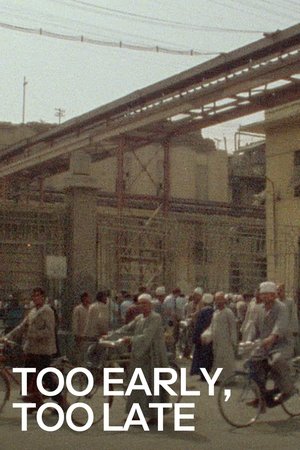
Jakub presents an extensive ethnographical-sociological study of the life of the Ruthenians, filmed in the Maramuresh mountains in the north of Romania and in the former Sudetenland in Western Bohemia. The film was made over a period of five years during the time of both totalitarian regimes and was completed in 1992 after the revolution.
This documentary film is about one of Georgia's regions - Racha. The title of the film is taken from the name of one of Racha's high mountain villages. It tells about the poorest in society living in the mountains and the rise of the SSSR. The product of a remarkable collaboration between the first Georgian female filmmaker and the leading Georgian avant-garde artist David Kakabadze.
The life of internationally renowned artist and activist Nan Goldin is told through her slideshows, intimate interviews, ground-breaking photography, and rare footage of her personal fight to hold the Sackler family accountable for the overdose crisis.
Two tons of snow—flown from New Hampshire to Puerto Rico in 1952 in order to “gift” Puerto Ricans a “white Christmas”—become a metaphor for the colonialist paternalism of America’s relationship to Puerto Rico.
Both during and after pregnancy, yoga is a perfect way to firm your body, build strength, and gain flexibility. These two yoga practices, filmed in a serene garden overlooking the Pacific Ocean, are also a wonderful way to maintain emotional balance and reduce stress during the exciting and often hectic times surrounding the birth of a child. In the prenatal sequence you'll practice safe and simple movements intended to strengthen and tone your body at any stage of pregnancy, while providing relaxation that will help create a luminous space in which your baby will thrive. The postnatal sequence is designed to redefine your body, restore your energy, and help you reconnect to yourself and your own wellness.
A 65-year-old cleaning woman for a professional dancers' exercise studio performs her job while telling us in voiceover about her life, hopes, goals, and feelings. A challenge to mainstream media's ongoing stereotypes of women of color who earn their living as domestic workers, this seemingly simple documentary achieves a quiet revolution: the expressive portrait of a fully realized individual.
A diffraction of the autobiography using family footage filmed between the 1940s and today, this "science fiction documentary" creates multiple "I"s and transcends a story of mourning
When Ariel was just 33, his legs were shredded by an industrial dough mixer in Mendoza, Argentina. He became a living embodiment of the ongoing duel between man and machine. From that point on, he began to rediscover the meaning of freedom: to rebuild his broken identity, keep his family together and design his own prosthetic legs. Following Ariel for 10 years from the time of the accident, director Laura Bari has created an intimate and metaphorical portrait of Ariel’s newfound transhumanity, juxtaposing his daily life with dreamlike inner worlds—and pushing the boundary between the real and the imaginary.
Margy Kinmonth meets millionaire customers and world-famous designers as she explores the anachronistic but little-explained pocket of the fashion industry known as haute couture.
The Pimp and His Trophies
The unbelievable story of 22 year old Or, who secretly finances his sex change operation in Thailand by lying to his conservative parents and then returns home as a woman to face her new life, her family and the cost of living her dream
Maria Iliou documents the ethnic cleansing and violent expulsion of Greeks from the Ottoman Empire. In the first compulsory "exchange of populations" in the modern world, 1.2 million Greek Orthodox and 400,000 Muslims were forcibly relocated from Turkey to Greece and Greece to Turkey respectively.
Et glas vand til Johnie
April 1994 in the Lacandona Jungle, Chiapas, México. The Zapatista women talk about the living conditions of Mexican indigenous populations and the life of peasant women. They explain the reasons for their struggle and their uprising.
This investigation into the layers of mass incarceration and its shaping of the modern black American family is seen through the eyes of a single mother in New Orleans, Louisiana.
Starting with a long and lyrical overture, evoking the origins of the Olympic Games in ancient Greece, Riefenstahl covers twenty-one athletic events in the first half of this two-part love letter to the human body and spirit, culminating with the marathon, where Jesse Owens became the first track and field athlete to win four gold medals in a single Olympics.
Part two of Leni Riefenstahl's monumental examination of the 1938 Olympic Games, the cameras leave the main stadium and venture into the many halls and fields deployed for such sports as fencing, polo, cycling, and the modern pentathlon, which was won by American Glenn Morris.
This short documentary focuses on the very end of Washington Boulevard, where the city of Los Angeles meets the ocean and the Venice Pier begins. The rough and simplistic concrete pier braves pacific storms and provides stillness and stability. People come to walk, to fish and ease their minds. The film takes a closer look at the diverse people all around the pier. Among them the filmmakers find two citizens, both immigrants, who take us on their personal journey through history.
Eleven major film makers from Europe, America and Asia talk about Akira Kurosawa and discover surprising influences on their own work.
Scar Tissue by Su Friedrich is a filmic version of a white canvas or a silent music piece.The fact that Friedrich never really shows the whole body, but rather plays off of body parts could be read as a desire to show less of the people on the screen, so that the viewer's reading can be generalized. If the "characters" existed as people, the images would inevitably read to be telling a story about these people. The legs and torsos do not signify people; it is the experience of these body parts and the rhythm with which they are portrayed that constitute the work.