a 32-minute color film by Gwen Brown, featuring precious footage of Living Theatre productions “Mysteries” and smaller pieces, “Paradise Now” and “Frankenstein.” “The fusion of Brown’s freewheeling direct cinema and the Living Theatre’s performance for revolutionary change (amidst the heydays of both) unite as a dynamic concoction of the era, yielding for the viewer a shifting terrain of both critical insight and ecstatic zeal, not as a vacant nostalgia for a pre-commodified radicality, but as tactical inspiration for future days.” – Andrew Wilson (Artist’s Access Television)
Video Fanzine featuring: Half Japanese, Redd Kross with Sky Saxon as Purple Electricity, R Kern, Sonic Youth, White Flag, Psycho Daisies, Charlie Pickett, Nick Zedd, Morbid Opera More R&R, Film, Prose. Pencil numbering indicates there was a run of 600 tapes.
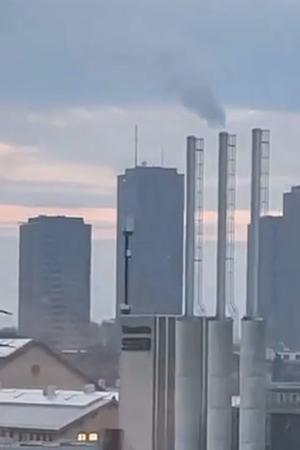
A new exploration of familiar places located in the region of Rhône and Isère throught an reinvention of digital nuances, a study of perceptions and fluidity around the nature of motion in landscapes and human interactions.
This free-form film is a self-portrait, which revisits more than 40 years of the author’s filmography and questions the major stations of his life, while capturing the political tremors of the time.
A camera crew travels through Thailand asking villagers to invent the next chapter of an ever-growing story.
Godard by Godard is an archival self-portrait of Jean-Luc Godard. It retraces the unique and unheard-of path, made up of sudden detours and dramatic returns, of a filmmaker who never looks back on his past, never makes the same film twice, and tirelessly pursues his research, in a truly inexhaustible diversity of inspiration. Through Godard’s words, his gaze and his work, the film tells the story of a life of cinema; that of a man who will always demand a lot of himself and his art, to the point of merging with it.
A meditation on childhood, loss, and the desire to recreate one’s innocence; the recalling of memories.
Phantom Islands is an experimental film that exists at the boundary of documentary and fiction. It follows a couple adrift and disoriented in the stunning landscape of Ireland’s islands. Yet this deliberately melodramatic romance is constantly questioned by a provocative cinematic approach that ultimately results in a hypnotic and visceral inquiry into the very possibility of documentary objectivity.
Filmmaking icon Agnès Varda, the award-winning director regarded by many as the grandmother of the French new wave, turns the camera on herself with this unique autobiographical documentary. Composed of film excerpts and elaborate dramatic re-creations, Varda's self-portrait recounts the highs and lows of her professional career, the many friendships that affected her life and her longtime marriage to cinematic giant Jacques Demy.
A psychological odyssey-like telling of the year 2025, that takes you on a roller coaster full of emotion, excitement and dark adventures documented by Joesiah Garcia.
Nevermore Eleanor (2024) | 2160p
Anger discusses his Aleister Crowley-inspired theories of art: How he views his camera like a wand and how he casts his films, preferring to consider his actors, not human beings but as elemental spirits. In fact, he reveals that he goes so far as to use astrology when making these choices. This is as direct an explanation of Anger’s cinemagical modus operandi as I have ever heard him articulate anywhere. It’s a must see for anyone interested in his work and showcases the Magus of cinema at the very height of his artistic powers. Fascinating. (Dangerous Minds)
New York City's Monterey is a residence hotel, whose inhabitants are older and primarily live alone. The camera, usually stationery, observes the lobby. No score, the lobby is clean with granite floors, men wear hats, people enter and exit an elevator, the camera looks out from within the elevator as doors open and close. People sit alone and motionless in their apartments. There are long shots of empty halls. Paint peels. The flooring on upper levels is linoleum. Hall lights are florescent. Doors open a crack then close.
P. Adams Sitney, Professor of Visual Art at Princeton University, wrote a short essay for Artforum International "Medium Shots: the films of Morgan Fisher" in which he describes the film "()." "Fisher's most recent film, (), succeeds astonishingly where Frampton's parallel effort, Hapax Legomena: Remote Control (1972) failed; it uses aleatory methods to release the narrative unconscious of a set of randomly selected films. () is made up entirely of "inserts" from feature films organized according to Oulipian principles. Inserts were usually shot by assistants when star actors, large crews, or expensive sets were not needed. These include details of weapons, wounds, letters, signs, tombstones, machinery, games of chance, timepieces, money, and even intimate caresses.
A roll and a half made to delight in color and the presence of friends. Steps toward learning to read in the dark.
A ritual of grids, reflections and chasms; a complete state of entropy; a space that devours itself; a vertigo that destroys the gravity of the Earth; a trap that captures us inside the voids of the screen of light: «That blank arena wherein converge at once the hundred spaces» (Hollis Frampton).
In 1975, as America faced social and political upheaval, filmmakers turned chaos into art.
The author's erotic imagination is mixed between desire and magazine clippings, and the trade of collage becomes a ship that travels from outer space to the city itself.
An experience of a camera swinging in different gestures facing the optical distortion of the Sun. The last appearance of the smudge.
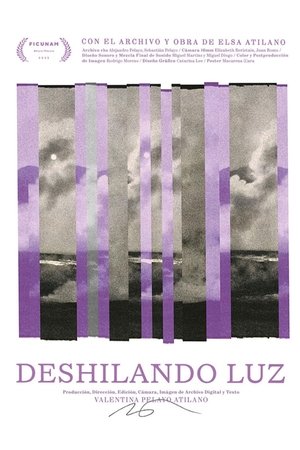
A film essay that intertwines the director's gaze with that of her late mother. Beyond exploring mourning and absence as exclusively painful experiences, the film pays tribute to her mother through memories embodied by places and objects that evidence the traces of her existence. The filmmaker asks herself: What does she owe her mother for who she is and how she films? To what extent does her film belong to her?