Exclusively created with period engravings, this animated feature explores the Franco-Prussian War of 1870 and the ensuing Paris Commune revolution in 1871.
Through interviews with key AIDS Healthcare Foundation (AHF) stakeholders from over the years coupled with archival video footage culled from AHF's 30 years of advocacy, care and activism, 'Keeping the Promise' tells a compelling story of AHF's history while offering a glimpse of, and road map to its future.
Easter Island has long been the subject of curiosity and speculation. A triangle of volcanic rock in the South Pacific, Easter Island is over 2000 miles away from the nearest population center, making it one of the most isolated spots on Earth. It is best known for the giant stone statues, known as the Moai, that dot the coastline.
Les raisins du Reich
The Great Wall: The Making of China
After 20 years seeking Cleopatra's tomb, archaeologist K. Martinez's search shifts to an underwater Mediterranean site. She's joined by Titanic finder Bob Ballard, Egyptian Navy and dive teams to explore the location.
Expédition Pétra : sur la piste des Nabatéens
It was the battle that decided the future of Europe: on August 26, 1278, two dynasties faced each other at Marchfeld. On one side was the Roman-German King Rudolf I from the House of Habsburg, on the other Ottokar II from the Bohemian Přemyslid dynasty. Rudolf's victory over Ottokar laid the foundations for the unprecedented rise of the Habsburg Empire, which was to play a decisive role in Europe for more than six centuries.
Louis XIV's ship La Lune was wrecked off Toulon in November 1664. The ship was returning from an expedition to the Barbary Coast with nearly one thousand people on board, simple seamen or nobles of the highest rank. Discovered by a submarine in 1993, the wreck lies in 90 metres of water. In a state of magificent preservation, like some underwater Pompei, she will, starting in 2012, be the subject of an exceptional archeological investigation, bringing together history and robotics, the expertise of archeologists and the passion for the deep.
Schätze aus der Unterwelt
Cruelty, psychological and sexual violence, humiliations: reality television seems to have gone mad. His debut in the early 2000s inaugurated a new era in the history of the audio-visual. Fifty years of archives trace the evolution of entertainment: how the staging of intimacy during the 80s opened new territories, how the privatization of the biggest channels has changed the relationship with the spectator. With the contribution of specialists, including philosopher Bernard Stiegler, this documentary demonstrates how emotion has made way for the exacerbation of the most destructive impulses.
More than 2.000 years ago, Narbonne in today's Département Aude was the capital of a huge Roman province in Southern Gaul - Gallia Narbonensis. It was the second most important Roman port in the western Mediterranean and the town was one of the most important commercial hubs between the colonies and the Roman Empire, thus the town could boast a size rivaling that of the city that had established it: Rome itself. Paradoxically, the town that distinguished itself for its impressive architecture, today shows no more signs of it: neither temples, arenas, nor theaters. Far less significant Roman towns like Nîmes or Arles are full of ancient sites. Narbonne today is a tranquil town in Occitania
De Gaulle, l'homme à abattre
This documentary by Theo Kamecke from 1970 gives an in-depth and profound look at the Apollo 11 mission to the moon. NASA footage is interspersed with reactions to the mission around the world as the film captures the intensity as well of the philosophical significance of the event. Won special award at Cannes.
The film chronicles the journey of the renowned De Le Rue family: Xavier, a 7 x World Champion; his younger brother Victor, a 3 x World Champion; and his daughter Mila, who is turning 18 and embarking on her first expedition. Their first challenge is sailing across the infamous Drake passage before confronting the otherworldly white continent. Unimaginably steep icy lines rise from the ocean, towering seracs, pods of orcas and colonies of penguins, but at the bottom of the world, rescue is not an option. For Xavier and Victor, it's a giant playground filled with first descents; for Mila, it's an intimidating initiation into big-mountain free riding. The film captures their intimate inner dialogue through personal diaries, showcasing Mila's journey as she confronts her fears and embraces the challenge. A celebration of discovery, adventure, and the passing of the torch to the next generation against the breathtaking backdrop of Antarctica. The voyage of a lifetime.
Résistants, Collabos - Une lutte à mort
Documentary covering the current state of both the theoretical and practical development of the various scientific basic principles that served, as per Gene Roddenberry's dictum, as a believable basis at the time for The Original Series. Several real-world scientists are interviewed, not a few of them unabashedly admitting they went into their chosen field of profession because of Star Trek: The Original Series.
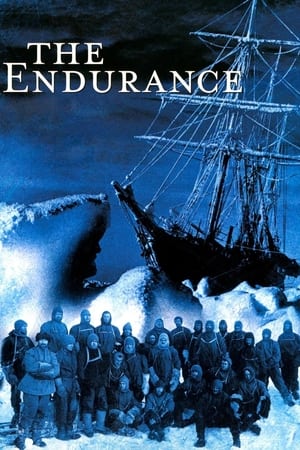
Documentary on the Shackleton Antartic expedition. A retelling of Sir Ernest Shackleton's ill-fated expedition to Antarctica in and the crew of his vessel 'The Endurance', which was trapped in the ice floes and frigid open ocean of the Antarctic in 1914. Shackleton decided, with many of his crew injured and weak from exposure and starvation, to take a team of his fittest men and attempt to find help. Setting out in appalling conditions with hopelessly inadequate equipment, they endured all weather and terrain and finally reached safety. Persuading a local team of his confidence that the abandoned team would still be alive, he set out again to find them. After almost 2 years trapped on the ice, all members of the crew were finally rescued.
Marijuana is the most controversial drug of the 20th Century. Smoked by generations to little discernible ill effect, it continues to be reviled by many governments on Earth. In this Genie Award-winning documentary veteran Canadian director Ron Mann and narrator Woody Harrelson mix humour and historical footage together to recount how the United States has demonized a relatively harmless drug.
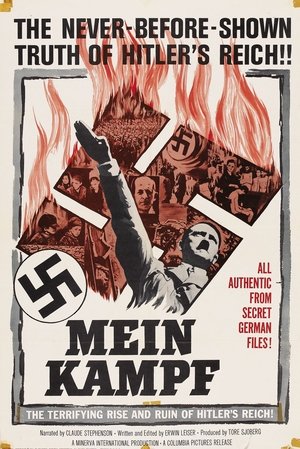
Using exclusively archival footage, Erwin Leiser traces the rise and collapse of the Third Reich, from Adolf Hitler’s early years to the devastation of Europe and his suicide in 1945. The film draws heavily on material produced and preserved by the Nazi propaganda apparatus to confront the mechanisms, imagery, and consequences of totalitarian power.