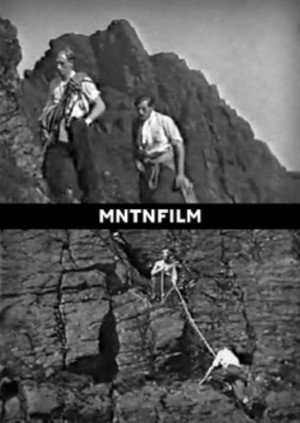
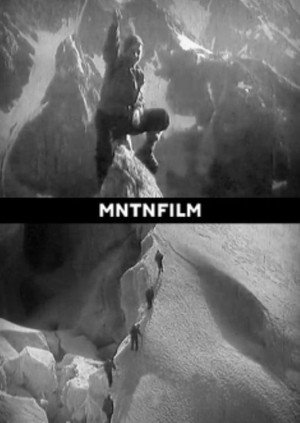
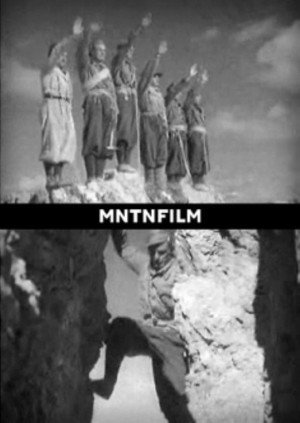
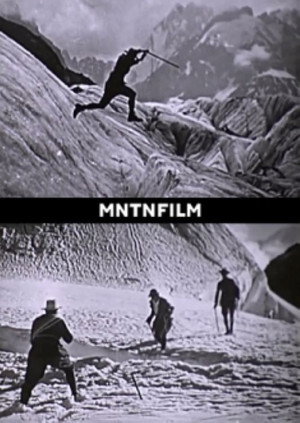
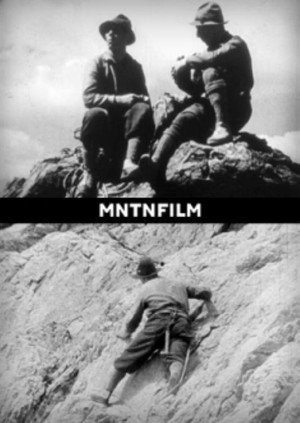
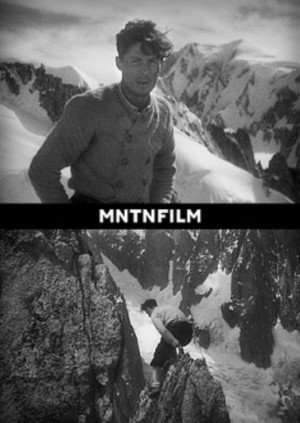
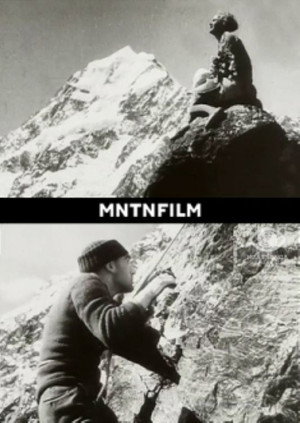
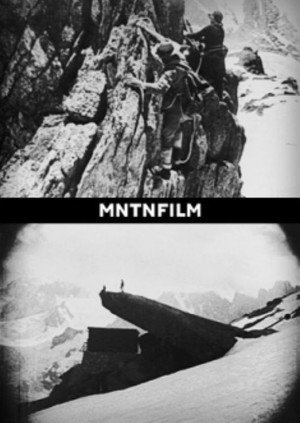
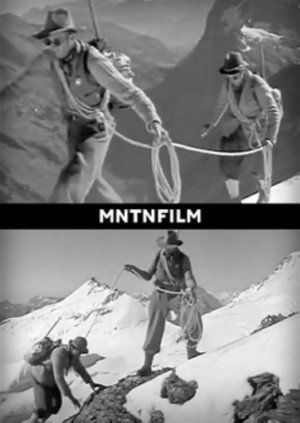
Rock climbing on the "Cobbler". Awarded first prize by Michael Powell in the 1948 Scottish Amateur Film Festival
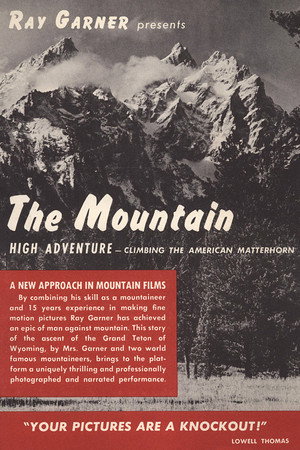
A film on mountain-climbing in Grand Teton National Park, Wyo. Glenn Exum, Virginia Garner, and Paul Petzoldt demonstrate mountaineering techniques and equipment. They reach the peak, shake hands, and rappel and glissade to base of mountain.
On September 28th, 1903, the Urban Mountaineering Expedition, headed by Frank Ormiston-Smith, left Zermatt to attempt the conquest of the Matterhorn. On the 29th, the conquest was completed by the filming of the panorama from the actual summit of the mountain. The film consists of 20 scenes and illustrates the whole ascent from Zermatt through the Hornli Ridge. A copy of the film was found in Zermatt in 1953 and was was erroneously attributed to Frederick Burlingham and dated 1901. Since then, the film has been widely publicized as the first mountain film under the title of 'Cervin 1901', but this is incorrect. Ormiston previously had made 'Alpine series' (1901), 'The ascent of Mont Blanc' (1902), 'Climbing the Great Schreckhorn' (1902) and 'Ascent of the Jungfrau' (1903). The pictures and descriptions of the Charles Urban Trading 1903 film catalogue show without any doubt that 'Ascent of the Matterhorn' and 'Cervin 1901' are the same film.
Released in 1923, produced by Frederick Burlingham.
In beginning of the 20th century, two climbers carry a statue of the Virgin to the top of a mountain.
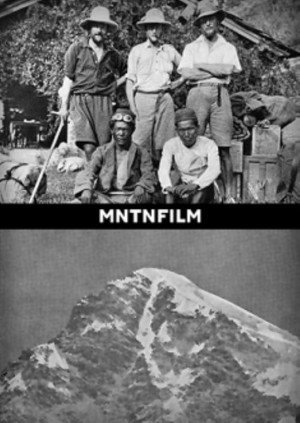
Following in the footsteps of Captain John Noel and his immensely popular documentaries taken on the Mount Everest expeditions of the 1920s ("Climbing Mount Everest"/"The Epic of Everest"), Frank Smythe hoped to help finance his 1931 attempt on Kamet, another Himalayan peak, by bringing back film footage of a successful ascent including summit shots which were at that time the highest ever taken in the world.
A party of tourists ascending to the peak of the Rigi find a fresh fall of snow covering the summit. They soon divided into battalions, and bombard each other with snowballs.
1902, cinematography by Frank Ormiston-Smith
An ascent of 'The Tooth' via the South-east Face. The film was made by Burge Bickford and Lyman Boyer. It features Jim Crooks leading Fred Beckey on a rock climbing ascent of the southeast face of The Tooth, near Snoqualmie Pass, Washington. At the summit, the climbers find a brass tube with a Mountaineers register book inside. Illustrates Cascade Mountains climbing just before World War II. The leader never places any protection such as pitons or slings. The film focuses on the climbers' hand and foot work intermixed with mountain views.
In 1941, under the Vichy regime, during the Nazi occupation, a team of six people crossed the Mont-Blanc massif. Leaving the Arve Valley with a month of supplies, five young men and a woman attempt a raid to show that France has passion and love for the effort and to celebrate youth, teamwork, leadership, tradition and achievement. The team advances roped, above the clouds. They pass the different passages, glaciers and needles, sleeping in tent under the stars at minus 20°C, facing the storms and the dangers represented by crevasses. Among others, they climb the Aiguille Verte, the Aiguille du Grépon and Mont Blanc.
Presented as a kind of docu-fiction, the film shows training maneuvers by the young mountaineers of the Scuola Centrale Militare di Alpinismo (Military School of Mountaineering). Differents groups of rock climbers ascend the Winkler Tower and Torre del Vajolet. While ascending one of the towers, one of the climbers is attacked by an eagle that makes him fall and leaves him hanging on the rope. The film, produced in 1942 by the Instituto Nazionale Luce at the end of the Italian Fascist regime, was awarded in the Mostra Internazionale del Cinema di Venezia.
A short version of the film 'A la conquête des cimes' by René Moreau released for the domestic market in two Pathe Baby big reels. In the film, the mountain guide Hermann Perren prepares the ascent of Dent du Requin with a companion. He checks the equipment necessary for any mountaineer, rope, ice axe, glasses, double socks and iron shoes. They leave Chamonix, cross the Mer de Glace and arrive at the Requin Refuge. The next morning, Perren and his companion cross the glacier and encounter huge crevasses and seracs, which slow their progress. They cautiously cross a snow bridge and bivouac a few hours later. The climb is more and more difficult. They reach the Requin shoulder and have to climb the vertical wall to the summit.
A group of mountaineers ascend the Grossvenediger in the Austrian Tyrol in winter. The group starts from the Krimmler waterfalls and the Warnsdorfer Hütte and continues through the Krimmler glacier by icy terrain using ice axes. They reach the summit and start the descent. The second half of the film starts with an intertitle presenting how the film was made, and then the film crew is shown while filming the mountain scenes, preparing the shots and carrying the material up to the mountain.
A rock climbing in the Bavarian Allgäu Alps in Germany. The camera follows two mountaineers on a climb. We see all stages of the ascent, from the screes at the foot of the mountain up to the difficult ledges that require the use of pitons and belay ropes. The mountaineers ascend from Einödsbach to the Waltenberger Haus. After they have surmounted a chimney, the mountaineers eventually reach the summit. From there, they descend with ropes.
"A rock climbing traverse in the Gastlosen Massif. Arrival of the train to Saanenmöser, three men walk to reach the wall. Crossing the rock face to reach the Wandspits, the first summit of the Gastlosen. Crossing the whole chain and climbing the last summit, the Katze. Rappelling of the Katze to cross the Markzähne and ascent of the highest point of the Gastlosen. After a picnic in the summit, the mountaineers greet with their hat." 1920's.
The idea is a simple one: three alpinists climb in the Mont Blanc Massif. This situation brings one face to face with the dangers of the mountain: avalanches, crevasses, fog, the climbing of the rocks, roping up, etc. All of this is magnified, transcended by a remarkable and strong use of the language of cinema. One of the first films about high mountains with Roger Frison-Roche and magnificent music by Maurice Jaubert
Along New Zealand’s South Islands runs the mighty chain of the Southern Alps, where large and beautiful glaciers and Ice-falls abound among the towering peaks... That's how the film presents different leisure activities in the Southern Alps of New Zealand, and more specifically around the Hermitage Hotel. Activities include snow activities like snowball fights, dog sledding, ski lessons, and hunting of European chamois; and summer activities like golf practice in front of the hotel, rock climbing, and sight-seeing trips and picnic outings amid scenery of outstanding beauty.
Three mountaineers, including a woman, climb the l'Aiguille du Moine, in the Mont Blanc Massif departing from the Couvercle Shelter. Facing walls that are sometimes rocky and sometimes snowy, they end up reaching the summit, which rises to 3412 meters high. One of the mountain guides in the film is Hermann Perren, who also participated in the another film by René Moreau: A la conquête des cimes (1927).
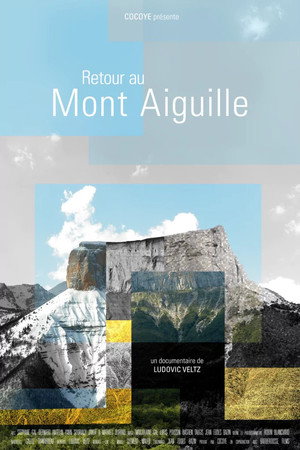
In 1492, Captain Antoine de Ville reached the summit of Mont Aiguille. At the time, there were no climbing shoes, no harnesses, no quickdraws! Historian Stéphane Gal, accompanied by director Ludovic Veltz, sets out to (re)conquer this inaccessible mountain using the weapons and methods of yesteryear.
Swiss documentary on the ascent of the Eiger by the Mitellegi ridge. After spending the night in the hut located 625 meters below the summit, two rope teams climb the 3975 meters of the Eiger through the tedious and dangerous 2.5 kilometer long Mittellegi ridge. The film ends in the last scenes with a spectacular descent. Directed by Otto Ritter in 1947 and produced by Condor Films. It features Willi Steuri, Fritz Steuri, Robert Abegglen and Roland Urban.