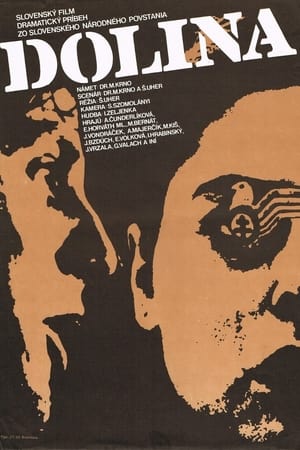
In Slovakia, they often and gladly honored those soldiers who refused to serve the fascist regime and stood against it. Lieutenant Kukorelli also rejected the tempting career of a pilot, instead helping the resistance fighters and later participating in the Slovak National Uprising.
The dramatic story captures the hard and dangerous life of the partisan group "Čapajev" led by Ľudovít Kukorelli during World War II. It retrospectively presents the course of the Slovak National Uprising in eastern Slovakia.
In WWII, a squad of U.S. African-American soldiers are sent on a rescue mission behind enemy lines to locate their lost commanding officer and a downed fighter pilot.
Čenkovej deti
Jacquot Demy, the son of a garage owner and a hairdresser, is fascinated by cinema and decides to pursue his dream of becoming a filmmaker by any means necessary.
The passionate Merchant-Ivory drama tells the story of Francoise Gilot, the only lover of Pablo Picasso who was strong enough to withstand his ferocious cruelty and move on with her life.
In the early days of Nazi Germany, a powerful noble family must adjust to life under the new dictatorship regime.
80-year-old Alice Hargreaves is about to visit Columbia University to attend a reception in honour of author Lewis Carroll. As a child, Alice's close friendship with the writer was the creative catalyst for Carroll's most beloved work. However, as Alice reflects on her experiences with the author, she slowly realises the complexity of their bond has had lasting, deeply felt ramifications.
It was one of the great crimes of the Second World War: from 1941 to 1944, a total of 872 days, the siege and starvation of Leningrad by the German Wehrmacht on Hitler's orders lasted. Over a million people fell victim to the blockade, most of them dying of hunger. Countless of these starving people wrote diaries with the last of their strength, and cameramen filmed in the paralyzed city. Evidence from the hell of the siege, many of the film recordings, but above all the written memories on which this documentary on the occasion of the 80th anniversary of the liberation is based, remained under lock and key after the war. The voices of those who had suffered through this terrible time should not be heard by anyone, because they did not fit the pathos of the Leningrad heroic song that was officially sung. Most of the recordings come from women. The writers feared neither the enemy nor the Communist Party or Stalin, who often proved incompetent in providing for the population.
Set across three timelines — Republican Spain in 1932, the Civil War in 1937, and contemporary Spain in 2017 — the film follows a constellation of interconnected lives centered on three young men, whose emotional and political echoes gradually reveal themselves.
Berlin, 1930, during the rise of Nazism. Hermann Hermann, a Russian emigrant and chocolate manufacturer, married to the capricious Lydia, loses his temper more and more every day when dealing with his workers and other businessmen; until he meets Felix, a vagrant, who seems to be physically identical to him; a disconcerting fact that leads Hermann Hermann to plot a particular way out of a fake world he actually hates.
Stockholm in the 1920s. Young Roland lives with his socialist father, Jewish mother and a boxing brother. His mother sells condoms illegally, and from them, Roland makes slingshots which he sells. His rebellious ways has gotten him the special attention of his school teacher, who always makes sure that Roland is punished. Roland also tries to make extra money by repairing bicycles, a successful business that in the end lands him in hot water.
During World War II, a Cockney woman marries a Canadian soldier and adjusts to life in Alberta.
The film tells about the childhood of Yuri Gagarin, about that time of life, which, in his own words, played an important role in shaping his character: war, the occupation of their villages by the Germans, famine, the theft of the elder brother and sister to Germany, the expulsion of the Nazis from Smolensk, moving family in the city of Gzhatsk.
A Hungarian youth comes of age at Buchenwald during World War II. György Köves is 14, the son of a merchant who's sent to a forced labor camp. After his father's departure, György gets a job at a brickyard; his bus is stopped and its Jewish occupants sent to camps. There, György find camaraderie, suffering, cruelty, illness, and death. He hears advice on preserving one's dignity and self-esteem. He discovers hatred. If he does survive and returns to Budapest, what will he find? What is natural; what is it to be a Jew? Sepia, black and white, and color alternate to shade the mood.
A TV film based on Karol Horák's novel. The story takes place in southern Gemer in the spring of 1945. It covers several days in the first months after the war. Matyla, a simple village woman, sets out into the world to get sugar for her daughter and her unborn child. A film about a mother, which is a testimony about people and an era from the perspective of the current middle generation.
Krásna neznáma
In the Ukrainian steppe, toward the end of World War II, the German and Romanian troops are retreating in the face of the unstoppable Red Army. A Romanian military unit has set up its headquarters in a deserted school. A visit of high-ranking Wehrmacht officers is suddenly announced. Hope is awakened: will they receive new orders? But disappointment comes quickly.
In 1960, a team of Israeli secret agents is deployed to find Adolf Eichmann, the infamous Nazi architect of the Holocaust, supposedly hidden in Argentina, and get him to Israel to be judged.
The plot of the film is based on real events of the Great Patriotic War. When the Nazis occupied Crimea, the actors of the drama theater of the city of Simferopol entered the underground group Sokol. The activities of the underground members were diverse: they put up leaflets with information from Soviet Information Bureau, compiled maps showing the strategic objects of the enemy, and supplied the partisans with medicines. On April 10, 1944, 3 days before the liberation of Simferopol, the underground members died from enemy bullets — they were shot on the outskirts of the city.