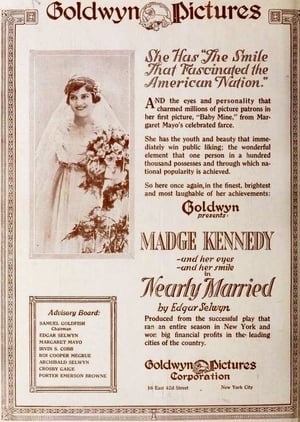
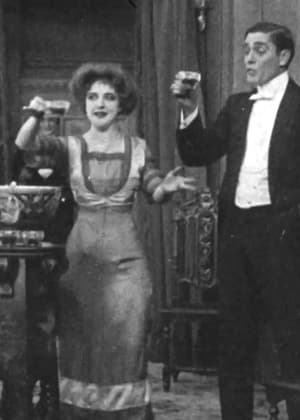
John Stonehouse (William Russell) checks into a hotel, intending to commit suicide. But instead he winds up helping a girl, Gilberte Bonheur (Fritzi Brunette), out of a jam. He finds her bending over a man who she has apparently killed, and since he's about to kill himself anyway, he offers to assume the blame. Throw a valuable emerald into the works, and the fact that the dead man suddenly comes back to life, and Stonehouse -- not to mention the audience -- becomes thoroughly befuddled by it all. Everything clears up, however, when Gilberte gives him a theater ticket -- it turns out that everything he went through was the plot to a stage play, enacted in real life by the actors. The critics roasted the play, saying it wasn't true to life, and this was their proof that the situations really could happen. Gilberte retires from acting when Stonehouse proposes.
The Great Kantō Earthquake is said to be the worst natural disaster in the history of Japan. When disaster struck on September 1st, 1923, a woman called Nobu managed to survive by fleeing desperately all while caring for her two small children. What did she see? What actions did she take? Her decision making during her evacuation is still relevant in present day and can help shed light on what actions to take to save your life should a large disaster strike without warning.
The embodiment of ultimate evil, a glowing orb terrorizes a young girl with bizarre stories of dark fantasy, eroticism and horror.
Daisy Jones had been married just a year when her husband failed to kiss her one morning, and she decided that he did not love her any more.
A prophet who longed to look upon his deities. A daunting journey to a mountain peak. A confrontation with gods too powerful to name. This is the story that inspired Peter Rhodes, who worked as a filmmaker and artist during the 1920s. Few people know of his work, and it's only through luck and perseverance that we have been able to track down the elements for this "lost" film. Rhodes' films were created using silhouette animation, a technique perfectly suited to depict Lovecraft's mythic Dreamland stories. The filmmaker's involvement in New York City's occult and literary scenes provided him with a select audience for his work. Rhodes was especially influenced through his relationships with occultist Aleister Crowley and writer H.P. Lovecraft, but it was personal tragedy that moved him to produce "The Other Gods: A Tale of the Dream Cycle," his most powerful film.
At Thanksgiving, a tramp arrives in a homeless-hostile town.
An opportunistic umbrella salesman attempts to save a musician and his daughter from blackmail.
Taken from The Arabian Nights, a wicked sorcerer and the beautiful prince Achmed battle one against the other during a series of wondrous adventures.
Jackie is a boy who is so trapped by his fears and doubts that he could not communicate with anyone. Then, a magic dragon named Puff comes to help Jackie by taking his soul force on a wonderous voyage to his island of Honah Lee. Along the way, they have adventures that nurture Jackie's imagination and courage in unorthodox ways.
A meek young man must find the courage within when a rogue tramp menaces his hometown.
A hapless young man living in New York City rallies to save his girlfriend's grandfather's horse-drawn trolley, the last in the city, from being put out of business by a railroad company.
When a store clerk organizes a contest to climb the outside of a tall building, circumstances force him to make the perilous climb himself.
Pierre and Jacques are working as waiters at a restaurant where the cooks go on strike. When the two are forced to work as bakers, the striking cooks put dynamite in the dough, with explosive results.
The Tramp interferes with the celebration of several kid auto races in Venice, California (Junior Vanderbilt Cup Race, January 10 and 11, 1914), standing himself in the way of the cameraman who is filming the event.
Although only a dental assistant, Charlie pretends to be the dentist. After receiving too much anesthesia, a patient can't stop laughing, so Charlie knocks him out with a club.
Mabel tries to sell hot dogs at a car race, but isn't doing a very good job at it. She sets down the box of hot dogs and leaves them for a moment. Charlie finds them and gives them away to the hungry spectators at the track as Mabel frantically tries to find her lost box of hot dogs. Mabel finds out that Charlie has stolen them and sends the police after him. Chaos ensues.
A tramp gets drunk in a hotel lobby and, upstairs, causes some misunderstandings between Mabel, two hotel guests across the hall from her room, and Mabel's visiting sweetheart.
Three men compete for the attentions of a pretty girl. One of them, a little tramp, plays dirty.
Charlie plays an actor who bungles several scenes and is kicked out. He returns convincingly dressed as a lady and charms the director, but Charlie never makes it into the film.
The hero, a janitor played by Chaplin, is fired from work for accidentally knocking his bucket of water out the window and onto his boss the chief banker (Tandy). Meanwhile, one of the junior managers (Dillon) is being threatened with exposure by his bookie for gambling debts unpaid. Thus the manager decides to steal from the company.