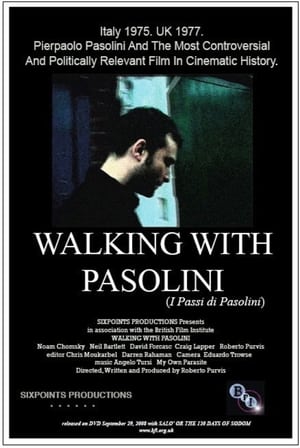
A documentary about Pier Paolo Pasolini and his film 'Salò o le 120 giornate di Sodoma'.
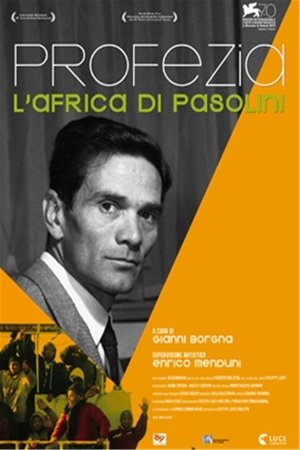
Pasolini seeks in Africa the peasant and revolutionary authenticity he had sought in the Roman villages. This hope will end in a new disappointment: Africa is a reservoir of irremediable contradictions that will explode in the massacres of yesterday and today. It is an Africa that starts from the outskirts of Rome, but thousands of non-EU citizens flock to the sub-proletariat of the villages.
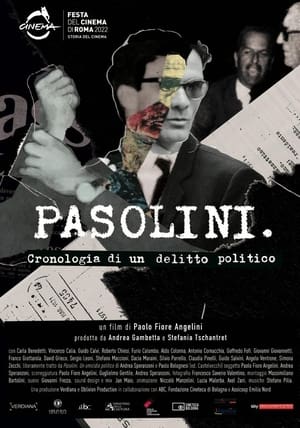
An investigative film, an "investigative itinerary" from 1960 to 1975, in the story of Pasolini alive, in search of the political truth of his murder. A violent death in the world of homosexual prostitution. And the "truth" is definitely written in black and white. But what happened to the testimonies of the inhabitants of the Idroscalo? Through testimonies and visual archival material, the true story of the assassination of Pier Paolo Pasolini is reconstructed in the documentary.
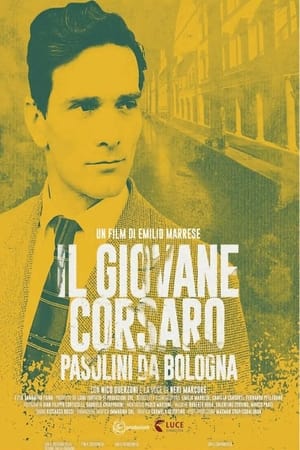
A young student prepares his degree thesis on Pasolini and Bologna by investigating the relationship of the great intellectual with the city of his childhood and his studies. Following in the footsteps left by Pasolini in Bologna, the protagonist will tell, for the first time in the form of a documentary and with a rock narrative rhythm, the emotional, visceral but also controversial bond of Pasolini with Bologna until his final days, also characterized by severe criticisms of the “consumerist and communist” city, a symbolic terrain of the adverse social and economic metamorphosis from paleoindustrial to neo-capitalist society.
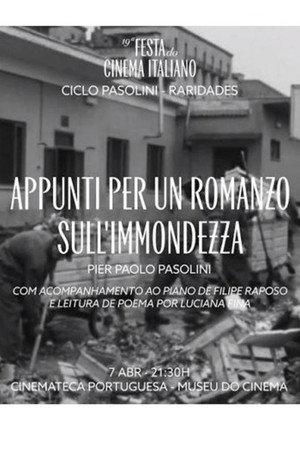
In the spring of 1970, between the African Orestiade and The Decameron, Pasolini shot a film for which he wrote a commentary in verses but never finished editing. The film was born as a typical Pasolini intervention: filming the strike of the garbage collectors in Rome, who at the time worked in dramatic health conditions, and filming the humility of their daily work, amidst the waste and scraps of society, in the squares and in the streets. Pasolini also filmed the faces of garbage collectors engaged in claims discussions and the result was an extraordinary anthropological picture of an unknown humanity.
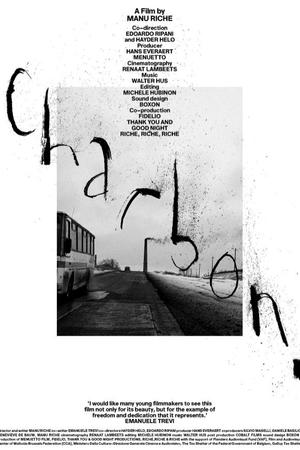
CHARBON depicts how Europe was built on fossil fuels over the past 100 years. And how it was torn apart by wars that were the result of these same fossil fuels. During 3 trips to Ukraine, Italy and Iraq, filmmaker Manu Riche explains how he and his French-German family are inseparably connected to the fate of the Iraqi filmmaker and refugee Hayder Helo.
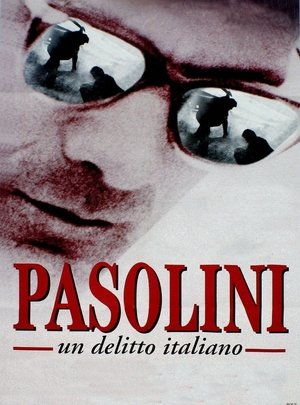
November 2, 1975: Pier Paolo Pasolini is murdered in the outskirts of Rome. The suspect, a 17-year-old hustler, pleads to have acted in self-defense, citing Pasolini's notorious sexual habits as proof. However, many inconsistencies start to undermine his version, pointing to him not having acted alone or even being assaulted in the first place. Was Pasolini also killed for another reason?
Following the trip Pasolini made in 1959 along the entire coast of Italy as a reporter for the magazine Sucesso, they where located different places as possible scenarios for his death. Understanding cataloging as a tool that allows us to organize knowledge for recovery, this catalog offers the viewer the possibility of redemption of the rebellious individual or the questioning of our acceptance of the critical difference.
"MANIFESTO"
Un hombre sin miedo
Como Combustível Para As Máquinas
For this work Alÿs purchased a gun in Mexico City then walked through the city streets with the weapon in his hand. After eleven minutes he was arrested by the police. The following day he repeated the action, this time in cooperation with the police. By presenting a record of this dramatic action alongside footage of its reenactment, Alÿs blurs the boundaries between documentation and fiction. Questioning the concept of authenticity, this work demonstrates “how media can distort and dramatize the immediate reality of a moment,” the artist has said. Gallery label from Francis Alÿs: A Story of Deception, May 8–August 1, 2011.
Experimental Video Opera.
Juremeiras
La théorie de l'évolution
On his 89th birthday, renowned English broadcaster and naturalist Sir David Attenborough pays his first ever visit to the White House to be interviewed by one of his biggest fans, United States President Barack Obama.
Première Campagne
The personal stories lived by the Uncle, the Father and the Son, respectively, form a tragic experience that is drawn along a line in time. This line is comparable to a crease in the pages of the family album, but also to a crack in the walls of the paternal house. It resembles the open wound created when drilling into a mountain, but also a scar in the collective imaginary of a society, where the idea of salvation finds its tragic destiny in the political struggle. What is at the end of that line? Will old war songs be enough to circumvent that destiny?
"The Last Season: Shawaks" revolves around an extended Shawak family whose life is marked by seasonal migration.
A 10-part documentary about 10 Brazilian filmmakers: Linduarte Noronha, Jorge Furtado, Ruy Guerra, Murilo Salles, Paulo Caldas, Walter Salles & Daniela Thomas, David Neves, Julio Bressane, Ana Carolina and Carlos Reichenbach.