Lorenz Ferleitner has worked his way up from a poor but gifted farm boy to a recognized master builder. When a new cathedral is to be built, he is given the honor of carrying out the task. He would like to commission the unknown young painter Fritz Rasmussen to decorate the dome. The director of the art academy, Professor Marquardt, however, wants to employ his untalented nephew for the painting work. A bitter conflict unfolds.
A 1922 film directed by Frank Lloyd.
A piece of lumber projecting from the side of a freight car picks up the mail sack hanging from the crane at Bell Station. Two hobos find the sack and rifle the contents. Morrison, postmaster at Bell, has been systematically robbing the mails and benefits by the mail sack's disappearance. Mary Gates, daughter of an engineer, supplies the Post Office inspectors with the first clue. The detectives blunder, however, and arrest Billy, Mary's sweetheart. Chance leads them on the trail of the tramps. The hobos are arrested after a desperate battle. Later, as the result of Mary's clever work, Morrison is brought to bay, while Billy wins his freedom.
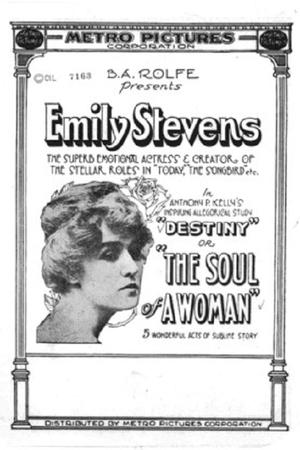
A young girl, Rose Eastmen lives with her lazy Uncle, who works as a janitor in a publishing house. Lacking education, both Rose and her Uncle are susceptible to the socialist ideas of writer Rudolph Creig. One day Rose encounters Jack Steven's the wealthy son of the publishing house, working on his car. She believes he is a common laborer, and begins seeing him. Through her exposure to Jack, Rose begins to realize the rich are not such an abominable people. Rudolph has also reached this conclusion after learning Steven's has published his book. Now with a hefty royalty check and success, Rudolph is able to marry Rose.
When his ne'er-do-well brother embezzles the commissary funds of their cavalry unit stationed in the Sudan, a British soldier takes the blame for him. He winds up deserting his post and joining up with a traveling vaudeville troupe. He falls in love with a pretty young woman in one of the show's acts but finds that a local Arab sheik has his own plans for the young girl.
A couple of boy gangs in Budapest constantly fight over the neighborhood turf.
Hester Prynne's forced public shaming in a strict 17th-century Puritan colony. She wears a scarlet "A" for having a child out of wedlock while her husband is missing and her lover, a minister, hides his involvement.
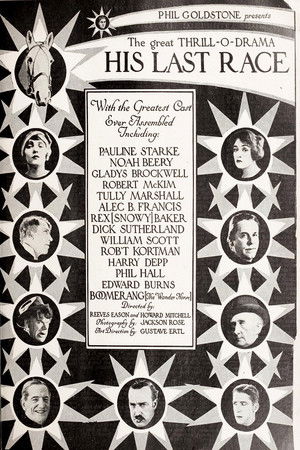
His Last Race
A gang of crooks evade the police by moving their operations to a small town. There the gang's leader encounters a faith healer and uses him to scam gullible public of funds for a supposed chapel. But when a real healing takes place, a change comes over the gang. Lost film, only the most famous scene has survived.
To keep his social-climbing wife and daughters in the lifestyle to which they are accustomed, wealthy George Hunter makes some large investments in the stock market, but the stocks crash and he loses a great deal of money. His wealthy aunt offers to bail the family out, but complications ensue.
Just as Galeen and Wegener's Der Golem (1915) can be seen as a testament to early German film artistry, The Story of the Kelly Gang (1906) symbolizes both the birth of the Australian film industry and the emergence of an Australian cinema identity. Even more significantly, it heralds the emergence of the feature film format. However, only fragments of the original production of more than one hour are known to exist, preserved at the National Film and Sound Archive, Canberra; Efforts at reconstruction have made the film available to modern audiences.
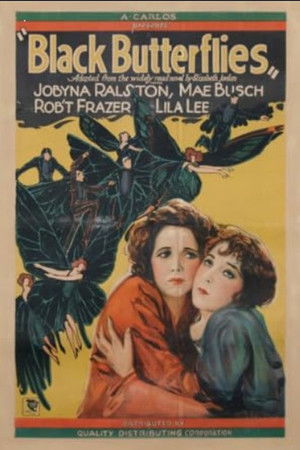
Two sisters are separated as infants after their father leaves their mother. One grows up with her father in privilege and the other grows up in hardship with her mother.
A popular silent action-adventure film in 8 episodes released from 1914-1916. Directed by Aleksandr Chargonin et al., the series is only partially preserved.
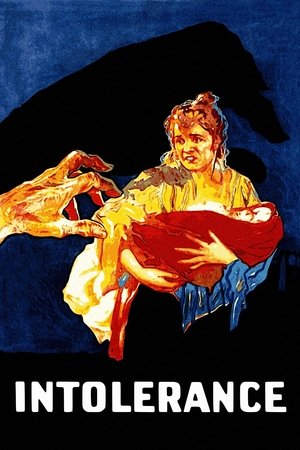
A peasant girl goes to great lengths to protect her child in 19th century Vienna. The film is considered lost, and only four minutes of footage are known to remain.
Three Scottish officers, including Sir Archi, murder Sir Arne and his household for a coffin filled with gold. The only survivor is Elsalill, who moves to relatives in Marstrand. There she meets a charming young officer- Sir Archi- and she soon understands that he was one of the murderers.
In 19th century Paris a hedonistic woman marries an aristocrat but has trouble keeping faithful to him.
Our doggy hero is abandoned in the desert while in pup-hood. Upon reaching maturity, Tin Tin has undeservedly earned the reputation as a killer canine. Thus, the human characters spend most of their time hunting down the dog in hopes of collecting a huge bounty.
A melodrama about a painter who is infected with syphilis, refuses treatment, turns to the use instead of narcotics, and withers away.
Ilda Barosky, a Jewess whose father was killed by Russian soldiers, is a violin student in love with Alexis Nazimoff, son of the Russian aristocracy. Alexis' father arranges a marriage of convenience between Alexis and Olga Karischeff, the daughter of the ambitious minister of police and attempts to shame Ilda at the betrothal celebration. Defiant, Ilda is whipped before the entire assembly. Alexis rushes in to rescue her and terminates his engagement to Olga. In retaliation, Karischeff sentences both Ilda and Alexis to ten years in Siberia as his last official act. The couple attempt to escape their Siberian captivity, are caught and face a firing squad until Count Nazimoff, who has assumed Karischeff's position as minister of police, arrives with a pardon. The couple return home, and the penitent count finally grants them his blessings.
Famous Russian screen actors play themselves in this drama about the lives of actors. Thirteen minutes of the film survive.