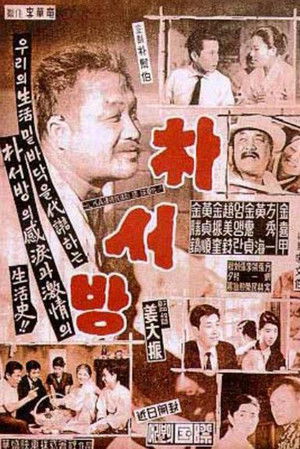
Anzukko (Little Peach) is the daughter of a successful writer. She turns down each one of her suitors, until she marries a beginning writer named Ryokichi. Their life quickly sinks into despair.
When allied troops liberate a small battle-scarred Belgium town in 1944 the American and British commanders do all they can to help the war-weary people back on their feet. There are mental and physical wounds to heal, fields to plough, the church to rebuild. But a top Nazi, knowing the War is lost, has infiltrated the town and is fostering dissent and disunity.
Sunny, a priest, comes to know that Vavachan is running an old age home with vile intentions. He wants the corpses of the inmates for the medical college run by his son. Sunny decides to expose this.
Without lights and in a driving rain, a bus is lumbering along the muddy Assam Road en route from Chunking to the Indian border. Passengers include a European of unknown nationality, a missionary a French officer, and a White Russian. There is also an ancient Chinese lady on an important diplomatic mission to Indian and her traveling companion. The trip is halted when Japanese planes bomb the road and hit a munitions truck and kill many Chinese soldiers. The Chinese commander puts the wounded soldiers on the bus and directs it to a nearby secret airport where the officer in charge is an American attached to the Chinese Air Force.
An eight-year-old boy is willing to do whatever it takes to end World War II so he can bring his father home. The story reveals the indescribable love a father has for his little boy and the love a son has for his father.
The two enemies from war, Slovenian partisan Berk and German soldier Bitter, meet each other during holidays in Spain. Recalling the war through conversation, Berk remembers Anton, his fellow comrade he had spend the most time with.
The name "Voss" is given to a high-ranking Nazi criminal who flees from Germany to South America after the end of the Second World War, like hundreds of thousands of other people. The escape route leads across the Alps and South Tyrol to Genoa and from there by ship to a supposedly better world in South America. Most of these refugees were "displaced persons", i.e. people who had become homeless. Many Nazi criminals also used the same escape route to reach safety. The film depicts the conflicts that arise during the flight, but also in South America, where perpetrators and victims meet again. The main characters of the film, he a murderer, she a survivor of Nazi terror, help each other on the run and experience for the first time what it means to love. Only gradually does it become clear who has which past and whether their love can still endure.
The film interprets a story from the Uttara Kanda of the epic poem Ramayana, where Rama sends his wife, Sita, to the jungle to satisfy his subjects. Sita is never actually seen in the film, but her virtual presence is compellingly evoked in the moods of the forest and the elements. The film retells the epic from a womens' liberationist perspective, and is about the tragedy of power and the sacrifices that adherence to dharma demands, including abandoning a chaste wife.
Autumn 1944. A doctor is accused in the collaboration with the Nazis and found guilty...
Eric and Louise's honeymoon is disrupted by a stranger who claims he will perform a miracle. Meanwhile, Eric's brother and best friend are both experiencing trouble with their own relationships and want to warn him about challenges of marriage.
Young Brad Craig enters the military school with a chip on his shoulder which upperclassmen quickly knock off. Once adjusted, Craig falls in love with a professor's beautiful daughter, only to find she is in love with his roommate.
Middle-class housewife Kay Miniver deals with petty problems. She and her husband Clem watch her Oxford-educated son Vin court Carol Beldon, the charming granddaughter of the local nobility as represented by Lady Beldon. Then the war comes and Vin joins the RAF.
The account of keepers of the Warsaw Zoo, Jan and Antonina Zabinski, who helped save hundreds of people and animals during the Nazi invasion.
One night, in a Los Angeles hospital, Dr. Flax attends to a seriously injured man who, apparently crazed, whispers mysterious and disconcerting words in French into her ear.
An emotionally scarred fifty-something female, a high-profile but haunted British novelist, and a heroic dissident-cum-Soviet psychiatric hospital veteran, all reunite decades after bonding and surviving together in a detention camp during World War II.
Life for a happy couple is turned upside down after their young son dies in an accident.
Spring 1943: A three-member group of resistance fighters flies from a Soviet military airport into the Protectorate of Bohemia and Moravia to establish contacts with an illegal communist center in the occupied territory.
The Narrator tells us how the radio influenced his childhood in the days before TV. In the New York City of the late 1930s to the New Year's Eve 1944, this coming-of-age tale mixes the narrator's experiences with contemporary anecdotes and urban legends of the radio stars.
Kelvin and Mila are getting married. The situation get intense between them as they got into more and more quarrel over trivial things.
The film portrays MacArthur's life from 1942, before the Battle of Bataan, to 1952, when he was removed from his Korean War command by President Truman for insubordination, and is recounted in flashback as he visits West Point.