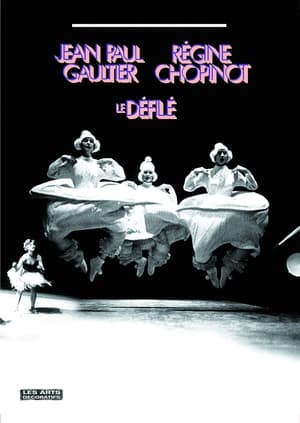
"Le Défilé" is a short film of Regine Chopinot & Jean-Paul Gaultier's collaborations, from a retrospective exhibit by the same name.
Twenty-two prominent American women discuss their activism for nuclear disarmament and their motivations in seeking the end of the arms race.
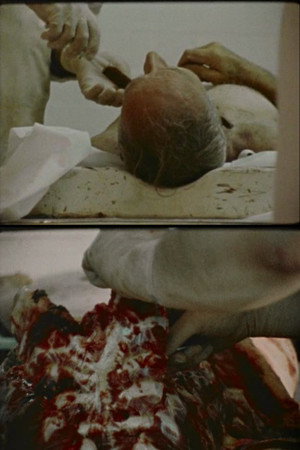
At a morgue, forensic pathologists conduct autopsies of the corpses assigned. "S. Brakhage, entering, WITH HIS CAMERA, one of the forbidden, terrific locations of our culture, the autopsy room. It is a place wherein, inversely, life is cherished, for it exists to affirm that no one of us may die without our knowing exactly why. All of us, in the person of the coroner, must see that, for ourselves, with our own eyes. It is a room full of appalling particular intimacies, the last ditch of individuation. Here our vague nightmare of mortality acquires the names and faces of OTHERS. This last is a process that requires a WITNESS; and what 'idea' may finally have inserted itself into the sensible world we can still scarcely guess, for the CAMERA would seem the perfect Eidetic Witness, staring with perfect compassion where we can scarcely bear to glance." – Hollis Frampton
A woman wearing a light-colored leotard, gathered at the waist, and tights stands against a black background. Although she is filmed in a long shot, her feet are cut off in the frame. She opens with a flourish of her arms and faces the camera. First stretching up with her arms, Latina then bends in half at the waist, steps into a metal ring or hoop, and places her head in the ring as well.
A woman from the Ashanti tribe bathes her child in a shallow bowl.
Travellers, nomads and salesmen make their way along a dam next to the Nile.
Visitors come and go to the thermal springs of Le Mont-Dore. Some are wrapped up in warm garments, some arrive in palanquins.
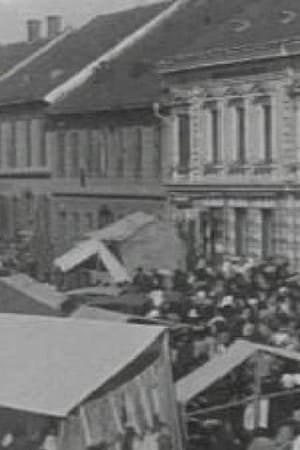
A short film from Slovenia made by Karol Grossmann.
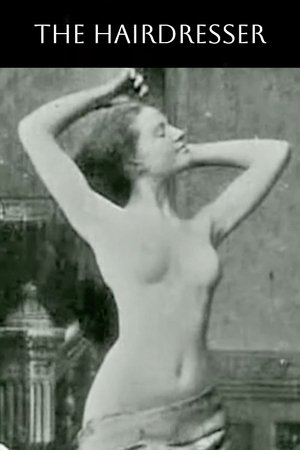
A partially nude woman fixes and brushes her hair.
This picture was taken from the front end of a train during a trip from the famous Cliff House to Bakers Beach along the shore of the Golden Gate. The train runs along the brink of the cliff and gives a perfect representation of the objects that meet the eye prior to entering the Golden Gate. One of the features of this picture is the stirring ride along the very edge of the cliff, the track being laid in places within a foot of the brink, and far below can be seen the huge breakers dashing against the foot of the cliff. (Edison Catalog)
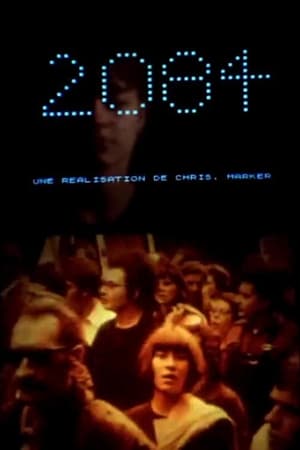
Made for the centenary of France’s trade union laws, Chris Marker’s 2084 imagines a future in which a computer looks back on the labor movement of the 20th century. Mixing documentary reflection with speculative fiction, the film envisions contrasting paths for the future of workers and unions.
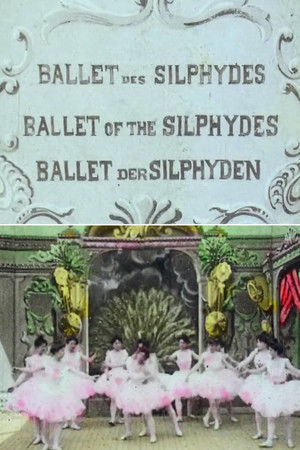
This is a short, simple ballet performance. Colors are used here, but the print is quite badly damaged.
Made in 1903, Eccentric Waltz showcases an exhibition by dancers Boldoni and Solinski, residents at the famous Eldorado cabaret in the Boulevard de Strasbourg in Paris. The lavish stencil colouring emphasises the woman's swirling skirt. (BFI)
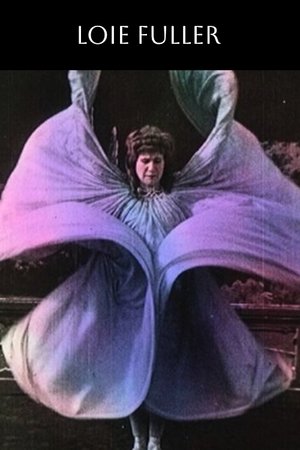
This is another short, simple dance number. It’s quite stunning and unusual though with a bat turning into a woman who proceeds to give us a skirt dance before disappearing into thin air. The dance is mesmerising with the skirt stunningly changing colour throughout the film.
Taken while ascending some 2,000 yards into the clouds, and represents a most diversified view of the city of San Francisco, the Golden Gate, Pacific Ocean, and surrounding country for miles. The huge balloon from which this picture was taken is 75 feet in diameter, 250 feet in circumference and about 105 feet high, and it requires some 150,000 feet of gas to raise it from the ground.
A man and a woman, both dressed in rough clothing, go around and around, half dancing and half wrestling, until they tumble to the ground in a heap. The Apache dance was named not after the Indians of the American Southwest, but the lower class demimondaines of Paris. Acts like this were popular because they permitted their audiences to go slumming, attending events that looked and seemed risky but in truth were not. Acts like this were part of the reason that public dancing was often seen as disreputable. Polite society restricted their dancing to private parties where dances like the waltz and polka -- which had been shocking half a century earlier -- were performed. It would take the influence of Vernon and Irene Castle and the rise of night clubs during Prohibition to make public dancing respectable again. In the meantime, there's this. It's not very graceful.
A brief portrait of famous and brave bullfighter Manuel Benítez el Corbobés; an account on still photos of his triumphs and failures.
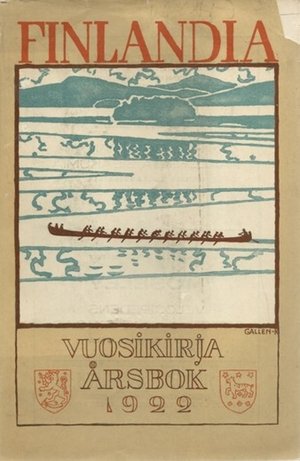
A documentary from Erkki Karu, one of the earliest pioneers of Finnish cinema: This government-produced propaganda film introduces the nature, sports, military, agriculture and capital of Finland.
A medium-length film that takes the central place in the video installation "The Lady of Corinth". In both the medium-length film and the installation, Guerin delves into the relationship between cinema and painting based on Pliny the Elder's account of the invention of painting.