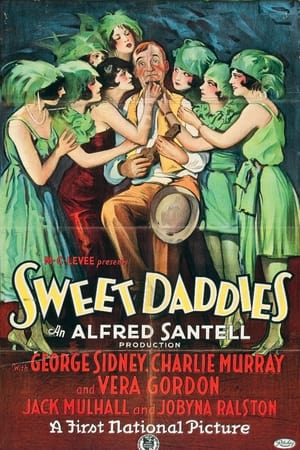
Marco Perkins is a garage mechanic and a would-be-prizefighter who gets a place on the ritzy country club's polo team because he is the town's most proficient mallet-wielder, having learned to play polo while serving in the U.S. army. His hobnobbing with the town-elite and social upper-crust at the polo-matches gives him an inflated idea of his social position, and he decides he is is moving on up. He breaks off with his girl-friend, true-blue Cynthia Brown, and hits on débutante Gloria Staunton, who appears to have an interest in being hit upon. Gloria's interest lies mostly in showing Marco that hired-hands who can play polo still aren't to the manor born.
At Thanksgiving, a tramp arrives in a homeless-hostile town.
An opportunistic umbrella salesman attempts to save a musician and his daughter from blackmail.
Anita and Marion realize that an abandoned baby they sneaked into an orphanage was kidnapped from a millionaire. For the reward, they proceed to break into the institution at night, dressed as men to beat curfew, to get the kid out again. This film survives only in very fragmentary form.
Wanting his son to get away from his many girlfriends and buckle down to work, the New York industrialist father of a playboy sends him to an obscure village in Spain to find samples of a rare mineral. When the son gets to Spain, he runs afoul of the local police chief - who has a secret that he tries to keep the young man from discovering.
Le mogli e le arance is characterized by a wonderful sereneness. It is the kind of quietude which many of us connect immediately with the south. Everything seems to be in its perfect place, and time is just passing. In the setting of a sanatorium a nobleman is practicing idleness and slow-motion mind games. Does it sound boring? Yes, it does. But it is not, the uneventfulness is definitively enthralling. The film director tries to narrate time, time itself, as such, for its own sake: a rare experiment.
John Stonehouse (William Russell) checks into a hotel, intending to commit suicide. But instead he winds up helping a girl, Gilberte Bonheur (Fritzi Brunette), out of a jam. He finds her bending over a man who she has apparently killed, and since he's about to kill himself anyway, he offers to assume the blame. Throw a valuable emerald into the works, and the fact that the dead man suddenly comes back to life, and Stonehouse -- not to mention the audience -- becomes thoroughly befuddled by it all. Everything clears up, however, when Gilberte gives him a theater ticket -- it turns out that everything he went through was the plot to a stage play, enacted in real life by the actors. The critics roasted the play, saying it wasn't true to life, and this was their proof that the situations really could happen. Gilberte retires from acting when Stonehouse proposes.
As a practical joke, an actor impersonates the screen monster he made famous. A lost film.
Compilation of comedy sketches from the comedy kings Buster Keaton, Charlie Chaplin, Danny Kaye & Bing Crosby.
A tramp cares for a boy after he's abandoned as a newborn by his mother. Later the mother has a change of heart and aches to be reunited with her son.
Talented 20-year-old Lolita dreams of a singing career. But her self-esteem is low due to her weight problem and her narcissistic father, Étienne, a literary star with scant interest in his daughter's life. Lolita finds little comfort in the attentions of her vocal coach, suspecting the woman is using her to meet her influential father. Étienne's second wife proves to be Lolita's only trustworthy ally in her private battle to find a sense of worth.
One of the two earliest horror films ever made. This film is presumed lost. In this black comedy scene, the bottom falls out of a coffin, the corpse tumble out, and is jolted back to life. Short sequences like this, as well as street scenes and dancing geisha girls were the main subjects of early Nippon cinema, pioneered by Shiro Asano and Shibata Tsunekichi from 1897 onwards. In creating dramatic, scenes, film-makers naturally chose the most striking or bizarre. Another undocumented film, recalled by cameraman Shiro Asano.
Aspiring filmmakers Mel Funn, Marty Eggs and Dom Bell go to a financially troubled studio with an idea for a silent movie. In an effort to make the movie more marketable, they attempt to recruit a number of big name stars to appear, while the studio's creditors attempt to thwart them.
The film consists of a series of tightly interlinked vignettes, the most sustained of which details the story of a man and a woman who are passionately in love. Their attempts to consummate their passion are constantly thwarted, by their families, by the Church and bourgeois society in general.
While visiting his hometown during Christmas, a man comes face-to-face with his old high school crush whom he was best friends with – a woman whose rejection of him turned him into a ferocious womanizer.
Afif is fired from his job and his home at the movie theater. He looks for a place to sleep but little does he know that he will walk the steps of glory.
A pseudo documentary study of an archetypal German who tries to model his world according to his ideas of law and (sexual) order.
Bébé a le béguin
Le homard
When her grandson is kidnapped during the Tour de France, Madame Souza and her beloved pooch Bruno team up with the Belleville Sisters—an aged song-and-dance team from the days of Fred Astaire—to rescue him.