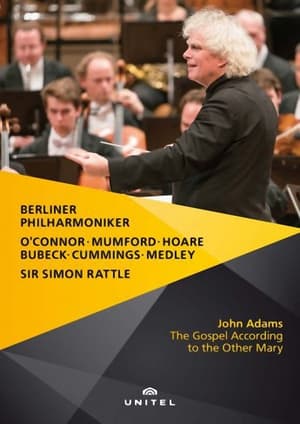
Like many of John Adams’ operas, Doctor Atomic is based on recent world historical events—here, the effusive Robert Oppenheimer, “father of the atomic bomb,” anxiously awaits the bomb’s first test in Los Alamos, New Mexico. Adams adapted the work into a symphony, comprising its three main acts. In the second half of the program, Adams conducts his 2015 violin concerto, Scheherazade.2, which restages the tale of the One Thousand and One Nights heroine as a strong woman navigating a patriarchial society, incarnated by the solo violin part. The work was composed specifically for Canadian-American virtuoso Leila Josefowicz and co-commissioned by the Royal Concertgebouw Orchestra, who perform it to perfection. The evening then closes out with Tromba Lontana, an orchestral fanfare written to mark the 150th anniversary of Texas’s independence from Mexico in 1836.
Lyrical biography of the classical composer, depicted as a romantic hero, an accursed artist.
Jenny is young. Her life is over. She killed someone. And she would do it again. When an 80-year-old piano teacher discovers the girl’s secret, her brutality and her dreams, she decides to transform her pupil into the musical wunderkind she once was.
In the ancient theater of Delphi, against the backdrop of the ruins of the Temple of Apollo, musicAeterna, conducted by Teodor Currentzis, performs Ludwig van Beethoven’s 7th Symphony, in conjunction with a new choreography by Sasha Waltz and her company.
Contents Boulez: Initiale /Boulez Ensemble (chamber ensemble) Schubert: Der Hirt auf dem Felsen, D965 (Von Chezy / Muller) Anna Prohaska (soprano), Jörg Widmann (clarinet), Daniel Barenboim (piano) Mozart: Piano Quartet No. 2 in E flat major, K493 Daniel Barenboim (piano), Michael Barenboim (violin), Yulia Deyneka (viola), Kian Soltani(cello) Berg: Chamber Concerto for Piano and Violin with 13 Wind Instruments Michael Barenboim (violin), Karim Said (piano), Boulez Ensemble
Mozart - Berliner Philharmoniker - Radek Baborák - Daniel Barenboim
Frederick Ashton's La Fille mal gardée (The Wayward Daughter) is one of the choreographer's most joyous and colourful creations. Inspired by his love for the Suffolk countryside, the ballet is set on a farm and tells a story of love between Lise, the daughter of Widow Simone, and Colas, a young farmer. It contains some of Ashton's most stunning choreography, most strikingly in the series of energetic pas de deux that express the youthful passion of the young lovers, performed here by Natalia Osipova and Steven McRae. The ballet is laced with exuberant good humour, and elements of national folk dance, from dancing chickens and a maypole dance to a Lancashire clog dance for Widow Simone, performed by Philip Mosley.
El Sistema at the Salzburg Festival
Although he is unanimously credited with having democratised opera, making it accessible to the greatest number, focus is rarely put on the strategy he devised and implemented in order to carry out his actions, nor what his actions reveal of the man and artist, and of the resulting metamorphosis from opera singer to pop artist. Through this angle, this film sets out to pay tribute to the man who summed up his credo, obsession and life’s work, in the following way: “They led the public to believe that classical music belonged to a restricted elite. I was the way to prove to the world that was wrong.
The film sketches the creative life of the protagonist Kapila. The film’s narrative is structured as one day in the life of a Koodiyattam performer.
During his birthday’s celebration, Prince Siegfried must choose a bride. Trying to escape reality, he dreams of a perfect love. His tutor tries to bring him down to Earth and reminds him of his duties. On a dreamlike getaway, the prince meets Odette, a princess who has been transformed into a swan by the powerful sorcerer Rothbart. Only true love can break the spell. Captivated, Siegfried promises Odette to save her and invites her to his party. To trap the prince, the sorcerer sends his daughter Odile, disguised as Odette, to seduce him.
Newman's poem tells the story of a soul's journey through death, and provides a meditation on the unseen world of Roman Catholic theology. Gerontius (a name derived from the Greek word geron, "old man") is a devout Everyman. Elgar's setting uses most of the text of the first part of the poem, which takes place on Earth, but omits many of the more meditative sections of the much longer, otherworldly second part, tightening the narrative flow.
Known for his mournful "Adagio for Strings," Samuel Barber was never quite fashionable. This acclaimed film is a probing exploration of his music and melancholia. Performance, oral history, musicology, and biography combine to explore the life and music of one of America’s greatest composers. Features Thomas Hampson, Leonard Slatkin, Marin Alsop and many more of the world's leading experts on Barber's music, with tributes from composers Leonard Bernstein, Aaron Copland, Virgil Thomson and William Schuman. The film was broadcast on PBS, and screened at nine film festivals internationally, with three best-of awards. It was named a Recording of the Year 2017 by MusicWeb International.
A thoroughly researched biopic of Charles Ives, America's greatest and most innovative composer (and insurance executive), who combined strikingly futuristic experimentalism with gentle nostalgia. Includes narration taken directly from Ives's own writings, and reminiscence from those who knew him.
With more than 50 years of experience as film director, Peter Greenaway (Nightwatching, Eisenstein in Guanajuato) combines the worlds of film and opera at the Verdi Festival in Parma, demonstrating what magic those two can do together with an all new approach to Giuseppe Verdi's Giovanna d'Arco, staged and edited by himself and his wife, Saskia Boddeke. The opera's libretto is based on Friedrich Schiller's 'The Maid of Orleans'. It tells the story of the French national hero Jeanne d'Arc, who defends her country against the English troops during the Hundred Years' War. Constantly torn between her humble roots, her love for King Charles VII and her heavenly task to fight for France, she gains eternal glory by giving her life in the final, victorious battle against England.
Elmer Fudd introduces two pieces of classical music: "Tales of the Vienna Woods" and "The Blue Danube", and acted out by Bugs Bunny, Porky Pig, Laramore the Hound Dog, a family of swans, and a juvenile Daffy Duck.
Giuseppe Verdi based his famous opera on the novel “The Lady of the Camellias” by Alexandre Dumas. Robert Wilson’s production of Violetta Valéry’s tragic fate is his first work at the State Theater of Linz, Austria, one of the most modern operatic stages in Europe by architect Terry Pawson. After the run in Linz, the production was transferred to the Opera House in Perm, Russia, where the production was conducted by Teodor Currentzis. In 2017, the work received a “Golden Mask”, the most prestigious Russian theater award, in three categories (Teodor Currentzis, Best Conductor; Nadezhda Pavlova, Best Female Singer; Robert Wilson, Best Lighting Design).
Letters, Riddles and Writs is a one act opera for television by Michael Nyman broadcast in 1991.
The wait is over! After two long years, Maestro André Rieu is performing again in his hometown of Maastricht! We are proud to present André's brand new summer concert - Happy Days are Here Again!
The evocative music of Claude Debussy has been described as the foundation of modern music. But how did the composer come to develop his unique style? On this video, maestro Francois-Xavier Roth and the London Symphony Orchestra present the UK premiere of a previously lost work by the young Debussy, alongside some of his earliest inspirations. Debussy's newly discovered Premiére Suite gives a rare insight into the mind of a young composer on the cusp of innovation. It's a work filled with Romantic and Eastern influences and glimpses of the unexpected harmonies that came to define Debussy's work. Paired alongside the composer's role models - from Wagner's powerful intertwining motifs, the abundant Spanish influences in Lalo's rarely-heard Cello Concerto performed here by Edgar Moreau, and Massenet's majestic Le Cid - Francois-Xavier Roth gives a fresh perspective on the much-loved composer.