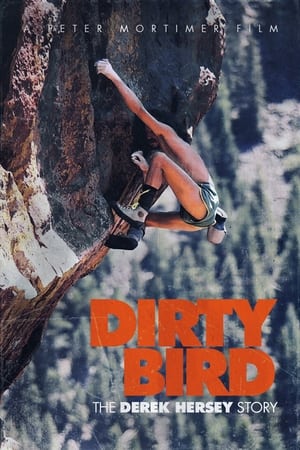
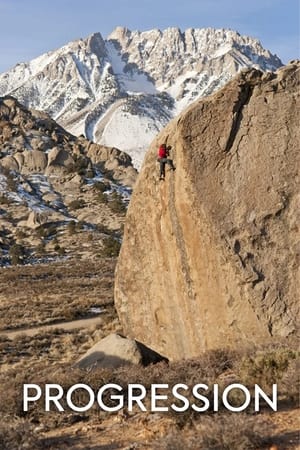
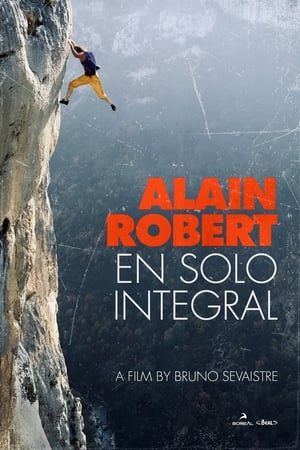
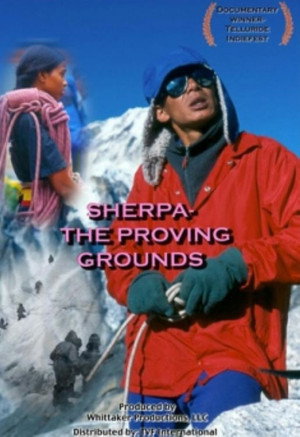
For nearly three years, director Dina Khreino interviewed world-class mountain climbing athletes, listening to what compels them to leave behind families, friends, and everyday comforts to risk everything for a fleeting glimpse into the unknown. What she found was a tribe, a diverse group of professional adventurers and amateur philosophers forged by the ultimate test of body, mind, and spirit. In the face of shifting winds, sheer granite cliffs, and impossible odds, they climb. Each for their own reason, but every one connected by the vertical world. In this rarefied air, these athletes are fundamentally changed, not just as climbers, but as human beings.
Immersive documentary in two parts, filmed in high-resolution 360° 3D, which follows Alex Honnold's journey through Yosemite National Park, home to the famous El Capitan – immortalized in the film “Free Solo”, then at Red Rocks , in Nevada, west of Las Vegas. Then it's off to Europe where he teams up with Swiss climber Nicolas Hojac in some of the most difficult solo free climbs in the Dolomites. In episode 2, the two climbers tackle the Directe americaine on the Aiguille du Dru in Chamonix and the Kuffner ridge on Mont Maudit, the second highest peak of the Mont Blanc massif, in free solo.
An international team of climbers ascends Mt. Everest in the spring of 1996. The film depicts their lengthy preparations for the climb, their trek to the summit, and their successful return to Base Camp. It also shows many of the challenges the group faced, including avalanches, lack of oxygen, treacherous ice walls, and a deadly blizzard.
Documentary about K2 tragedy of 1986. On August 4, 1986, Diemberger and Julie Tullis reached the summit of K2 very late in the day. Shortly after starting their descent, Tullis fell and dragged Diemberger down with her. Fortunately, they somehow stopped from going over the edge and spent the night above 8,000 metres. They managed to reach Camp IV the next day, where they were forced to share a tent with six other climbers after their tent had collapsed from hurricane force winds. Tullis died later that night, possibly from high altitude cerebral edema (HACE), and only one other climber, Austrian Willi Bauer, survived the descent with Diemberger. Both climbers suffered severe frostbite during the descent and had to have amputations.
From America, England, France, Italy and Japan. From each corner of the earth, five climbers – Sam Elias, James Pearson, Caroline Ciavaldini, Jacopo Larcher and Yuji Hirayama – attempt to open a new multi-pitch route on the basalt island of Reunion. Lost in the South Indian Ocean, Reunion is the childhood home of Caroline and, after traveling the world for several years as a professional climber, returning was something she had to do. By working together as climbers and friends, the team is able to open, ground-up, one of the hardest multi-pitch rock climbs in the world.
Surrounded by the mountains and people who are his inspiration, in ‘Path to Everest’, the mountain athlete Kilian Jornet reveals his most intimate fears, contradictions and passions. Summits of My Life is the personal project of Kilian Jornet, in which for five years he has traveled to some of the most important peaks of the planet to try to establish FKT (fastest known time) of ascent and descent of some of the most emblematic mountains of the world. The project is closely linked to values and a way of understanding the purist and minimalist mountain. The experiences lived in each challenge have been captured in different films.
He climbed solo, without a rope, the north face of the Eigers in 2h47. Below him the rock wall steigen über 1000 Meter ab. Mehr Ueli Steck, the lone wolf, does not lose his temper. For a year, Steck has meticulously prepared this record of less than three hours. The portrait of an extraordinary man who takes us on a journey to the most beautiful and challenging peaks in the world.
Six big north faces of the Alps. The film consists of six films: "Die Wand der Wände" (Eger by Robert Jasper, Roger Schäli), "Das letzte Wort hat der Berg" (Matterhorn by Michael Lerjen, Jorge Ackermann), "Selig, wer in Träumen stirbt" (Grandes Jorasses by Felix Berg, Robert Steiner), "Licht und Schatten" (Piz badile by Hansjörg Auer), "Grenzen der Felskletterei" (Drei Zinnen by Alexander Huber) and "Der zerfallene Berg" (Petit Dru by Steve House, Andy Parkin).
On May 23, 1971, a French expedition led by Robert Paragot successfully climbed Makalu via its west pillar. Makalu is one of the five highest peaks in the world, located in the Himalayas on the Nepalese-Tibetan border. Jean-Pierre Janssen and Lucien Bérardini filmed this expedition, where Robert Paragot spoke about the expedition conditions, life at altitude, and his state of mind as expedition leader. On the return to base camp, Jean-Pierre Janssen interviewed Lucien Berardini, Georges Payot, Jean-Claude Mosca, François Guillot, and Jean-Paul Paris, all of whom played a key role in bringing Bernard Mellet and Yannick Seigneur to the summit. Expedition members: Robert Paragot (expedition leader), Georges Payot, Yannick Seigneur, Claude Jager, Jean-Claude Mosca, François Guillot, Bernard Mellet, Lucien Bérardini, Jean-Paul Paris, Robert Jacob, Jacques Marchal (surgeon).
The French Alpine Club's film about the French expedition to conquer Makalu (8481m) via the west pillar in Nepal, which began on February 24, 1971. Composed of 11 mountaineers, Robert Paragot (expedition leader), Georges Payot, Lucien Berardini, Yannick Seigneur, Claude Jager, Jean-Paul Paris, Jean-Claude Mosca, François Guillot, Bernard Mellet, Robert Jacob and Jacques Marchal (surgeon), it took twenty-five days of walking on the Himalayan trails with 460 porters and 18 Sherpas to transport 14 tons of equipment to reach the base camp. Finally, it was Mellet and Seigneur who managed to reach the summit on May 23, 1971: 8481 m, temperature - 30°, oxygen 30%, no wind.
In 1984 Ron Fawcett, is one of the most athletic climbers, he takes pleasure in taking up the challenge of climbing "free" without artificial aids, the equipment and rope being used only for safety, a revolution at the time. The documentary is part of "Pushing The Limits", a 10-episode series by Leo Dickinson documenting sporting adventures that push the limits of human endurance. Each episode focused on an extreme sport, ranging from rock climbing to hot air ballooning.
Georges Livanos, nicknamed the Greek but pure child of Marseille, amateur mountaineer, opened more than 500 routes in the Calanques, 40 in the Dolomites, and repeated many of the greatest routes in the Alps in the company of the best climbers of his time, d friends, and especially his wife Sonia. He is also the author of the classic "Beyond the vertical". This report follows for a day the legend, still 71 years old, of his apartment in the Marseille city in the Calanques. As a true Provençal, he speaks without filter of the exploits that made him famous, gives his opinion on modern climbing and on life in general: the portrait of a great climber and above all of a fascinating character with a sense of humor sharp.
Looking at whether the history of early human evolution should be rewritten. For decades, most experts have been convinced that Africa is the cradle of mankind and many fossil finds from Kenya, Ethiopia, South Africa and Chad seemed to prove it.
A climatologist, a physicist, and a volcanologist set out to conquer the highest peak in the Alps. Through exceptional images, the film recounts their odyssey and reveals the immense wealth of this natural laboratory. Straddling France, Italy, and Switzerland, the Mont Blanc massif was formed 240 million years ago. Four times the size of Paris, it covers 400 km2. Its summit, the highest in Western Europe, rises to 4,810 meters. Three scientists begin its ascent: Martine Rebetez, a Swiss climatologist; Étienne Klein, a philosopher and physicist at the French Atomic Energy Commission; and Jacques-Marie Bardintzeff, a geologist and volcanologist. Advancing in two roped teams, they are accompanied by Jean-Franck Charlet and François-Régis Thévenet, mountain guides, as well as physiologist Hugo Nespoulet.
As darkness fell on May 10, 1996, a fast moving storm of unimaginable ferocity trapped three climbing teams high on the slopes of Mount Everest. The climbers, exhausted from their summit climb, were soon lost in darkness, in a fierce blizzard, far from the safety of High Camp at 26,000 feet. World-renowned climber and filmmaker David Breashears, who aided the rescue efforts back in 1996, now returns to Everest to tell the fuller story of what really happened on that legendary climb. Through remarkably intimate interviews with the climbers and Sherpas many who have never spoken before on American television Breashears sheds new light on the worst climbing tragedy in Mount Everest s history.
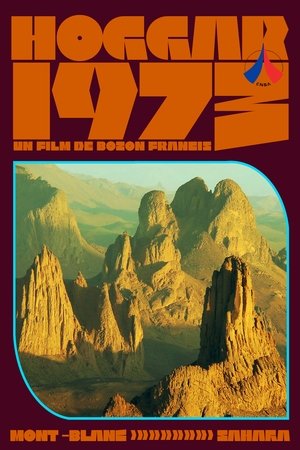
Documentary on the French Alpine expedition to Hoggar in Algeria, starring Roger Frison-Roche, Raymond Coche, Pierre Lewden, and François de Chasseloup-Laubat. The 1935 French Alpine Expedition to Hoggar was conceived and prepared by Lieutenant Raymond Coche, the ideal leader for an expedition that would combine alpine and Saharan terrain in Algeria. Among his goals, he set himself the task of leading a French rope team to the still-untouched summits of Atakor and Tefedest and planting the French flag there. His old friend, Pierre Lewden, an athlete and journalist, was soon on the team, and to complete their project and complete the trio, they called on Roger Frison-Roche, a guide from Chamonix and one of the best climbers of this generation. A few days before their departure from Paris, filmmaker Pierre Ichac joined them.
Bravo Marcel
Ueli Steck may be the greatest speed alpinist the world has ever seen. In this film he tells the stories of his record-breaking ascents in the Alps, accompanied by stunning aerial footage of him racing up 8,000 foot alpine faces. Ueli joins Alex Honnold in Yosemite to attempt speed records there. His ultimate goal: take his one-man alpine speed game to the largest, highest walls in the world.
Explore Mont Blanc
This is Gaston Rebuffat's fourth film, in which, with several close friends, he discovers the sublime landscapes of the Alps. “Mont-Blanc is beautiful. I climbed it several times depending on the time, the color of the sky and the shape of the cornices and ridges. Because of the weather and also because of this feeling of altitude, Mont-Blanc provides great pleasure. For the guide, Mont Blanc is his garden, but the garden becomes more beautiful when shown to a friend. Personally, I really like the bivouacs; only there one penetrates a little the mystery of the altitude. That's why I immediately accepted when Tazieff expressed the desire to spend the night at the top of Mont Blanc in an igloo. The film won the Grand Prix at the Trento Film Festival in 1961.