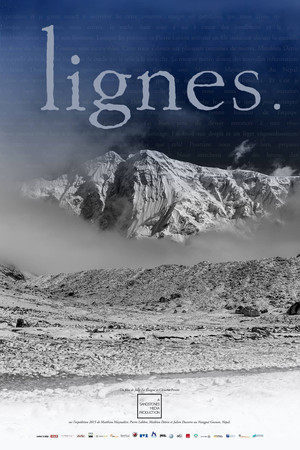
In 1975, Raymond Renaud, Yves Pollet-Villard, Maurice Gicquel, Maurice Cretton, Jean Coudray, Yvon Masino, Walter Cecchinel, all teacher guides at ENSA in Chamonix, with the help of the Indian Mountaineering Foundation, set out to cross the 2 peaks of the highest mountain in India. After 43 hours in a truck, 10 days of slow and difficult approach walking, helped by goats for the portage due to lack of sherpas, the base camp is set up on the Nanda Devi glacier. Two groups share the two eastern and western slopes, 3 kilometers separate them: the goal being to meet between the two summits by the ridge. But on the big day, with the monsoon, bad weather arrives with wind and snow, we will have to give up. Like the French expedition of 1951 which lost two mountaineers, Roger Duplat and Gilbert Vigne, to whom Paul Gendre and Louis Dubosc pay tribute.
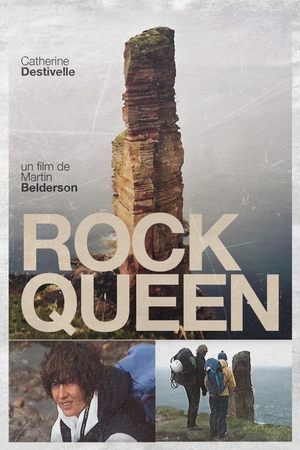
Catherine Destivelle has deservedly become the most famous female climber in the world. She rose to prominence with historic climbs, such as the free ascent of the Nameless Tower in Pakistan, and solo winter ascents of the classic north faces of the Matterhorn and the Eiger, climbs that have never been repeated by any woman. She also made history in sport climbing by winning the world championship title. In 1997, this time in Scotland, on the iconic Old Man of Hoy route, opened by Bonington, Patey & Baillie, Martin Belderson crowned Destivelle Queen of the Rock. She was four months pregnant when she made this 137-meter ascent, which was not difficult but on tricky rock.
Mountaineering documentary on the Nanga Parbat expedition, in India, in 1982. Led by mountaineer Pierre Mazeaud, this international expedition brings together eight French people, two Germans, an Iraqi, an Austrian and an Englishman including Michel Afanassieff, Michel Berrueux, Walter Cecchinel, Kurt Diemberger, Hans Engl, Shah Jehan, Karim Imamdad and others. On July 14, 1982, Hans Engl reached the summit after twelve hours of struggle.
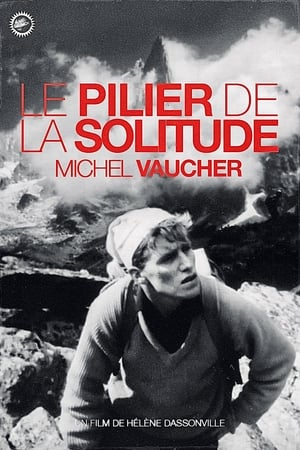
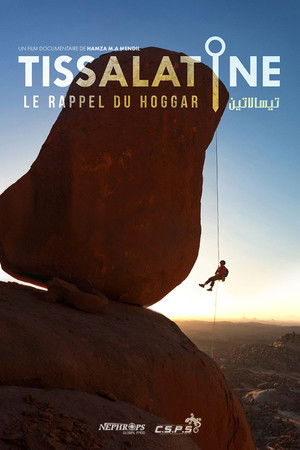
TSR documentary on the 1979 expedition to Algeria in the Atakor massif (Hoggar desert), organized by Geneva mountaineer Michel Vaucher and Jean-Blaise Fellay. The climbers make a dozen ascents including the famous summit of Adaouda (which means "finger" in Tamasheq, the Tuareg dialect), by several routes. Then a new route on the peaks of the southern Tezoulegs. They discover the volcanic geological characteristics of the Atakor massif and meet the nomadic inhabitants of the region, the Tuaregs, who are increasingly settling in the town of Tamanrasset.
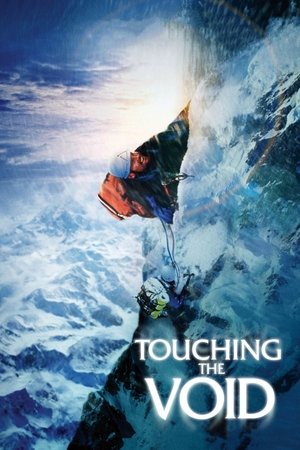
The true story of Joe Simpson and Simon Yates' disastrous and nearly-fatal mountain climb of 6,344m Siula Grande in the Cordillera Huayhuash in the Peruvian Andes in 1985.
René Collet, skier member of the French team, guides a friend from the summit of the Aiguille du Midi. This descent is an opportunity to focus on the remarkable elements of the terrain: the cable car and its work still in progress, the surrounding peaks (Capucin, Mont Maudit, Mont Blanc). The two skiers stop regularly, here to observe climbers scaling the south face of the Aiguille, there to visit the Cosmiques Laboratory. They even take the time to rescue a skier stuck in a crevasse at the Séracs du Géant, before continuing their descent in style onto the Mer de Glace.
Bastien Lardat and Jordi Noguere, two rope brothers, invite us to pay tribute to the pioneers of modern Pyrenees, through a new kind of sporting journey. Pierre and Jean Ravier opened the way several decades ago, drawing on the Pyrenean reliefs one of the most beautiful pages of amateur climbing excellence. In three days, climbing and connecting 3 legendary north faces by Ravier on foot is the crazy challenge that Bastien and Jordi have set themselves. 3 days, 3 routes, 85 km of pedestrian connection, to arrive at the end of the north face of the Tour de Marboré in Gavarnie, the Dièdre Jaune du Vignemale and the Embarradère du Pic du Midi d'Ossau.
The story of the ascent of the Aiguille de la République by mountaineers Jacques Fromentin and Michel Bastien. The Aiguille de la République, in the Mont-Blanc massif, culminates at an altitude of 3,305 meters among the Aiguilles de Chamonix group of summits. In the Fontainebleau forest, children learn mountaineering techniques on the bouldering climbing site. In 1954, rock climbing was also practiced in the Chamonix valley. The Montenvers train crosses the viaduct taking tourists or athletes to the Mer de Glace viewpoint. The two climbers take an approach step and reach the Envers des Aiguilles refuge. They then climb this steep and smooth wall, progressing along the ridge. On the platform, a rope throw allows them to climb up and sit at the top to dominate the panorama. Then the return: abseiling from the summit block.
Three years after the 1959 expedition, abandoned 350m from the summit, Lionel Terray leads a new assault on Jannu, one of the most demanding peaks in the Himalayas. At the base camp, equipment and food rations are prepared. The conditions are optimal and the ascent can begin. The camera follows the progress of the mountaineers and Sherpas as closely as possible, from one high-altitude camp to another: installing fixed ropes, progressing over crevasses, in the middle of frozen towers, vertically down immense ice falls or along the edge of sharp ridges. From 7000m, oxygen bottles become essential, as the difficulty of the climb prevents acclimatization. The expedition is a total success: the majority of its members reach the 7710m summit.
1967: Two of the world's best climbers, Yvon Chouinard and Royal Robbins, tackle the west face of Sentinel Rock, an iconic 2,100-meter granite peak located in Yosemite National Park, considered one of the most difficult in the world. The film's atmosphere is immersive, driven by a sober narrative that highlights the intimate relationship between man and the wall. The technical difficulty of the route, the prolonged physical effort, and the isolation reinforce the heroic dimension of this ascent. The documentary also reveals the essential solidarity between the climbers: each progression requires rigor, inventiveness, and total trust in both the equipment and the partner. This film is considered a benchmark in the history of mountain cinema. It testifies to the pioneering spirit of the era and the evolution of climbing techniques, perfectly illustrating the transition to a more athletic and thoughtful approach to large rock faces.
A screen adaptation of the well-known novel by Roger Frison-Roche about the harsh lives of mountain guides and their families in the French Alps, near Chamonix and the French/Swiss/Italian borders... Like his father, Zian Servettaz is a dedicated mountain man. His Italian-born wife Bianca does not adjust well to his mountain village in France, and to the ever life-threatening dangers presented by his mountain guiding and climbing. She briefly returns to Italy and to her family. However, after Zian's insistence and trip to Italy, she returns to mountain life in the French Alps. Once back there, events will unfold, changing their lives as well as those of other mountain people forever.
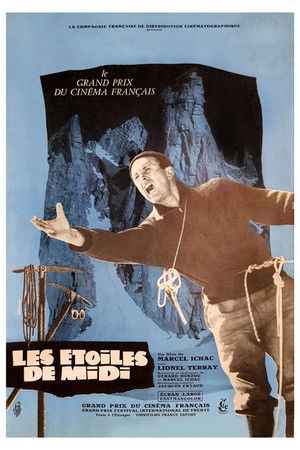
Les Etoiles de Midi is an engaging docudrama about some of the more spectacular exploits of French mountain climbers over the last several decades. In one re-enacted story, there is a wartime escape through the mountains, and in another, a daring rescue of a pair of climbers who had been missing. The actors themselves are adept at the sport of climbing, and they give the scenes an immediacy and real daring that brings the stories alive. A combination of their acrobatics and skill and the outstanding episodes in the history of French climbing creates a winning 78 minutes.
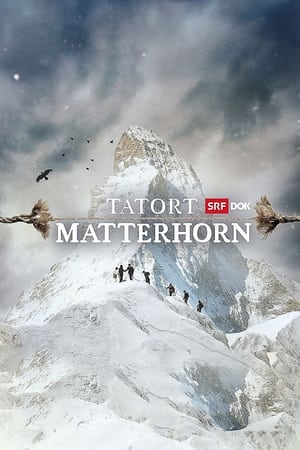
The first ascent of the Matterhorn was made on July 14, 1865 by Edward Whymper, Francis Douglas, Charles Hudson, Douglas Hadow, Michel Croz and two guides from Zermatt, Peter Taugwalder father and son. Douglas, Hudson, Hadow and Croz are killed on the descent after Hadow slips and drags the other three men down the north face. Whymper and the two Taugwalders, who survive, are later accused of having cut the rope that connected them to the rest of the group so as not to be dragged into the fall, but the ensuing investigation finds no evidence of their guilt and they are acquitted. The Matterhorn is the last great peak in the Alps to be conquered and its ascent marks the end of the golden age of mountaineering. One hundred and fifty years later, a team undertakes the same expedition in order to unravel the mystery.
Avoir 16 ans et toutes ses Andes
Dhaulagiri - 1ère hivernale française 1987
Dans les pas du Groupe
Breathtaking climbing sequences. As a guide, none other than "The Rock Queen" Catherine Destivelle. Climbing companions of the caliber of Chris Bonington or Tom Livingstone, one of the greatest Himalayan climbers today... for the production of "Great Britain, Journey to the Sources of Mountaineering," Vincent Perazio and Bertrand Delapierre have proven themselves equal to a complex but fascinating subject: the British origins of mountaineering. A journey through time. Since the second half of the 19th century and the beginnings of the British writer Albert F. Mummery, who would become the first sport mountaineer, notably in the Alps and the Caucasus.
In the shady campgrounds of Yosemite valley, climbers carved out a counterculture lifestyle of dumpster-diving and wild parties that clashed with the conservative values of the National Park Service. And up on the walls, generation after generation has pushed the limits of climbing, vying amongst each other for supremacy on Yosemite's cliffs. "Valley Uprising" is the riveting, unforgettable tale of this bold rock climbing tradition in Yosemite National Park: half a century of struggle against the laws of gravity -- and the laws of the land.
As darkness fell on May 10, 1996, a fast moving storm of unimaginable ferocity trapped three climbing teams high on the slopes of Mount Everest. The climbers, exhausted from their summit climb, were soon lost in darkness, in a fierce blizzard, far from the safety of High Camp at 26,000 feet. World-renowned climber and filmmaker David Breashears, who aided the rescue efforts back in 1996, now returns to Everest to tell the fuller story of what really happened on that legendary climb. Through remarkably intimate interviews with the climbers and Sherpas many who have never spoken before on American television Breashears sheds new light on the worst climbing tragedy in Mount Everest s history.
In 2013, Alberto Iñurrategi, Juan Vallejo and Mikel Zabalza desist in their attempt to climb Paiju Peak (6,610m). A year later, his steps cross with Mikel Renteria and Mentxu Mendieta from the WOP Foundation, who decide that the second attempt at Paiju Peak will be the first stage of their WOPeak project. The three members of the cordada land again in Pakistan. Identical scenery, the same objective and a maximum motivation for a challenge beyond mountaineering in a route full of emotions that ends with the opening of a new road in the heart of the Karakorum that they christened '2t'.