The documentary follows one woman's quest to overcome anxiety, depression, and opioid addiction through the use of psychedelic medicines.
When Harvard PhD student Jennifer Brea is struck down at 28 by a fever that leaves her bedridden, doctors tell her it’s "all in her head." Determined to live, she sets out on a virtual journey to document her story—and four other families' stories—fighting a disease medicine forgot.
Civil discourse is vanishing from modern society. Improv comedians heal the divide in this documentary feature film starring Colin Mochrie (Whose Line is it, Anyway?) that explores the use of improvisation for conflict resolution. Republican Karl Rove performs improv with Colin Mochrie and endears himself to a room half-full with Democrats. Police officers do improv with local youth in order to learn listening skills. Dr. Daniel J. Wiener brings couples back from the brink of divorce using improv. Dr. Charles Limb places Second City improv comedians in a functional MRI machine to see what happens in the brain when we improvise.
"The Monsters in My Home" focuses on the work Carme Artero, a foster mother from Majorca, Spain, who has devoted her time to setting up a foundation in defense of the rights of children who have suffered from abuse. The documentary features testimonies and the experience of people who care of children living situations of vulnerability, such as sexual or physical abuse or neglect and whose parents have their parental custody taken away by the Law.
It offers a nuanced look at life in the women's ward of a psychiatric clinic, where most patients have been convicted of a crime.
Forget the neon lights and cherry blossoms — this is Japan like you’ve never seen it. In this gripping short documentary, Omar Farooq dives into the dark underbelly of Japanese society, exposing hidden truths, silent struggles, and the untold stories that lie behind the country's polished image.
At the age of 16, Alice was a victim of abuse. Fifty years later, this repressed experience unexpectedly makes its way back into her conscience. How is it possible to repress an incident for one’s entire life? How did it happen that she made films and wrote books always about children and violence? Alice walks with her accordion through the desert, searching for answers, looking at a phenomenon that affects many women in a similar or related way.
Her rise was a global phenomenon. Her downfall was a cruel national sport. People close to Britney Spears and lawyers tied to her conservatorship now reassess her career as she battles her father in court over who should control her life.
The Iron Man takes us on an introspective journey into the life of Toni, a man who finds in art and nature the essential pillars of his existence. The creation of iron and stone sculptures, together with work in the countryside as a gardener, help him to find beauty in the simplicity of life. His vision of life, as if he were a ‘rural philosopher’, will teach us to break down stigmas about mental health and to look at life from a hopeful perspective.
In his first HBO comedy special, Gary Gulman offers candid reflections on his struggles with depression through stand-up and short documentary interludes. While speaking to issues of mental health, Gulman also offers his observations on a number of topics, including his admiration for Millennial attitudes toward bullying, the intersection of masculinity and sports, and how his mother's voice is always in his head.
Manly Feelings is a short film by Chris Blom, about the difficulty that many men face while experiencing, expressing, and sharing the difficult emotion of sadness. The film lingers in this place of difficulty through interviews with men, supported by metaphorical imagery.
"Wolfe" is an intimate confessional from Nick, who learned through puberty that the imaginary friend in his head was real, and violent.
Faceless is a documentary film about the workings of an inpatient psychiatry unit, seen through the eyes of both the patients trying to get well and the staff trying to help them.
Filmmaker Stephen Hosier takes a journey with Richard Csanyi, his childhood friend, as he investigates the life and death of his twin brother Attila, who was found dead on a rooftop in 2020.
MENTAL is a feature-length documentary that observes the complex world of an outpatient mental health clinic in Japan, interwoven with patients, doctors, staff, volunteers, and home-helpers, in cinema- verite style. The film breaks a major taboo against discussing mental illness prevalent in Japanese society, and captures the candid lives of people coping with suicidal tendencies, poverty, a sense of shame, apprehension, and fear of society.
Animated short documentary following a young woman's diagnosis of bipolar: a journey of self-acceptance to challenge everyday stigma. In "Trust Me", a genre-bending short documentary, a young woman uses humour and compassion to share her moving and deeply personal story of coming to terms with her mental health condition. When she starts exhibiting atypical and extreme behaviour, her loved ones trick her into hospitalisation against her will. She is diagnosed with bipolar disorder which starts her challenging journey of self-acceptance, confronting internalised and societal stigma, and learning to trust herself and others again.
Marilyn Monroe's final project, "Something's Got to Give", has become one of the most talked about unfinished films in history. The story of the film and Marilyn's last days were seemingly lost… until now. Through interviews, never-before-seen footage and an edited reconstruction of "Something's Got to Give", Marilyn Monroe: The Final Days provides a definitive and fascinating look at the last act in the life of the world's most famous and tragic superstar.
OBAIDA, a short film by Matthew Cassel, explores a Palestinian child’s experience of Israeli military arrest. Each year, some 700 Palestinian children undergo military detention in a system where ill-treatment is widespread and institutionalized. For these young detainees, few rights are guaranteed, even on paper. After release, the experience of detention continues to shape and mark former child prisoners’ path forward.
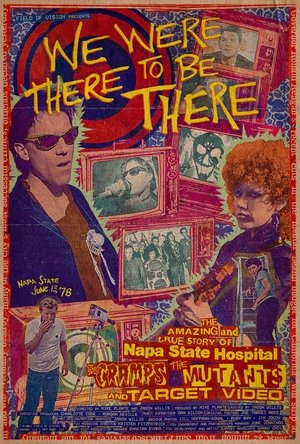
On June 13, 1978, the punk bands the Cramps and the Mutants played a free show for psychiatric patients at the Napa State Hospital in California. We Were There to Be There chronicles the people, politics, and cultural currents that led to the show and its live recording.
After more than twenty years, Swiss musician Dino Brandão travels to Angola to give a concert in his father's home country. Confronted with his family's past and questions about his own identity, Dino is triggered into a manic episode.