The film covers a hundred years in the lives of the Ricordi family, the Milan publishing house of the title, and the various composers and other historic personalities, whose careers intersected with the growth of the Ricordi house. It beautifully draws the parallel between the great music of the composers, the historic and social upheavals of their times, as well as the "smaller stories" of the successive generations of Ricordi.
Disciplined Italian composer Antonio Salieri becomes consumed by jealousy and resentment towards the hedonistic and remarkably talented young Salzburger composer Wolfgang Amadeus Mozart.
Beginning on the eve of her thirtieth birthday, “Brave Enough,” documents violinist Lindsey Stirling over the past year as she comes to terms with the most challenging & traumatic events of her life. Through her art, she seeks to share a message of hope and courage and yet she must ask herself the question, “Am I Brave Enough?” Capturing her personal obstacles and breakthrough moments during the “Brave Enough,” tour, the film presents an intimate look at this one-of- a-kind artist and her spectacular live performances inspired by real-life heartbreak, joy, and love.
Eugen Suchoň's opera Svätopluk returns to the stage of the Slovak National Theatre Opera in 2023. Since 1960, when it had its world premiere, this is the fifth production of this musical drama at the Slovak National Theatre. It returns as an eloquent witness of Slovak operatic history, as a bearer of a message, as an impulse for reflection and reassessment of historical attitudes in a broader context.
"Probably the best living pianist" headlined the Berliner Morgenpost's review of Grigory Sokolov's sold-out June 2013 recital at the Berlin Philharmonie. "The four Impromptus could no be interpreted more dramatically... The D 946 Pieces cried out with despair an longing for death." (from DVD cover)
In this short, Johnny Green leads the MGM Symphony Orchestra in a performance of the overture to Rossini's "La Gazza Ladra".
Surely Bach’s French Suites, which he composed during his years at Cöthen (1717–1723), are among the finest inducements to practise that any teacher has ever made to a pupil. In this case Bach wrote them for his young wife, Anna Magdalena. The over-riding impression left by these suites is one of endearing tunefulness. Clavier-Übung II is a later collection of didactic keyboard pieces. It comprises two greatly contrasted works: the Italian Concerto and the Overture in the French Style. These performances admirably demonstrate the thoughtful and persuasive approach that András Schiff adopts when performing Bach. Recorded live at the Bachfest 2010, Protestant Reformed Church of Leipzig, 11 June 2010 Repertoire J.S. Bach: French Suites Nos. 1–6, Overture in the French Style in B minor, Italian Concerto in F major, BWV 971
Recently diagnosed with ADHD, a symphony conductor uses the career shutdown of the 2020 pandemic to dive into her mental health. She looks for ways to face the challenges and honour the gifts of being neurodiverse.
Valery Gergiev is widely recognised as the greatest modern interpreter of Tchaikovsky’s music and the Mariinsky holds a peerless reputation in the repertoire. Together they deliver definitive interpretations of Tchaikovsky’s most popular symphonies. These acclaimed performances were filmed at Salle Pleyel in Paris during January 2010, directed by Andy Sommer. The themes of fate and death pervade Tchaikovsky’s final symphonies. The composition of the Fourth Symphony coincided with the breakdown of Tchaikovsky’s marriage and a failed suicide attempt, yet he considered it to be his greatest. In contrast he believed his Fifth to be flawed and uninviting, yet today this heartfelt work is widely regarded as one of his finest. The subject of fate is further instilled in the Sixth Symphony, premiered shortly before Tchaikovsky’s death. It was posthumously entitled ‘Pathétique’ by his brother and is a deeply melancholic work, full of dynamic extremes and an inherent sense of finality.
Packed with intricate melodies, harmonies, and instrumentation, Johannes Vogel conducts the Synchron Stage Orchestra to perform Mozart’s Symphony No. 41 in C Major K. 551 in this elegant live concert stream. Captured in Vienna’s state-of-the-art Synchron Stage recording facility, experience the thrills and swells of a 40-piece ensemble - 30 string, 5 woodwind, 4 brass, and 1 percussion - comprised of talented musicians from renowned Viennese orchestras. Mozart completed Symphony No. 41 in C Major on 10 August 1788 – the final of three masterpieces he wrote that summer. Labelled ‘Jupiter Symphony’ by music critics, Symphony No. 41 is an example of divine perfection, brimming with the beautiful complexity, emotion, and excitement that represents the possibilities of humankind.
Packed with intricate melodies, harmonies, and instrumentation, Johannes Vogel conducts the Synchron Stage Orchestra to perform Antonin Dvořák's Symphony No. 9 in E Minor Op.95 (also known as ‘New World Symphony’) in this joyful live concert stream. Captured in Vienna’s state-of-the-art Synchron Stage recording facility, experience the thrills and swells of a 60-piece ensemble – 40 string, 9 woodwind, 9 brass, and 2 percussion – comprised of talented musicians from renowned Viennese orchestras. While serving as the director of the National Conservatory of Music of America, Antonín Dvořák composed New World Symphony (a title inspired by his travels in the United States) and debuted the masterpiece in New York City on 16 December 1893. The symphony has since become one of the most famous works in classical music, filled with hope and happiness as well as uplifting instrumentals that makes it a pleasure to listen to come rain or shine.
Packed with intricate melodies, harmonies, and instrumentation, Johannes Vogel conducts the Synchron Stage Orchestra to perform Brahms’ Symphony No. 4 in E Minor Op.98 in this enthralling live concert stream. Captured in Vienna’s state-of-the-art Synchron Stage recording facility, experience the thrills and swells of a 60-piece ensemble – 40 string, 9 woodwind, 9 brass, and 2 percussion – comprised of talented musicians from renowned Viennese orchestras. With origins that date back to 1884 in Mürzzuschlag and the Austro-Hungarian Empire, Symphony No. 4 was introduced to the public on 25 October 1885 in Meiningen, Germany. In this modern-day performance, Brahms' fourth and final symphony continues to pulse with positive energy and swirls with trance-like melodies that’ll please classical fans far and wide.
Originally aired as part of Beethoven’s 250th anniversary celebration, Johannes Vogel conducts the Synchron Stage Orchestra to perform Gustav Mahler's Orchestration of Symphony No. 9 in D Minor Op. 125 in this dramatic live concert stream. Recorded at the historical Synchron Stage in Vienna, experience the thrills and swells of the Synchron Stage Orchestra - 48 string, 17 woodwind, 14 brass, 4 percussion - comprised of Austria’s finest instrumentalists, alongside a choir of 39 sopranos, altos, tenors, and basses. Composed between 1822 and 1824 in Vienna, Symphony No. 9 in D Minor was Beethoven’s final completed symphony. The use of solo singers and a chorus in the final movement was revolutionary, and the emotional journey from the doubt and struggle to the glorious vision of a world of love and tolerance is regarded as one of the greatest and most heartfelt pieces in classical music.
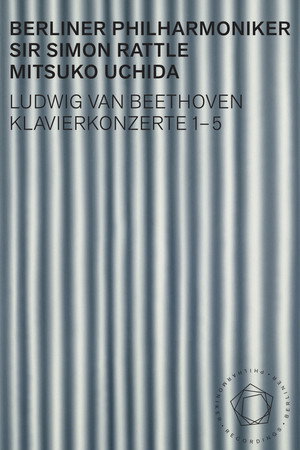
There is hardly a better way to approach Ludwig van Beethoven than through his piano concertos. Beethoven’s own instrument was the piano, and in his improvisations – which made him the darling of the Viennese salons – he merged virtuosity and unbridled expression. The piano concertos give a clear idea of these performances. At the same time, they are prime examples of Beethoven’s ability to create large orchestral works with seemingly endless arcs of tension. The complete recording of all five works with Mitsuko Uchida and Sir Simon Rattle was one of the most spectacular projects of the Berliner Philharmoniker during the Rattle era – and at the same time the highlight of the collaboration between the orchestra and the pianist, which began in 1984.
Beethoven Piano Sonatas Vol. 1
Beethoven Piano Sonatas Vol. 2
Beethoven Piano Sonatas Vol. 3
Shortly after WWII, the DEFA Studios produced a series of operas and operettas which belonged to the classical German musical heritage. This enchanting film, the very first opera production of DEFA, stands out because of its lavish decor and costumes, its outstanding actors and their masterful voices of that time.
In Anton Bruckner’s 7th Symphony, the listener encounters a music characterized by great spaciousness and profound solemnity, a music which speaks of grief and lamentation, but also of their transcendence. With its monumental architecture and intensity of sound, the symphony has moved listeners ever since its triumphal premiere in 1884. The Guardian calls Daniel Barenboim’s London interpretation “Tremendous … Barenboim and the Staatskapelle seem to have this work in their systems, and the overall impression was of music unfolding organically at its own pace rather than of a work being self-consciously interpreted or led.” Anton Bruckner Symphony No. 7 in E major (original version) Daniel Barenboim, conductor Staatskapelle Berlin Recorded live at the Philharmonie Berlin, 25 June 2010
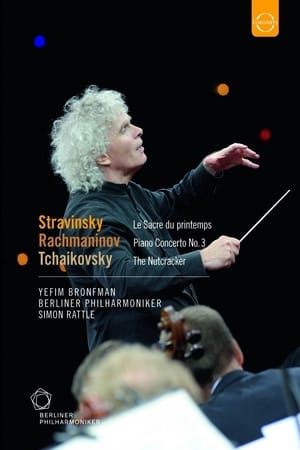
Every year, the Berliner Philharmoniker hold a kind of classical-music fête with a bright, cheerful concert to end the season. In 2009 about 22,000 people had come together at the Berlin Waldbühne to enjoy the traditional summer picnic concert. The theme of the evening was “Russian rhythms”, and star conductor Sir Simon Rattle, the Berliner Philharmoniker and Yefim Bronfman, one of the most famous pianists in the world today, presented a superb selection of Russian music. Repertoire Tchaikovsky: The Nutcracker, op. 71, Overture, The Christmas Tree, March, Pas de deux (Intrada) Rachmaninoff: Piano Concerto No.3 in D minor, op. 30 Stravinsky: Le Sacre du printemps Lincke: Berliner Luft