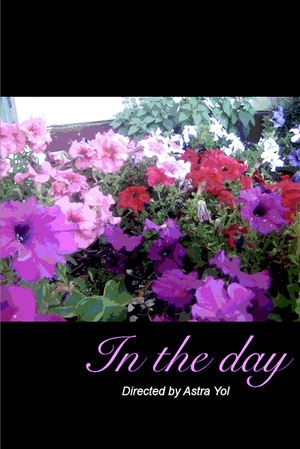
In the day three girls wander the idyllic St Kilda pier, basking in the rays of a sweet summer day.
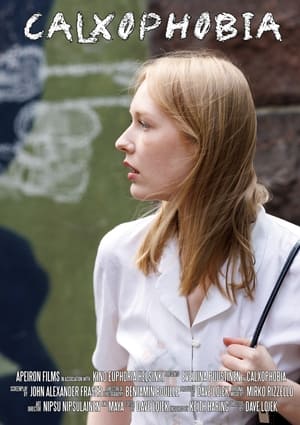
Helen suffers from a rare fear of chalk. One day she feels encroached by several chalk figures in Helsinki and decides to confront her fear. In the Amos Rex museum, she discovers the works of Keith Haring in a catalogue and adapts his style to her needs for catharsis.
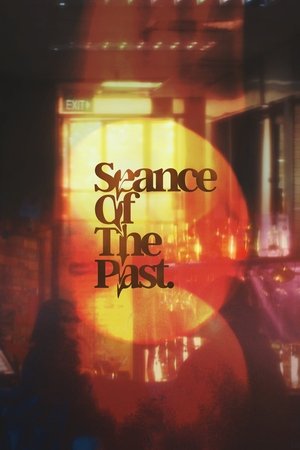
A person spends most of their life mourning the things they have lost, unable to move on. They frequent a silent but helpful medium and embark on a spiritual journey where they linger among their past lives.
In the aftermath of her friend's passing, an artist processes her grief by making a film. She weaves her personal archival footage and an unfinished science-fiction narrative into a deeply raw and emotive work of art.
An abstract mood piece that aims to cultivate existential anxiety, exploring the shape and purpose of both man-made and natural objects, while observing how they intersect and overlap.
An interpretation of the color Black.
The story of a young woman entering the world of filmmaking as assistant director to Bilge Olgaç and the two years they worked together. Through her diary, Belmin Söylemez explores what she learned from Bilge Olgaç, the most productive woman director in the history of Turkish Cinema. The film also gives us clues on filmmaking in Turkey in the late 80’s. From tough shooting conditions to 35 mm editing, we discover Olgaç’s world through her assistant’s eyes. ‘Bilge and Her Apprentice’ pays tribute to the life and work of Bilge Olgaç, who passed away in 1994.
A partial differential equation is illustrated by mathematician Tariah Gatlin.
Agnes was diagnosed with dementia in her fifties. Five years have passed and she is still struggling with her new identity, and the loss of who she once was. She decides to pay a visit to Nancy, who eight years ago was also diagnosed with dementia in her fifties. We follow Agnes in her quest for renewal and along the way our notions of what it means to have dementia are challenged and given a fresh perspective. A film about friendship and living with dementia.
A simple mans life who lives very close to the Estonian main transportation railroad. The constant vibrations that slowly disintegrate his house and the incredible loud noise are just a few things he has to deal with.
If his father had lived beyond the age of seventy-four, the following may have been the cinematic response to the city where in 1944, he last saw his family. Filmed in the mid-1980's, Lodz, Poland. Constructed in 2012, Florence, Massachusetts.
They have partied through their 20s. Now, Tamara, Ponek and Sierzput have to figure out what to do with their lives. Tamara is a feminist, but also a hopeless romantic. Sierzput has just won his girlfriend back, but is struggling to hold on to her. And out of sheer boredom, Ponek has broken her own rule number one and has started sleeping with her friends. Three lives, intertwined in a fog of cigarette smoke and canned beer during a long summer in concrete-grey Warsaw, where the desire to party to the early hours is never far away. The Danish director Karl Forchhammer’s film is an entertaining and existential tale with raw edges.
In just 80 minutes, this documentary takes us on an impressive journey, from the origins of the universe to the present time. On the program, the original Big Bang, the formation of the solar system and then of the Earth. The elements from the Big Bang then favor life on our planet. It develops, then mammals emerge, which lead to the appearance of Homo Sapiens. The viewer witnesses the arrival of the first civilizations, up to global conflicts and discovers how the acceleration of technical progress has led to today's world.
A documentary about the history of Argentine cinema, made with the intention of incorporating it into the Argentine Film Museum. The film includes excerpts from silent films, very useful for researchers of the subject.
Les passages de paris
Divadlo Svoboda
A high school editor loses all the footage of a film. As deadlines close in, the crew spirals into chaos. This is a film about making a film and learning the cost of finishing a movie.
Trafačka: Chrám svobody
Řepka: Hříšník
Filmed in his home in Paris one late summer, the philosopher and political figure Antonio Negri takes as a starting point a short story — a parable written by Marine Hugonnier — and transforms it into a political hypothesis. It is the story of a community of children who live in roofless houses in a world where two suns shine permanently. When an eclipse is about to take place, the children get scared. They are terrified as they do not know the darkness, they’ve never seen the stars. To cope with their fear, they decide to burn their houses to generate light. From there Antonio Negri weaves anecdotes, evokes Alexis de Tocqueville and Saint Francis of Assisi, protests against biopolitics and formalises arguments which reveal his unconditional engagement for activism, absolute democracy, the need to recreate communities, and his restless quest to find joy in the heart of “the multitude”.