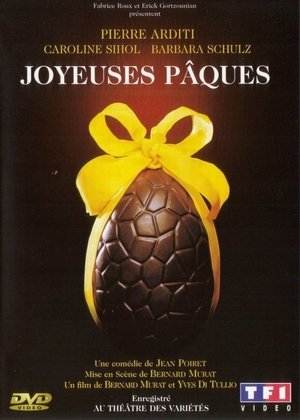
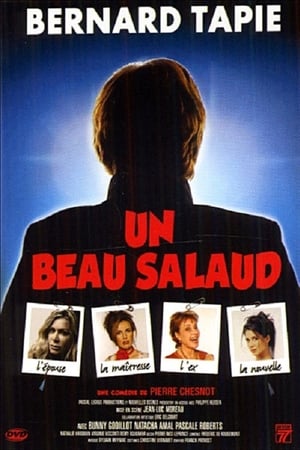
Charles Boulin decides to sell his small apartment on Avenue Foch to purchase a little hotel in the western suburbs of Paris. But the hotel happens to be a decaying house in Argenteuil. He wanted to surprise his wife and daughter, but it soon turns into a nightmare when they learn they have move into this shack, during the work, along with unscrupulous workers ...
Station Bonne Nouvelle
Luigiho srdce aneb Poprava tupým mečem
Tired of his wife's infidelities, Moliere rented a house in Auteuil, with his young protege, Michel Baron and his lifelong friend, Chapelle who invited a turbulent troop to dinner, that will mock/envy the jealous passion of the author.
Le Roi des Pâquerettes
L'Illusion conjugale
Au-delà des mers, rêve de théâtre
An overly spendthrift art gallery owner discovers at his own expense that his relatives, whom he thought to have cheated, are even more greedy than he.
"Love for Three Oranges" is the first play by Carlo Gozzi (December 13, 1720 - April 4, 1806). He wrote it in 1761. The play is based on a parody of the fairy tale "Love Against Three Oranges". It was originally written as canovaccio (the explanation of the content on which commedia dell'arte actors improvise the text), but later Gozzi also added some dialogue instructions and critical explanations.
Chante et tais-toi !
Le Clan des divorcées
Les Bodin's - Bienvenue à la capitale
A professional card player and swindler, Icharev, arrives in a small town with a plan to rip off some local jackdaw if possible. However, a trio of local, experienced swindlers have the same plan. They want to play cards with Icharev, but they immediately recognize each other's personalities. The fun continues, but the group regrets that they have no one to play with. There is a local landowner, Glov, but he avoids cards like the devil. And yet he is waiting for two hundred thousand rubles from the bank for the sold piece of land. Of course, the gentlemen will not miss their chance... A recording of a theatrical production by the Drama Club in Prague.
Cyrano de Bergerac is in love with his young cousin, Roxane, but does not dare to confess his love to her. It must be said that Cyrano's prominent nasal appendage attracts him constant mockery, which often forces him to defend his honor with weapons. When Roxane reveals to him that she loves the handsome Christian, a cadet of Gascony like Cyrano, the latter undertakes to take him under his protection. But the young man is cruelly lacking in spirit. It is therefore Cyrano who writes love letters to Roxane in her name, in which he expresses the ardent flame he also feels for his cousin. He even helps Christian to marry his beloved in secret. It is only years later and after having been the victim of an attack that Cyrano, on the verge of death, will finally declare his passion for her.
A man who accused a catholic bishop of abusing him when he was a child dies in the Austrian city Salzburg. Everyone except his widow and the eccentrical detective Simon Brenner keeps silent and believes that the man killed himself.
David Ireland's award-winning dark comedy about sectarian hatred in Northern Ireland. Eric Miller, a Belfast loyalist, mistakes his five-week-old granddaughter for Gerry Adams.
The Empty King created a mythical figure and a whole world from grotesque, archetypal images. The drama was originally conceived as a student tirade against a teacher at Jarry's school, the Lyceum of Rennes. This teacher, Hébert, was the target of public ridicule. In 1888, at the age of 15, Jarry wrote a puppet play about the exploits of the Woolly Tartar and staged it to the amusement of his friends. The figure of Übü is a crude, cruel caricature of the foolish, selfish bourgeoisie as seen through the unrelenting gaze of a schoolboy; but this Rabelaisian figure, in all his falstaffian greed and cowardice, is more than a mere social satire. It is a terrifying picture of man's animal nature, his evil and cruelty. The Katona József Theatre in Budapest premiered Jarry's play in 1984, and it ran continuously for more than 10 years.
GOLD. Der Film der Nibelungen
Les parents terribles
One of Shakespeare's greatest plays, The Winter's Tale, though written at the same period as The Tempest, smashes all the rules that The Tempest follows. Unity of time, place and action are hurled aside as we range across Europe, from court to country, from high tragedy to low comedy, across a time span of sixteen years. The Winter's Tale tells of a delusional and paranoid king who tears his family apart. But this is the new Shakespeare, after he completed his great tragedies, and the tough struggle for redemption yields flickers of hope. Initial darkness gives way to joy as Time leads the characters to a shattering conclusion...