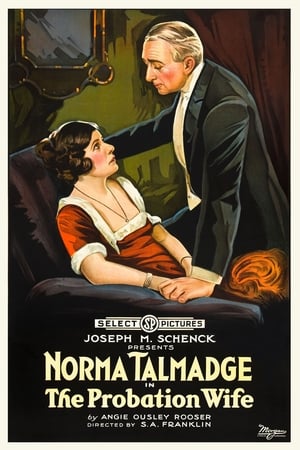
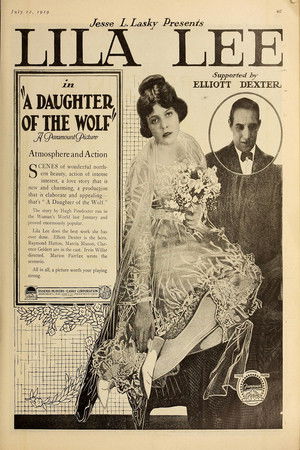
William Carter, a young Virginian in Paris, becomes enchanted with music hall dancer Fanchon La Fare. After William reluctantly returns to America, Fanchon follows him, and when she is threatened with deportation because of an irregularity in her passport, William marries her. The marriage causes consternation in the upright Carter family, which is compounded when Fanchon performs one of her dances at a church benefit. At the conclusion of her dance, Fanchon sees a stranger in the audience and faints. Later, the same man appears at the Carter residence and demands to see her. Leigh Carter, William's younger brother, becomes angered and shoots the man. At the trial, Fanchon confesses that the stranger was her estranged husband whom she had been forced to marry when she was but a child. The crime thus clarified, Leigh is freed, and Fanchon, who had been expelled earlier from the Carter house, is welcomed back by her husband and his family. (Courtesy TCM)
Nina, a blind girl, lives with her grandmother, who has taught her to make artificial flowers, which she sells at a flower-stand. Nina, and Jimmie, a crippled newsboy who sells papers on the same corner, are sweethearts. Nina's grandmother dies, and she turns to Jimmie. One day Jimmie has a fight with another newsboy, whom he thinks is hanging about Nina's stand too much, and the other boy is soon begging for mercy. Miss Fifi Chandler, an artist, happens to be passing, and becoming interested, she accompanies Nina and Jimmie to their rooms, and is surprised to find that Jimmie is an artist, having made a beautiful plaster cast of Nina. Fifi brings Jimmie and his protégé to the notice of her fellow artist, Fred Townsend, who falls in love with Nina.
Wee Lady Betty rules the O'Reilly castle with a stern hand and a big heart until she learns that Roger, the O'Reilly heir, is coming to take possession of his estate. Unable to provide for her aged father, Betty conceives of a scheme. Feigning to leave the castle, she returns after dark with her father and installs him in the haunted chamber.
Such a soul torments young composer Georg von Wergenthin, around whom the author creates a precise picture of the fin de siècle, its neuroses and its politics. Georg starts a relationship with a young singer, but does not confess to her in front of his friends, even when she becomes pregnant by him.
Caroline Rogers, a spirited young girl with a taste for highly romantic novels, comes home from boarding school to attend her sister Ethel's wedding. Having read a particularly lurid novel entitled Twin Souls recently, she arrives at the rehearsal wearing a daring gown in the hope of ensnaring a "soul mate." Because of his poetic name, Caroline becomes involved with Reginald Van Alden, a married fortune-seeker. On the morning of the wedding, she abandons her old sweetheart, Bob Worth, to take a ride with Reginald, but when he takes her to a disreputable roadhouse, she escapes and then tries to commit suicide by drinking cologne.
Young Celeste Janvier ( Bessie Love ) lives in an East Side tenement with her immigrant grandfather, a humanitarian and socialist. Like her kindly grandfather, Celeste also has a kindhearted soul, and her friendly nature has earned her the nickname, " the little sister of everybody."
The Hollisters, a bright, spirited, wholesome family, are compelled to move into the country. After many efforts to secure a home, Shirley, eldest of the Hollisters, contrives a way out by renting a magnificent old stone barn at a ridiculously low price, transforming it into a house. The owner of the barn is not an ordinary landlord, as you will see, for he is a young man with fine ideals, and he is not content with establishing Shirley and her family in the quaintly beautiful old place, but makes the world a much happier place to live in for all of them.
The second of Thomas Meighan's three 1927 vehicles, We're All Gamblers was also the first of two collaborations between Meighan and director James Cruze. Based on Lucky Sam McCarver, a play by Sidney Howard, the story concerns a refugee of the Lower East Side who rises to the uppermost rungs of the nightclub world, all for the sake of a "dame." Boxer Sam McCarver (Meighan) falls in love with society girl Carlotta Asche (Mariette Mische).
A Yankee Princess is a 1919 American silent comedy-drama film produced and distributed by the Vitagraph Company of America. It was directed by David Smith and stars Bessie Love, who also wrote the screenplay. It is a lost film.
The Spirit of the Lake is a 1921 American silent short Western drama film produced by Cyrus J. Williams and distributed by Pathé Exchange. It was directed by Robert North Bradbury and stars Tom Santschi, Bessie Love, and Ruth Stonehouse.
Young mother Mary Gordoon is too poor to take care of her infant daughter, Ann, and leaves the child at an orphanage. Ann grows up with a crippled leg in the orphanage, and has fallen in love with a fellow orphan, Jimmy.
The Purple Dawn is a 1923 American silent romantic drama film that was produced, written, and directed by Charles R. Seeling. Starring Bessie Love, Bert Sprotte, and William E. Aldrich. The film is presumed lost.
St. Elmo is a man who killed his romantic rival in a brawl. Traveling the world as a confirmed misogynist, St. Elmo returns to home and hearth only to fall in love with the daughter of the local blacksmith. The film is based on the 1867 novel of the same name written by Augusta Jane Evans. Today, St. Elmo is a lost film.
Young and spunky Alannah, an Irish immigrant living in a tenement, sells newspapers to support her family. She is soon helping a district attorney secure proof that the unjust town mayor is collecting bribes. For her reward, Alannah and her boyfriend Jimmy are appointed managers of a municipal restaurant.
The Vermilion Pencil is a 1922 American silent drama film directed by Norman Dawn, and produced and distributed by Robertson–Cole. It is based on the eponymous 1908 novel by Homer Lea. The film stars Japanese actor Sessue Hayakawa in multiple roles, and white actors Ann May, Bessie Love, and Sidney Franklin, all in Asian roles. It is now a lost film.
An unexpected pregnancy throws a young teen girl's life and reputation in throes.
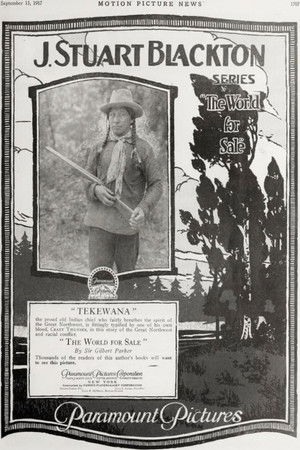
The Native American Siwash people have been displaced from their land and live on a reservation. The wealthy Mr. Boland attempts to buy the reservation from the Siwash for dubious reasons.
A Harp in Hock, also known as The Samaritan, is a lost 1927 American silent melodrama film directed by Renaud Hoffman, produced by DeMille Pictures, and distributed by Pathé Exchange. The film starred Rudolph Schildkraut, Junior Coghlan, May Robson, and Bessie Love, and was based on the short story by Evelyn Campbell.
In honor of his return from abroad, Mrs. Worthington invites her cousin, Brian Hartley, to dinner that evening, but forgets to tell him she has moved from her old address. He goes to the old home where he is met at the door by Celia Thayer, a guest of the Holbrooks, who now occupy the residence. None of the family being at home, Ceclia admits him, thinking he has been invited to dinner. When her hostess does not arrive the two have dinner together and become quite infatuated. Later it develops that the house was robbed while Mr. Hartley was there and, of course, he is suspected.
Gentle Julia is a 1923 American silent romantic drama film based on the popular novel Gentle Julia by Booth Tarkington. Directed by Rowland V. Lee, the film starred Bessie Love.