Prohibido Amar is a Mexican telenovela produced by Azteca in 2013. It is a remake of Colombian telenovela, La Sombra del Deseo.
Rosa is abandoned as a baby at a boarding school along with a payment of 18 white diamonds. Her mother is Rosaura Sotomayor, a distinguished socialite who needs to hide the fruit of her affair. Rosa grows up and befriends Eva Sotomayor, and both girls vow to live as sisters. Their lives change after they meet José Ignacio Altamirano, an attractive, intelligent and conquering man who takes advantage of Eva’s innocence. The rich heiress dies in a mysterious accident, and Rosa decides to take her identity to avenge her dear friend.
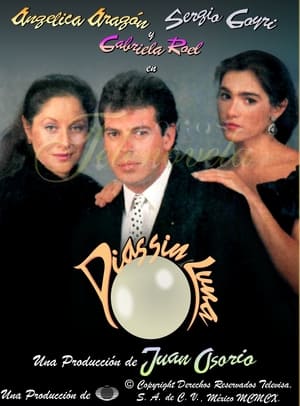
Días sin luna is a 1990 Mexican telenovela produced by Juan Osorio and directed by Rafael Banquells based on an original script by Eric Vonn. It was aired in Canal de las Estrellas Monday to Friday at 17:00 between May 14 and August 31, 1990.
El Alma Herida
Tu Voz Estéreo
Gente bien is a Mexican telenovela produced by Lucy Orozco for Televisa and originally broadcast on Canal de las Estrellas from April 28 to August 15, 1997. Created by Lucy Orozco, Antonio Serrano, and Humberto Robles, the telenovela stars Patricia Manterola and Mario Cimarro, with stellar performances by Helena Rojo, Ana Martín, and María Rivas. The story follows María Figueroa, a hardworking and honest young woman who is forced to leave her job after suffering harassment from her employer. She later begins working at the Dumas family's company, where she becomes involved in a world of power, corruption, and family conflicts. There, she meets Gerardo Felipe, an environmentalist fighting against illegal activities connected to the company, and together they face obstacles, betrayal, and the struggle to protect their love.
An Intelligence Agent is sent to El Principe, on the border with Morocco, to investigate a possible police collaboration with a terrorist cell but finds unexpected love in the least suitable person: a drug baron's sister.
After her parents death, the little Cecilia is under the care of her aunts: Natalia and Evangelina. Evangelina is a cruel woman who doesn't love the child and she treats her bad. Unlike Evangelina, Natalia is good and will help Cecilia because she is her real mother. She was seduced and got pregnant by Padre Julio. Evangelina hates Padre Julio because in the past he preferred Natalia to her. Many years later, there is a problem, because Evangelina doesn't want to give Cecilia money to attend the University. But Cecilia wins a grant and she can study now. She is engaged and wants to marry Giovanni, but Evangelina is against. She will poison him with a drink. Then Cecilia meets and falls in love with Gerardo, who is engaged to Sofia. Sofia's parents are Marta and Armando. Armando returns home after abandoning his family for many years. Marta has a romance with Manuel, but Sofia and Armando are opposed. Ines and Renato, who are Gerardo's parents, also are opposed to his romance with Cecilia. She breaks up the romance and goes to sor Angelina's nunnery to become a nun. Sonia and Roberto try to separate Gerardo from Cecilia. Then Cecilia finds out the truth about her birth and meets padre Julio. Natalia discovers that Evangelina tries to appropriate the whole patrimony of Cecilia and Evangelina kills her.
Story about a woman that is unhappily married and with two daughters. She constantly reprimands Cristina and baby Raquel. What the people around her don't know is that Raquel is not her husband's daughter as everyone believes. Raquel is Eugenia and León's daughter. She has always loved him, not her husband. That is the reason she's always angry at Cristina.
Esmeralda, whom everyone knows as "The Stray Cat," is a girl who grows up in wretched conditions, yet possesses a special sweetness and charm. Her best friend is Pablo, a wealthy boy who defends her against the other children's teasing.
La malquerida is a Mexican telenovela produced by José Alberto Castro for Televisa. It is an adaptation of the play "La malquerida", written by Spanish playwright Jacinto Benavente. Victoria Ruffo and Christian Meier will star as the adult protagonist, Ariadne Díaz and Mane de la Parra will star as the young protagonists, while Brandon Peniche will star as the main antagonist.
A former A-list actress gets another chance at stardom – and love – thanks to a rookie drama producer.
Una luz en el camino is a Mexican children's telenovela produced by Mapat L. de Zatarain for Televisa and originally broadcast on Canal de las Estrellas from March 30 to July 31, 1998. It is an adaptation of the Argentine children's telenovela El árbol azul (1991–1992), created by Mario L. Mortheo and adapted for Mexican television by Alejandro Orive and Carlos Daniel González. The story follows Luciana, a young girl who loses her mother at an early age and longs to have a loving family again. After meeting child psychologist Marcela, she becomes determined to bring her and her widowed father, Rodrigo, together. Along the way, they must overcome grief, misunderstandings, and the schemes of the ambitious Astrid, who seeks to marry Rodrigo for his fortune.
Canción de amor is a Mexican youth telenovela produced by Luis de Llano Macedo for Televisa and originally broadcast on Canal de las Estrellas from May 13 to September 13, 1996. It is an adaptation of the 1982 Argentine telenovela Los cien días de Ana, created by Osvaldo Dragún. The telenovela stars Eduardo Capetillo and Lorena Rojas. The story follows Ana Guzmán, a young woman whose life changes after she falls in love with Renzo, an aspiring rock singer, shortly after being diagnosed with leukemia. Determined to live every moment to the fullest, Ana supports Renzo's dreams while the couple faces love, illness, separation, and the emotional challenges that test the strength of their relationship.
The series follows 14-year-old Emma Alonso, as she moves to Miami and her life turns upside-down. Not only does she discover that she is a witch, she also has a crush on the boy next door, Daniel. But Daniel’s ex-girlfriend Maddie, who is an 'evil witch' and leader of the school clique the 'Panthers', is still willing to fight for the boy she loves.
Chepe Fortuna and Niña Cabrales are from different social classes. Chepe is a poor fisherman and Niña is from a wealthy family. He wants to become mayor to stop her wealthy family from building a port to industrialize the town. Niña is an ecologist and dissident from her family. She wants to help the community. Their love is brought together by dreams and the past, though they do not know it.
El amor no tiene precio is an American telenovela. It aired in 2005 until the series finale in 2006.
Infierno en el paraíso is a Mexican telenovela produced by Carlos Sotomayor for Televisa and originally broadcast on Canal de las Estrellas from June 21 to October 22, 1999. Created by Nora Alemán, with co-writing by Nora I. Sánchez and literary editing by Alejandra León de la Barra and Martín Támez, the telenovela stars Alicia Machado and Juan Ferrara, with Diana Bracho and Julieta Rosen as the main antagonists. The story follows Alejandro Valdivia, a wealthy tobacco plantation owner whose wife, Fernanda, disappears after a car accident and is presumed dead. Haunted by guilt, Alejandro eventually falls in love with the kind-hearted Marian Ordiales and marries her. However, as Marian settles into the Valdivia estate, she faces hostility from Alejandro's family and begins to suspect that Fernanda's disappearance hides a dark secret, leading to a story of love, betrayal, greed, and deception.
Rebeca murders her sister Adriana to end up with the man she loved, and becomes the step mother of her niece Lucía. Nora, Lucía's half sister and daughter of Rebeca, resents Lucía for the same reasons Rebeca hated Adriana, as history repeats itself.
La Viuda Negra is a 2014 Spanish-language telenovela produced by RTI Producciones and Televisa for United States-based television network Univisión and for Colombia-based television network Caracol Television. It is an adaptation of the book La patrona de Pablo Escobar de José Guarnizo based on history from Griselda Blanco.