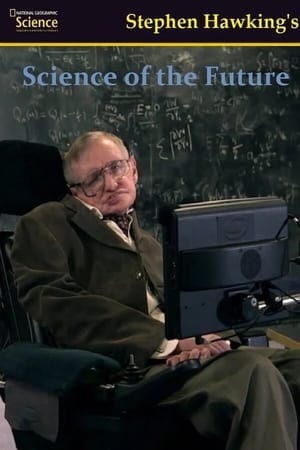
Stephen Hawking’s Science of the Future investigates the very latest game changing innovations. Each episode takes one area of progress and sends five top scientists out to actively test the inventions and breakthroughs that are driving it. The team explore human upgrades, the virtual world, bio-mimicry, high-tech emergency responses, and more. Featuring a wide range of examples, from advanced robotics and breathtaking digital actors, to cutting edge smart homes and electronic brain stimulation, the series reveals how science is delivering astonishing improvements to all our lives. Using the evidence they gather, the team reveals the year when each innovation will be rolled out for us all to benefit from, and Hawking then draws out his own uniquely insightful predictions about what our world will be like in the years to come.
In the series, "Wallace will take a light hearted and humorous look at the real-life inventors, contraptions, gadgets and inventions, with the silent help of Gromit. The series aims to inspire a whole new generation of innovative minds by showing them real, but mind-boggling, machines and inventions from around the world that have influenced his illustrious inventing career" (the BBC press statement). Peter Sallis reprised his role as the voice of Wallace. The filmed inserts are mostly narrated by Ashley Jensen, with one in each episode presented in-vision by Jem Stansfield. John Sparkes also voices a portion in the unseen character of archivist Goronwy.
The series investigates Paolo Macchiarini’s claims to have invented a ground-breaking method to create new organs. His method using plastic tracheas sown with stemcells has been operated on patients in the US, Russia, Sweden and the UK. So far, unfortunately, the track record of his plastic organs is not very good. Almost all patients are dead. And several of his former surgeon colleagues in Sweden claim that not only does the method not work, but that his scientific claim to fame is based on falsified and misrepresented data. Some even claim that his patients have been used as human guinea-pigs.
Using state-of-the-art technologies, Richard Hammond goes beyond the limits of the naked eye and explores the hidden secrets of the invisible world around us.
睡前消息合集
Dr Adam Rutherford explores the consequences of one of the biggest scientific projects of all time - the decoding of the entire human genome.
Zoboomafoo is an American children's television series that aired from January 25, 1999, to April 28, 2001, and is still shown today in syndication depending on the area, and it is regularly shown on PBS Kids Sprout. A total of 65 episodes were aired. A creation of the Kratt Brothers, it features a talking Coquerel's Sifaka, a type of lemur, named Zoboomafoo, or Zoboo for short, and a collection of repeat animal guests. Every episode begins with the Kratt brothers in "Animal Junction", a peculiar place in which the rules of nature change and wild animals come to visit and play. After January 16, 2004, the show was pulled from its weekday airing on most PBS stations, though some continue to air the show.
The Really Wild Show was a long-running British television show about wildlife, broadcast by the BBC as part of their CBBC service to children. It also runs on Animal Planet in the US. The show was broadcast continuously since 21 January 1986. In April 2006 the BBC announced that the show would be axed that summer, and as such the last ever episode was shown in April 2006, giving the show a run of 20 years.
A lecture series about the basic problems of flight, explained by visual presentation of flow experiments. As the material of the lectures should be understood by every interested listener, no mathematical or other theoretical knowledge is used for explanation. Every problem is demonstrated by a true-life experiment and purely scientific language is avoided. Each of the lectures deals with a basic problem of flight. The experiments are mostly shown as flow picture but at certain points scale models and flying models are used to ensure easier understanding.
Extremely popular with French audiences, Jamy Gourmaud made science accessible to all with the cult programme “C’est pas sorcier” (It’s not rocket science). Today, he travels all over the world with journalist Églantiné Éméyé to demystify the world around us: climate change, food, road safety, air traffic, animal intelligence…even fireworks and roller coasters! Filled with funny, lively experiences, explanatory 3D images and breathtaking landscapes, “Jamy’s World” is the go-to, popular science show.
Newton's Apple is an American educational television program produced and developed by KTCA, and distributed to PBS stations in the United States that ran from 1983 to 1999. The show's title is based on the rumor of Isaac Newton sitting under a tree and an apple falling near him—or, more popularly, on his head—prompting him to ponder what makes things fall, leading to the development of his theory of gravitation. The show was produced by Twin Cities Public Television. For most of the run, the show's theme song was Ruckzuck by Kraftwerk, later remixed by Absolute Music. Later episodes of the show featured an original song. An occasional short feature appeared called "Science of the Rich and Famous" in which celebrities appeared to explain a science principle.
A nine part television series, produced by J.C. Crimmins for PBS. Music composed, arranged and performed by Pat Metheny and Lyle Mays. The stated purpose of “The Search for Solutions” is to stimulate interest in science and technology, primarily among the young. The film comprises nine 18-minute sections touching on various aspects of scientific inquiry that its makers say can be shown as a whole, as it is in this engagement, or in any combination of its parts.
Professor Brian Cox reveals how the fundamental scientific principles and laws explain not only the story of the universe but also answer mankind's greatest questions.
Geologist Iain Stewart retraces the steps of a band of maverick pioneers who made ground-breaking discoveries in the landscape of Scotland about how our planet works.
Documentary series tracing mankind's exploration of our solar system.
Bill Nye explores science and its impact on politics, society and pop culture. Each episode tackles a topic from a scientific point of view, dispelling myths, and refuting anti-scientific claims that may be espoused by politicians, religious leaders or titans of industry.
NOVA scienceNOW is a News magazine version of the long-running and venerable PBS science program Nova. Premiering on January 25, 2005, the series was originally hosted by Robert Krulwich, who described it as an experiment in coverage of "breaking science, science that's right out of the lab, science that sometimes bumps up against politics, art, culture". At the beginning of season two, Neil deGrasse Tyson replaced Krulwich as the show's host. Tyson announced he would leave the show and was replaced by David Pogue beginning season 6.
From renowned author, educator and television presenter Ted Rimmarniet comes "Our Fascinating Planet", an exciting new educational series that explores our Universe and ourselves - and our place in both of those things. Featuring episodes on Space, Energy, The Brain and The Earth, this staggeringly monumental series contains all of the passion, wonder and curiosity of award-winning programs like “NOVA" but with double or triple the amount of fascinatingness.
Pandora's Box is a six-part 1992 BBC documentary television series which examines the consequences of political and technocratic rationalism. The episodes deal, in order, with communism in The Soviet Union, systems analysis and game theory during the Cold War, economy in the United Kingdom during the 1970s, the insecticide DDT, Kwame Nkrumah's leadership in Ghana during the 1950s and 1960s and the history of nuclear power.
Alberto Angela leads the dissemination program dedicated to history, art and culture. A historical, archaeological, informative story, with the presence of some protagonists of the Italian cultural or artistic scene.