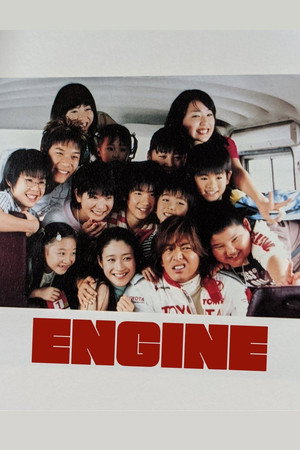
Makoto is a promising oarsman at a University regatta team. One day, he loses his best friend by a tragic accident which he believes and blames himself for the very cause. Although he once leaves the team out of tremendous sense of responsibility, he finally decides to return by the encouragement of Misao and his teammates, and moreover, for the love and passion of regatta. He is determined than ever to become a top class oarsman and struggles to fulfill his dream to participate in the Olympic games. Through the severe practices and competitions of regatta, Makoto learns the bitterness and difficulties of life. Rivalry with teammates, agonies of love and friendship.
Hoshino Asuka is dumped by her boyfriend, who is a colleague at the same workplace, on her 25th birthday. To make matters worse, her apartment catches fire and she can't return to live in it. Asuka finds herself wishing for happiness and the elephant god Ganesha suddenly appears. He had lived with Nogami Kohei in that apartment several years ago. With the appearance of Ganesha, Asuka learns what true happiness is.
Ball Four is a 1976 American situation comedy that aired on CBS in 1976. The series is inspired by the 1970 book of the same name by Jim Bouton. Bouton co-created the show with humorist and television critic Marvin Kitman and sportswriter Vic Ziegel. Bouton also starred in the series. Ball Four followed the Washington Americans, a fictitious minor league baseball team, dealing with the fallout from a series of Sports Illustrated articles written by Americans player Jim Barton. Like the book, the series covered controversial subjects including womanizing players, drug use, homosexuality in sports and religion. The series included a gay rookie ballplayer, one of the earliest regular gay characters on television. The trio began developing the series in 1975, looking to other series like M*A*S*H and All in the Family as models. CBS expressed interest and the creative team developed a script. CBS shot the pilot episode and ultimately bought the series. Ball Four aired at 8:30 PM Eastern time, which was during the Family Viewing Hour, an FCC-mandated hour of early evening "family-friendly" broadcasting. Consequently the writers had some trouble with the network's Standards and Practices in their attempt to portray realistic locker room scenes, especially the language used by the players. Pseudo-profanity such as "bullpimp" was disallowed, while "horse-crock" and "bullhorse" were approved.
Haru Satonaka is the captain of an ice-hockey team, a star athlete who stakes everything on hockey but can only consider love as a game. Aki Murase is a woman who has been waiting for her lover who went abroad two years ago. These two persons start a relationship while frankly admitting to each other that it is only a love game. …The result is the unfolding of a drama of people with their respective pasts and with their pride as individuals.
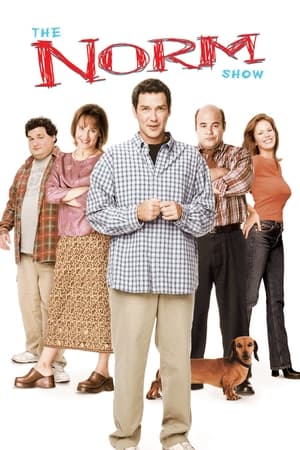
Drew is an assistant director of personnel in a Cleveland department store and he has been stuck there for ten years. Other than fighting with co-worker Mimi, his hobbies include drinking beer and not being able to get dates. To make a few extra bucks he has a micro-brewery going in his garage with his buddies.
Blue Water High is an Australian television drama series, broadcast by the Australian Broadcasting Corporation on ABC1 and on Austar/Foxtel Nickelodeon channel in Australia and on various channels in many other countries. Each season follows the lives of a young group of students at Solar Blue, a high-performance surf academy where several lucky 16-year-olds are selected for a 12-month-long surfing program on Sydney's northern beaches. There are three series in Blue Water High. The first two series were screened in 2005 and 2006 and the producers did not intend to create a third series. However, due to popular demand by fans, they relented and made one more series with only Kate Bell returning in a main role. Series three ended with the closure of Solar Blue, indicating that the show would most likely not continue.
The story about a blue-collar Boston bar run by former sports star Sam Malone and the quirky and wonderful people who worked and drank there.
Good Company is an American television sitcom that aired on CBS on Monday nights from March 3, 1996, to April 15, 1996. The series is set at the offices of Blanton, Booker & Hayden Agency, a Manhattan ad agency.
The Waverly Wonders is a short-lived TV sitcom, starring retired pro football star Joe Namath, that lasted less than a month on NBC in 1978.
The Brittas Empire is a British sitcom created and originally written by Andrew Norriss and Richard Fegen. Chris Barrie plays Gordon Brittas, the well-meaning but incompetent manager of Whitbury New Town Leisure Centre. The show ran for seven series and 53 episodes — including two Christmas specials — from 1991 to 1997 on BBC1. Norriss and Fegen wrote the first five series, after which they left the show. The Brittas Empire enjoyed a long and successful run throughout the 1990s, and gained itself large mainstream audiences. In 2004 the show came 47th on the BBC's Britain's Best Sitcom poll, and all series have been released on DVD. The creators Andrew Norriss and Richard Fegen often combine farce with either surreal or dramatic elements in episodes. For example in the first series, the leisure centre prepares for a royal visit, only for the doors to seal, the boiler room to flood and a visitor to become electrocuted. Unlike the traditional sitcom, deaths were quite common in The Brittas Empire.
This comedy series, which follows the exploits of employees at London's fictional "Grace Brothers" department store, is full of sexual innuendo, slapstick, visual gags, and double entendres. Much of the show's humor parodies Britain's class system, and many of the show's characters are based on stereotypes of the period, including the effeminate Mr. Humphries and the rich, but stingy, store owner.
A behind-the-scenes look at the glitzy, big-money world of professional sports following the eternally optimistic and endlessly resourceful L.A. sports agent Arliss Michaels whose Achilles' heel is his inability to say “no” to clients and employees.
Claude Casey moved up in the secretarial world of television news, from temp to the anchor's desk. After her boss hires her full time, Claude realizes she may be in over her head in this world of assistants fighting to get ahead. But Claude is determined to prove that though she may not be perfect, she's not going down without a fight.
A sportscaster becomes a full-time dad when his ex-wife decides to accept a job out of the country and his teenage daughter, Breanna, moves in with him.
Arnie is a television sitcom that ran for two seasons on the CBS network. It stars Herschel Bernardi, Sue Ane Langdon, and Roger Bowen. Bernardi played the title character, Arnie Nuvo, a longtime blue collar employee at the fictitious Continental Flange Company, who overnight was promoted to an executive position. The storylines mainly focused on this fish out of water situation, and on Arnie's sometimes-problematic relationship with his well-meaning but wealthy and eccentric boss, Hamilton Majors Jr.. Because he still held his union card, Arnie could negotiate tricky management/labor situations that no one else could. Arnie's surname was presumably a pun on nouveau riche, and possibly also on Art Nouveau. In addition to Bernardi, Bowen, and Langdon, cast members included Del Russel and Stephanie Steele as Arnie's son and daughter, Richard and Andrea; Elaine Shore as Arnie's secretary, Felicia; and Herb Voland as sour-tempered executive Neil Ogilvie. In its first season, despite being the lead-in to The Mary Tyler Moore Show on Saturday nights and winning an Emmy nomination as best comedy series, Arnie received only fair Nielsen ratings. For its second season, in order to increase its viewership, CBS made a major cast change in the show's format. Charles Nelson Reilly joined the cast as Randy Robinson, a TV chef who called himself "The Giddyap Gourmet," apparently a reference to The Galloping Gourmet.
Soccer AM is a British Saturday-morning football-based comedy/talk show, predominantly based around the Premier League. Originally presented by Jane Hoffen, Gary Stevens and Russ Williams, they lasted just a year before Helen Chamberlain and Tim Lovejoy replaced them, where Lovejoy served for over a decade. He has since been replaced by Andy Goldstein and, more recently, Max Rushden. The show has been aired on Sky Sports 2 each Saturday morning of the football season since 1995 from 7:00am or 9:00am to noon originally and currently between 10:00am and 12:00pm. In early 2009, the 500th episode was broadcast. Although the show is filmed live from 2010 it has been broadcast on a momentary delay due to bad language and/or inappropriate content from certain guests. The show's current sponsor is Procter & Gamble through their Head & Shoulders brand. The show was previously sponsored by Frijj, a brand of milkshake, after Dairy Crest signed a £2 million sponsorship deal. Parts of the show have remained since the beginning, whilst new items have been introduced each season. In that respect, it is almost the same every week, the difference being new football footage and comedy skits. Every week sees a new group of celebrity guests, generally featuring at least one footballer who is free on the Saturday, and a mix of musicians, TV personalities, and other sportsmen.
Alice is an American sitcom television series that ran from August 31, 1976 to March 19, 1985 on CBS. The series is based on the 1974 film Alice Doesn't Live Here Anymore. The show stars Linda Lavin in the title role, a widow who moves with her young son to start her life over again, and finds a job working at a roadside diner on the outskirts of Phoenix, Arizona. Most of the episodes revolve around events at Mel's Diner.
Brody, a young hot-shot banker at Whitestone Trust, thought he was just having a one-night stand with Jennifer, a beautiful woman he met at a bar. But when he discovers that she works in maintenance for the building where he works, their worlds begin to collide in the most unexpected way. Facing Brody’s critical boss, Mr. Mansfield, as well as annoyed colleagues, the pair must find a way to deal with their growing feelings for each other in this modern take on Romeo & Juliet.
Following the adventures of a bunch of nobodies who get up to a whole lot of nothing in the fictional prairie town of Dog River, Saskatchewan, Corner Gas focuses on the life (or lack thereof) of Brent LeRoy, proprietor of a gas station that is the only stop for miles around and a hub of action on the Prairies.
Dinnerladies is a BBC sitcom written by and starring Victoria Wood that chronicles the antics of a group of workers in a canteen in the north of England. Bren tries to maintain a semblance of order in amongst the chaos, while dealing with the canteen supervisor, slightly sex-obsessed cancer sufferer Tony. Dolly and Jean are the bickering menopausal older women, always at odds but best friends beneath it all. Then there's thick-as-two-short-planks Anita, and the terminally uninterested Twinkle, more concerned with having a good time than anything else. Making up the motley crew are military man handyman Stan, all rules and regulations, and ditzy Philippa, who never seems to get anything right.