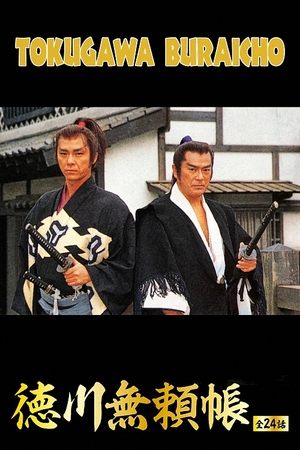
We're in Shamisen-bori of the bustling city of Edo. The officers of Guardhouse 36 monopolize the popularity in Edo. They're strong against evil, soft in compassion. Even the shogun depends on them. They're called the “Kirisute Bansho”... with a right to kill.
Kōchiyama Sōshun serves as a cha-bōzu (He is kind of tea man) in the administrative headquarters of the Tokugawa shogunate but he works behind the scene to protect powerless people from evil power of Tokugawa shogunate. Kataoka Naojirō and Ushimatsu work for Kōchiyama. Kaneko Ichinojō is a ronin whose interests often align with Kōchiyama
Heiji is an undercover policeman in the city of Edo. He possesses a superior skill of throwing coins. When a criminal is caught, Heiji throws coins at the offender and reveals his true identity. Like “Abarenbo Shogun,” “Mito Komon” and “Toyama no Kinsan,” “Zenigata Heiji” is about an official working undercover to catch criminals. The hero was created by novelist Kodō Nomura in 1931.
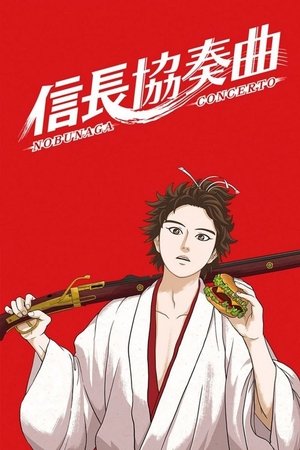
Saburo is a high school student good in sports, but not very good with his studies. One day, Saburo travels back in time and arrives in the Sengoku period of 1549. There, Saburo meets Nobunaga Oda who looks and sounds just like Saburo. Nobunaga Oda is the son of a warlord and magistrate of the lower Owari Province. Nobunaga Oda, though, is physically weak, and he asks Saburo to take his place. Then, Saburo as Nobunaga Oda attempts to unify the country of Japan.
Osome is an ex-actress who lost her parents in a fire when she was 6-years old. She then is separated from her older brother, who goes missing. While she tries to investigate the fire that killed her parents, an officer, Yoshikawa reveals that her father used to be a shogunate spy. Osome decides to become a spy herself under Yoshikawa, to find the man who killed her parents and to seek out her lost brother.
宮本武蔵
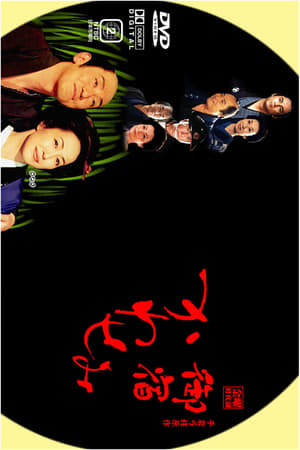
At the end of Edo period, Shoji Rui hands over her birthright to her relatives with the death of her father and begins running an inn "Kawasemi" in Ōkawabata. And she settles the matters in their daily lives with her lover Kamibayashi Tōgo, doshin (a sort of constable) Une Genzaburō, physician Amanō Sotarō, and O-Kichi.
The main character, Hanbei Hinata, who plays Mizutani, is a direct hatamoto guardian who guards Edo Castle. While working honestly on that mission, he became disgusted by a colleague who only thought about his career advancement, and soon he abandoned all his desires and began to think about a retired life
After the Onin War, the world is plunged into chaos. Amid this situation, heroes of the warring states begin to emerge in an attempt to unify the country and rule in these turbulent times. In the mid-1540s, there is a young wandering samurai in Mino which is strategically located between the East and West. His name is Akechi Mitsuhide. At this time, there is plenty of internal strife within the Toki clan which rules Mino. Surrounded by the Oda of Owari, the Imagawa of Suruga and the Asakura of Echizen, Mino has constantly faced the risk of invasion. Mitsuhide is pulled into battle and destroys the enemy. His bravery as well as stratagem catches the attention of Saito Toshimasa, the chief retainer of the Toki clan, and he is singled out. This man who is also known as Saito Dosan will go on to takeover the Toki and make Mino his own.
Mai Otonashi is a second-year student and the captain of the Ikkokukan High School Bowling Club, and recently, she's struggled to win. Whenever she scores a Turkey, three consecutive strikes, she follows it up with an unbeatable split—the Snake Eyes. This is the story of Mai, Rina, Sayuri, Nozomi, and Nanase as they fight, fall, and rise again in pursuit of victory in the final days of summer.
Saburo is a high school student good in sports, but not very good with his studies. One day, Saburo travels back in time and arrives in the Sengoku period of 1549. There, Saburo meets Nobunaga Oda who looks and sounds just like Saburo. Nobunaga Oda is the son of a warlord and magistrate of the lower Owari Province. Nobunaga Oda though is physically weak and he asks Saburo to take his place. Then, Saburo as Nobunaga Oda attempts to unify the country of Japan.
The life of Katsu Kaishū and his father.
Based on Kazuo Koike's extensive manga (over 110 volumes), this Edo-period drama follows an unlikely pair of law enforcement officers. One is a serious, skilled investigator, while the other is a witty, unconventional problem-solver, creating a dynamic partnership. The series also features the charmingly unorthodox detective Suruyoshi in a notable period drama debut. A memorable and catchy soundtrack complements the engaging stories brought to life by a large and talented cast.
In Edo, a determined young swordsman, Chiba Shūsaku, joins a dojo to pursue his dream. He forges strong friendships with fellow students, including one who works for a magistrate. As Shūsaku trains under a respected master, he faces challenges both within the dojo and in the city, growing as a swordsman and navigating the vibrant Edo society.
Based on the novel of the same name by Jiro Ikushima, this drama series aired on NET TV (now TV Asahi) in 1972 for a total of 26 episodes. Starring the talented actor Kinnosuke Yorozuya, who had previously shown his skills in various period films such as "Mabuta no Haha," "Seki no Yatappe," and "Kutsukake Tokijiro: Yoyo ichi-hiki," the show follows the tragic hero and is sure to captivate audiences with its compelling storyline. Viewers are sure to be drawn into the drama and root for the protagonist as the story unfolds.
Katsu Kaishū deals with end of the Edo period. Based on Kan Shimozawa's novels "Katsu Kaishū "
The 38th NHK Taiga Drama is Genroku Ryoran. The "Forty-seven Loyal Samurai" is one of the most enduring and best loved stories of Japan's history. Generations have grown up hearing the stirring tale of Oishi Kuranosuke, chief councillor of the Ako clan who leads his men through suffering and hardship to ultimately avenge their lord after he is unjustly forced to commit harakiri. NHK's 38th Taiga Drama "Genroku Ryoran" is the ambitious remake of this classic epic and boasts a cast that reads like a Who's Who in Japanese entertainment.
The 36th NHK Taiga Drama is Mori Motonari. This series chronicles the life of Mori Motonari, a warlord of the early 1500s who stood at the vanguard of the Warring States era. All Japanese school textbooks contain the Mitsuya no kyokun, Mori's famous lesson to his three sons that teaches that while one arrow is easily broken, three arrows together cannot be broken. In 1997, 500 years after his birth, NHK dramatizes Motonari's rise from a chief of the region of Aki (now Hiroshima) to a daimyo who rules over ten provinces of the Chugoku region. Motonari was 64 years old and already the patriarch of a powerful dynasty about the time Oda Nobunaga and Takeda Shingen appeared on the scene. And even after his death, the Mori family figured prominently in Japanese history. His grandson Terumoto became a loyal Toyotomi vassal. Defeated at the Battle of Sekigahara, Ieyasu confiscated most of his lands, leaving him only with Suwo and Nagato, later known as Choshu. But 260 years later, the Mori got their ultimate revenge, leading the imperial forces against the Tokugawa in the Meiji Restoration.
The straightforward samurai of the hatamoto class, Saotome Mondonosuke, who has a crescent-shaped scar on his forehead, is known as the "Boring Samurai" because of his idleness. Whenever any incident occurs, he appears in his flashy attire and punishes the evildoers with his fighting skills....
Shadow Warriors is a Japanese television jidaigeki show featuring Sonny Chiba that ran for four seasons in the early 1980s. Chiba played different ninja characters in each series. In the first series he played Hattori Hanzō III, in second one he played Tsuge Shinpachi, in the third one he played Tarao Hanzō, in the fourth series and in Bakumatsu Hen, he played Hattori Hanzō XV. In the 2003 direct-to-DVD series Shin Kage no Gundan he played Hattori Hanzō I.