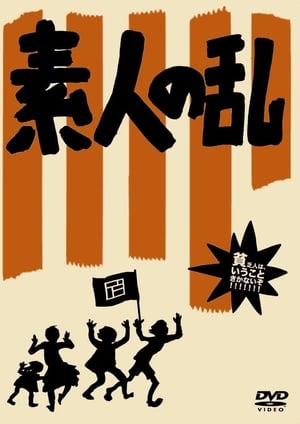
Kim Chang-in, a self-proclaimed ‘democratic socialist,’ and Kim Hyun-jin, who calls himself an ‘extremely centrist person,’ are ordinary young people in South Korea. While Chang-in became interested in politics because he was angry at the sight of bleeding workers at the Ssangyong Motors strike, Hyun-jin was angry at tax money being wasted on populist policies such as minimum wage and work incentives and decided to go into politics.
In Russia, criticizing the war in Ukraine or Vladimir Putin’s regime has become a crime. Thousands of ordinary citizens are being arrested, tried, and imprisoned. They are called “Politzek”: political prisoners. Filmed clandestinely over the course of more than a year, Politzek gives a platform to those who, despite the fear, continue to speak out against Putin’s repressive Russia. Through the intersecting stories of a teenager sentenced to five years in prison for criticizing the government on social media, a young artist jailed for placing anti-war stickers, a human rights activist, and two theater directors facing Kafkaesque trials, the film unveils the machinery of state repression in Russia. With rare footage, broken yet unyielding voices, this is a story of silenced resistance.
Following the 1974 French presidential campaign with Valéry Giscard d’Estaing.
The untold true story of how Dave Tomkins, originally a safe-cracker from London, rose from small-time criminal to international mercenary and arms dealer, enabling death and destruction around the world.
Pierre Bérégovoy, la tragédie du pouvoir
Commissioned by the journal Présence Africaine, this short documentary examines how African art is devalued and alienated through colonial and museum contexts. Beginning with the question of why African works are confined to ethnographic displays while Greek or Egyptian art is celebrated, the film became a landmark of anti-colonial cinema and was banned in France for eight years.
Tracking missing socks in the European Union.
David Grubin's probing and perceptive biography reassesses the remarkable and tragic life of Bobby Kennedy, whose early life was spent in the shadow of his elder brother John. After JFK's assassination, he discovered his own identity in the forefront of American politics before his career was also tragically curtailed by an assassin's bullet.
Jean-Luc Godard brings his firebrand political cinema to the UK, exploring the revolutionary signals in late '60s British society. Constructed as a montage of various disconnected political acts (in line with Godard's then appropriation of Soviet director Dziga Vertov's agitprop techniques), it combines a diverse range of footage, from students discussing The Beatles to the production line at the MG factory in Oxfordshire, burnished with onscreen political sloganeering.
In their feature film debut, CARTERLAND, the Pattiz Brothers examine the tragic, yet inspiring story of America's most misunderstood president. While leading the nation through a series of unprecedented crises, Jimmy Carter also confronted climate change and championed social justice at home and abroad. This groundbreaking film draws on archival footage, experts, and insiders to reveal how Carter's selfless leadership and moral integrity ultimately cost him the presidency.
Captures the incident of January 6, 2021, when scores of Trump supporters clashed with police, interrupting a constitutional process by Congress to affirm the victory of the then President-elect Biden and Vice President-elect Kamala Harris in the election.
Looking back at the history of the struggle for true equality, we follow the daughters and sons of immigrant workers who have been nominated as candidates representing "diversity" in various election campaigns since the 2007 presidential election. On the ground, through meetings, debates, and more "intimate" encounters with candidates and actors from past struggles, a great diversity of thought emerges. But they all have the same goal: not to be just "candidates for Beurs." With many activists from working-class neighborhoods, from Clichy-sous-Bois to Marseille, via Roubaix, and candidates Mouloud Aounit, Kamel Hamza, Faouzi Lamdaoui, Halima Boumedienne, Omar Slaouti, Samia Ghali, Karim Zeribi, Rama Yade, and others... Will these "new faces" of the Republic be in the picture when the votes are counted, or will they simply be "candidates for the Beurs"?
In the 1968 movement in Paris, Jean-Luc Godard made a 16mm, 3-minute long film, Film-tract No.1968, Le Rouge, in collaboration with French artist Gérard Fromanger. Starting with the shot identifying its title written in red paint on the Le Monde for 31 July 1968, the film shows the process of making Fromanger’s poster image, which is thick red paint flows over a tri-color French flag. —Hye Young Min
Amid the civil-military dictatorship implanted with the 1964 coup, Sergio Muniz had the idea of making a documentary about the action of the Death Squad. At the time, the press still had some freedom to disseminate the work of these death squads formed by police officers of various ranks, and that he acted on the outskirts of cities like Sao Paulo and Rio de Janeiro. The victims of police repression (as today) were men, poor and black, and this condition is supposed criminals.
Five women veterans who have endured unimaginable trauma in service create a shared sisterhood to help the rising number of stranded homeless women veterans by entering a competition that unexpectedly catalyzes moving events in their own lives.
Wars of the future will be fought over water as they are over oil today, as the source of human survival enters the global marketplace and political arena. Corporate giants, private investors, and corrupt governments vie for control of our dwindling supply, prompting protests, lawsuits, and revolutions from citizens fighting for the right to survive.
Boogie Man is a comprehensive look at political strategist, racist, and former Republican National Convention Committee chairman, Lee Atwater, who reinvigorated the Republican Party’s Southern Strategy to increase political support among white voters in the South by appealing to racism against African Americans. He mentored Karl Rove and George W. Bush and played a key role in the elections of Reagan and George H.W. Bush.
Paul Robeson: Here I Stand presents the life and achievements of an extraordinary man. Athlete, singer, and scholar, Robeson was also a charismatic champion of the rights of the poor working man, the disfranchised and people of color. He led a life in the vanguard of many movements, achieved international acclaim for his music and suffered tremendous personal sacrifice. His story is one of the great dramas of the 20th century, spanning an international canvas of social upheaval and ideological controversy.
At the peak of Perestroika, in 1987, in the village of Gorki, where Lenin spent his last years, after a long construction, the last and most grandiose museum of the Leader was opened. Soon after the opening, the ideology changed, and the flow of pilgrims gradually dried up. Despite this, the museum still works and the management is looking for ways to attract visitors. Faithful to the Lenin keepers of the museum as they can resist the onset of commercialization. The film tells about the modern life of this amazing museum-reserve and its employees.
This documentary profiles economist and writer Marilyn Waring. In extensive interviews, Waring details her feminist approach to finances and challenges commonly accepted truths about the global economy. The filmmakers detail Waring's early rise to political prominence and her successful protests against nuclear arms. Waring also speaks candidly about wartime economies, suggesting that government policies tend to marginalize the fiscal contributions of women.