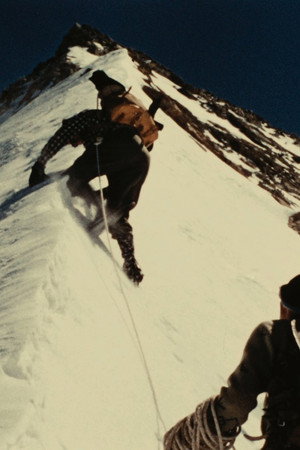
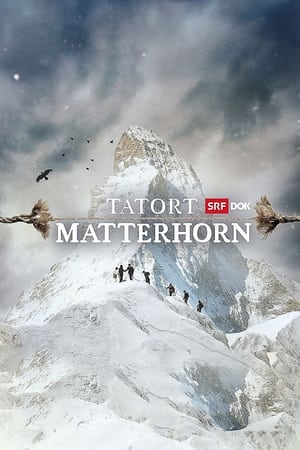
The first filmed winter ascent of the north face of the Matterhorn. To set the scene, the tragic story of Edward Whymper's first ascent is skillfully pieced together. The modern expedition, a team of three British climbers, is also plagued with epics: Eric Jones is hit by an avalanche and can only come to a dangerous stop at the edge of a 1000 foot drop. Then the worst storm ever recorded in Zermatt hits the Matterhorn. With time and weather against them, the team is forced to climb in the dark as thunderstorms rumble around them. This adventure captures the skill and courage of the climbers, their agony and tension, and the beauty of the assault on this spectacular mountain. Grand Prize at the Les Diablerets festival (Switzerland) in 1976.
Twelve talented young mountaineers, five geologists from the University of Lausanne and four mountain guides take an unprecedented risk in Patagonia. Trained by the great climbers Ralf Weber, Ueli Steck, Denis Burdet and David Fasel, the young people are collecting rock samples from the granite walls of the Paine Towers, which are up to 1000 meters high, on behalf of science. The challenges are enormous: Climbing a big wall at the highest level of difficulty, cloudy weather, relentless wind that tears at material and nerves - and an urgency that also pushes the group to their emotional limits. "Flying High" not only documents an extraordinary undertaking, but also shows up close what happens when something happens that can happen after every meter of altitude climbed: a fall.
Documentary about eating disorders among professional climbers
Jim Geiger, a retired forest ranger and amateur mountaineer, attempts to become the oldest American and first great grandfather to summit Mt. Everest, aged 68. His transformation from a weekend hiker to attempting one of the most extreme and physically demanding feats known to man is driven by a desire to prove that age is just a number. What ensued, however, forever changed Jim's life.
The dramatic story of the British expedition that made the first ascent of Everest. Combining interviews with the surviving members of the 1953 British and 1952 Swiss attempt on Everest with rare archival material, this film tells the story of the race to climb Everest in the early 1950s and its climax in 1953.
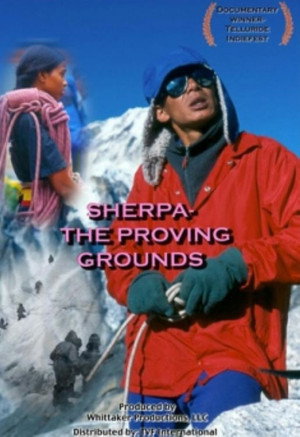
Transcending cultural barriers and consistently going against the grain, female Nepali climber Pasang Lhamu Sherpa attempted to summit Everest four times in the early nineties. Although she was not allowed to attend school as a child, Pasang did not let that stop her from pursuing her dreams. After founding her own trekking company in Kathmandu, she blazed a trail for Nepali women via her efforts to summit Everest. Proving how big you can dream and how far you can go to achieve those dreams, she left a legacy not only for the family she has left behind, but for the myriad women following in her footsteps.
Becoming a mountaineer and climbing Everest in exactly one year? That’s the dream of Inoxtag, a 21-year-old very rich YouTuber who doesn’t do any sports. By following him for a year, we will discover in this documentary all the changes in his life to achieve this dream.
Deceased but not forgotten. In 2017, Switzerland's most famous mountaineer, "Swiss Machine" Ueli Steck, fell to his death in the Himalayas when he was just 40 years old. Three close friends travel again to the Everest region where he died. His family in Emmental has to deal with premature death.
This documentary is a reconstruction, based on archive footage, testimonies, and filmed reconstructions, of the Vincendon / Henry tragedy. December 1956: Jean Vincendon and François Henry, two young mountaineers, aspire to join the High Mountain Group. Lacking experience, they set out to climb Mont Blanc via the Brenva spur in the middle of winter. The weather conditions deteriorated, and they decided to give up before meeting Walter Bonatti and Sylvano Gheser. They then decided to continue the climb and set off in two different roped parties. Bonatti decided to take refuge at the Vallot refuge higher up, rather than descend. The two young mountaineers, overcome by the poor weather conditions and fatigue, remained stuck for several days at 4,000 meters. What followed was a completely disorganized rescue operation that became, for more than ten days, a spectacle for all of France and a national tragedy.
For the documentary series Les Ascensions Célèbres, Denis Ducroz has created this historical reconstruction of the first ascent of the Meije, exploring etymology, physical geography, and the history of the emergence of mountaineering in the Oisans massif. The first ascent of the Grand Pic was made on August 16, 1877, by Emmanuel Boileau de Castelnau with Pierre Gaspard and son; the rope party moved along the Promontoire ridge on the south face to the Glacier Carré, where Jean-Baptiste Rodier, the second porter, separated from the three climbers who managed to overcome ice and granite to open the famous "normal route" to the summit.
L'Appel Des Cimes, directed by Alain Pol, is a documentary commissioned by the CAF and the various French ministries on the practice of post-war mountaineering. In 1946, climbers trained at the Fontainebleau Climbing School. Guy Poulet and Jacques Poincenot try to climb the Aiguilles de Chamonix but fail during the climbing phase. After a night in a refuge with Denise Rouzeau and the guide Pierre Allain, the mountaineers make a new attempt. Successful demonstration for those who continued the approach walk then the passage of the seracs of the glacier. On the rock, the roped party crosses a chimney and a crack to reach the summit and abseil down. Led by high mountain scouts, Guy and Jacques rediscover the glaciers and needles of the Mont-Blanc massif during the next lesson.
History, advice and demonstrations of mountaineering in the Mont Blanc massif by the renowned guides of the National School of Ski and Mountaineering from Chamonix. The film starts with an historical summary illustrating the aspirations and methods that lead man to conquer the mountains. Armand Charlet teaches mountaineering techniques and takes his students to the field for glacier or rock exercises. Gaston Rebuffat makes demonstrations of particularly dangerous climbs. At altitude, people move in solitude, cold and silence, like circus acrobats without spectators, but nothing stops the modern mountaineer.
"The ascent of the Aiguilles Ravanel and Mummery", climbed by young guides in cycling pants: The brothers Armand Charlet and Georges Charlet, Arthur Ravanel, Henri Couttet and Charles Balmat. The film was shot by Georges Tairraz II, Chamoniard mountain photographer, representative of the third generation of a family line of mountain photographers and filmmakers. George Tairraz II's film will lay the groundwork for a French vision of mountain film; In the 1930s, a French school of mountain cinema emerged, less expressionist, more stripped down and realistic than the German school. These are the films of Marcel Ichac, Roger Frison-Roche, Samivel, Georges Tairraz II, etc. It develops according to the principles set by Marcel Ichac, in opposition to the German school. It is both about getting out of the dramatic vision of the mountain and placing the mountain and the climbers at the heart of the plot.
A Nepali mountaineer risks everything on a record-breaking Mount Everest climb to secure a brighter future for her daughters.
Roger Frison-Roche born in Paris in 1906 and moved to Chamonix at the age of 17. He was quickly adopted by local mountaineers and became the first guide in the Company not to have been born in the valley. He is also an insatiable explorer, in love with landscapes and peoples, having traveled from the Hoggar to the Sami camps in Lapland. And the author, among others, of the famous adventure novel Premier de Cordée! This documentary, made up of archive images and interviews, exposes the prolific life of a man who communicated his passion for the mountains by all possible means. A young journalist from Chamonix follows in the footsteps of Roger Frison-Roche. She meets people who knew him and others who followed in his footsteps: guides, filmmaker and author Philippe Claudel, a director, his family; on a trip to Lapland, Algeria, Chamonix.
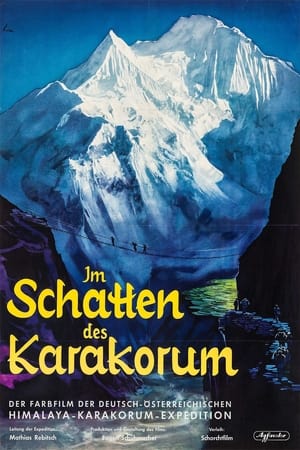
In 1954, a German-Austrian expedition led by Mathias Rebitsch set off for the difficult-to-access Karakoram Mountains, geographically north of the Himalayas. They come across the Hunza, a people who live in the valley of the same name and believe they are descended from the soldiers of Alexander the Great. The documentary conveys impressions of the poor life of the Hunza people, the harvest, a court hearing, festivals and the children's everyday school life. Finally, the expedition sets off again and sets up its main camp on the moraine ridge of a glacier, where they measure the glacier and the earth's magnetic field. Finally, some men from the research community set off for a sub-peak of Batura.
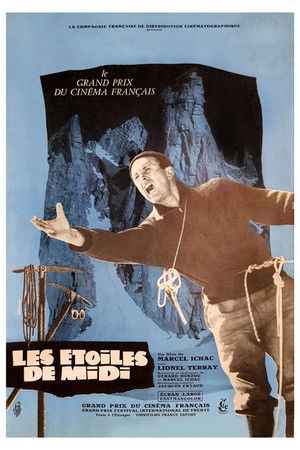
Les Etoiles de Midi is an engaging docudrama about some of the more spectacular exploits of French mountain climbers over the last several decades. In one re-enacted story, there is a wartime escape through the mountains, and in another, a daring rescue of a pair of climbers who had been missing. The actors themselves are adept at the sport of climbing, and they give the scenes an immediacy and real daring that brings the stories alive. A combination of their acrobatics and skill and the outstanding episodes in the history of French climbing creates a winning 78 minutes.
The documentary film Art of Freedom answers the most poignant questions on the phenomenon of Polish expeditions to the Himalayas. Poles have reigned the highest mountaintops of the world for more than 20 years. They not only set down new trails, but new rules of behavior. They set themselves apart with an original style of climbing, endurance, conscientiousness about the overall well-being of the team - and solidarity.
Record of the first ascent of Everest made without the use of oxygen equipment, made in May 1978 by Reinhold Messner and Peter Habeler. Could it be done? Would their blood vessels burst? Would they suffer brain damage leading to madness? Nobody was sure. Messner: 'I would never come here for trying Everest with oxygen. That is not a challenge for me.' A fascinating piece of history, well filmed by Leo Dickinson and Eric Jones (above the South Col Messner used a cine camera to continue the filming), featuring Messner and Habeler's thoughts. The film follows the usual sequence from Namche to Base Camp, through the Icefall, to Camps I, II and III. It also shows historical footage of the pioneering Mallory and Shipton expeditions.
May 25, 1996 - Bruce Herrod, a South African mountaineer reached the summit of Everest at 5 p.m. On the radio, we urge him to come down as soon as possible because the descent is dangerous in the middle of the night. A few hours later, no news from him. From this South African expedition which turned into a fiasco and another expedition carried out in parallel, the testimonies of the members of these expeditions show to what extent the thirst for climbing to the top of certain mountaineers, combined with the lack of oxygen , can alter the lucidity of climbers to the point of changing their relationship to death and thus lead them to neglect other expedition members in order to ensure their victory or save their own life.