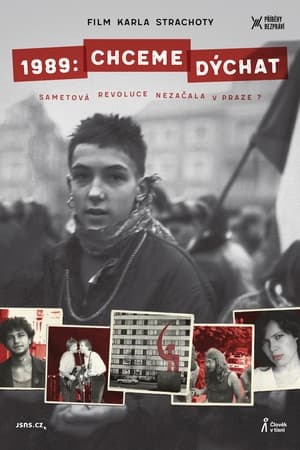
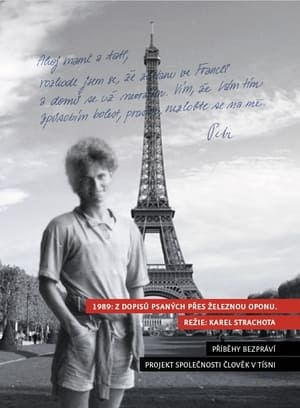
An original film testimony about the time 30 years ago. Peter Kořínek is 21 years old, hailing from Pardubice. He listens to underground bands, reads samizdat books, and faces school troubles due to his long hair. He dreams of emigration. It is the beginning of 1989, and there is no indication that he will experience freedom in communist Czechoslovakia.
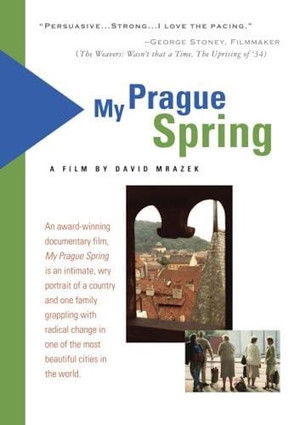
In its "velvet revolution" of 1989, the people of Czechoslovakia toppled its communist dictatorship and embraced democracy and capitalism. By January 1993, the country had peacefully split in two. In the early 1990s, thousands of American college graduates began flocking to Prague, where they could postpone entering the "real world," and live cheaply in a beautiful undiscovered European city. Throughout that decade more and more tourists crossed the statue-lined Charles Bridge in search of old world beauty previously hidden by communist isolation. But what of the people who cross the Charles Bridge on their way to work every morning? Who are the Czechs? What is their history? What is their future? My Prague Spring is an award-winning film that vividly humanizes a resilient people who have survived a tumultuous history. In the spring of 1990, a Czech-American filmmaker spent four months living with his Czech relatives, and opened an intimate window into an uncertain world.
During the so-called normalization period, Teplice, once a beautiful spa town nicknamed "Little Paris," is devastated, much like the entire northwestern industrial border region. It is often shrouded in dense smog, making visibility limited to just a few meters. Teplice is also a stronghold of a specific punk subculture and a city of exceptional alternative culture. The story of Pavel and Renata primarily unfolds in Teplice. They aspire to live freely, in accordance with their ideals. However, their lives are consistently disrupted by the repressive communist regime.
Polojasno
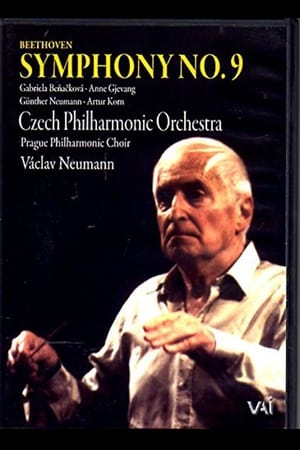
Václav Neumann leads the Czech Philharmonic Orchestra and Prague Philharmonic Choir, with soloists Gabriela Be?a?ková, Anne Gjevang, Günther Neumann, and Arthur Korn. This historic concert of December 14, 1989, given in support of the “Velvet Revolution” in Czechoslovakia, was attended by many prominent personalities, including Václav Havel, just weeks before he became the President of Czechoslovakia (later, the Czech Republic).
History shows that, when citizens are unarmed, government suppression and tyranny are inevitable. MOLON LABE - inspired by The Sword and Sovereignty by Edwin Vieira, Jr., A.B., A.M., Ph.D., J.D. Harvard - explores how the "power of the sword" guarantees America's freedom.
A documentary 33 years in the making. A director and friend of Kurt Vonnegut seeks through his archives to create the first film featuring the revolutionary late writer.
A sheltered aristocratic woman in feudal Japan, bored and unfamiliar with the world outside her estate, passes the time copying a special Buddhist sutra sent by her father who has been absent on official business for years. While gazing out her window one late afternoon, the setting sun creates a vision of a holy figure in the distant mountains.
Oliver Stone spends three days filming with Fidel Castro in Cuba, discussing an array of subjects with the president such as his rise to power, fellow revolutionary Che Guevara, the Cuban Missile crisis, and the present state of the country.
Amu is the story of Kaju, a twenty-one-year-old Indian American woman who returns to India to visit her family and discover the place where she was born. The film takes a dark turn as Kaju stumbles against secrets and lies from her past. A horrifying genocide that took place twenty years ago turns out to hold the key to her mysterious origins.
Upon suddenly learning of her imminent death, Jacqueline von Kaenel begins to search for the key to her life. Unsparingly, she looks back and discovers how everything is connected; her youth in Franco’s Spain with her mother’s feudal past in eastern Prussia, her desire for music with the one for a dominant and powerful husband. In her ambition to be a perfect mother, she recognizes her fight for identity. But all of a sudden experiences from her childhood in a seemingly happy family crop up turning everything upside down.
As the COVID-19 pandemic hit the Bronx, 6-time Grammy Award-winning jazz pianist Arturo O'Farrill brings to life a 9-piece hip-hop-jazz ensemble converting stories of South Bronx life to music resounding in the streets.
In this documentary we see Khyentse Norbu (director of The Cup, 1999) in Nepal during the filming for his latest film Looking for a Lady with Fangs and a Moustache, where he effortlessly switches between working with the hip film crew and performing ancient Buddhist rituals.
DRIVER is a soulful exploration of resolute female long-haul truck drivers pursuing validation for their hard-earned work as they navigate the oppressive forces in their industry. Employing an intimate lens, Nesa Azimi’s first feature brings the audience into a community of solidarity and self-determination.
When a massive Chinese factory complex attempts a high-stakes expansion in rural Ethiopia, three women in search of prosperity have their faith in industrialization tested to the limit. Filmed over four years with singular access, Made in Ethiopia lifts the curtain on China’s historic but misunderstood impact on Africa, and explores contemporary Ethiopia at a moment of profound crisis. The film was awarded the Jury Special Mention at Tribeca Festival.
Nicolás Molina’s visually astounding Pirópolis drops the viewer in the fiery port city of Valparaíso, Chile and observes a pack of determined volunteer firefighters as they band together to combat turbulent wildfires ravaging the city.
Legendary British guitarist Chris Spedding and enigmatic frontman Snips (aka Stephen Parsons) trace the fall and rise of their cult seventies band, the Sharks from the Marquee Club to... wherever. With former sex Pistol Paul Cook and Punk Empress 'Jordan' Mooney.
The story of the iconic trailblazer known by her initials DVF worldwide. Child of a Holocaust survivor, Princess by marriage, and founder of a fashion brand. Featuring interviews with Oprah Winfrey, Marc Jacobs, Hillary Rodham Clinton and more.
In 1988 it was exactly one hundred years ago that the Nicaraguan writer Ruben Dario published his first work. Azul was the first publication of modern poetry in the Spanish language. Legiarda-Laura has given the same title to his film, because he wanted to show the Nicaraguan poetic inheritance. 24 poems are read, interspersed with interviews and discussions. Thus, the cultural soul of Nicaragua is mapped out.