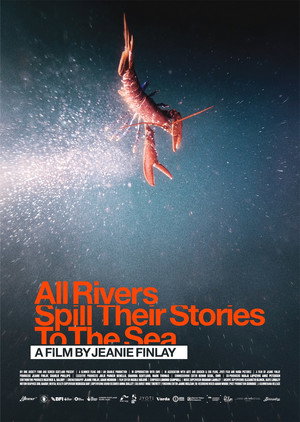
The ruthless dictator Teodoro Obiang has ruled Equatorial Guinea with an iron hand since 1979. Juan Tomás Ávila Laurel is the most translated Equatoguinean writer, but he had to flee the country in 2011, after starting a hunger strike denouncing the crimes of the dictatorship. Since then, he has lived in Spain, feeling that, despite the risks, he must return and fight the monster with words.
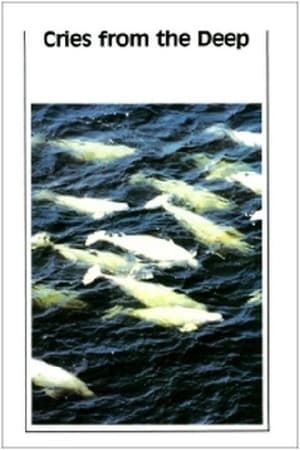
This documentary records the journey undertaken by Jacques Cousteau, his 24-member team, and an NFB film crew to explore the Grand Banks of Newfoundland, one of the world's richest fishing areas. They discover shipwrecks, film icebergs and observe beluga whales, humpback whales and harp seals. The film also includes a fascinating sequence showing Calypso divers freeing a calf whale entrapped in a fishing net.
In Inukjuak, an Inuit community in the Eastern Arctic, a baby boy has come into the world and they call him Timuti, a name that recurs across generations of his people, evoking other Timutis, alive and dead, who will nourish his spirit and shape his destiny.
A friendly wager on a family fishing trip to Emerald Isle years ago resulted in one boy’s dream come true. That boy, all grown up, turned his dream come true into a career.
A woman narrates the thoughts of a world traveler, meditations on time and memory expressed in words and images from places as far-flung as Japan, Guinea-Bissau, Iceland, and San Francisco.
Drawing on original footage from National Geographic, Etched in Bone explores the impact of one notorious bone theft by a member of the 1948 American-Australian Scientific Expedition to Arnhem Land. Hundred of bones were stolen and deposited in the Smithsonian Institution in Washington DC, until it became known to Arnhem elders in the late 1990s. The return of the sacred artefacts was called for, resulting in a tense standoff between indigenous tribespeople and the Department of Anthropology at the Smithsonian.
Three centuries of Venezuela's history as a Spanish colony are considered from economic, political and social standpoints; evocations of the past are compared to the present. Based on the ideas and research of Federico Brito Figueroa, Alfredo A. Alfonso, Miguel A. Saignes, Josefina Jordan, and Thaelman Urgelles among others.
Travel films have an established format with their own conventions, history and baggage. It is a medium that has all too often sought to control, define and dictate perceptions of ”other” places. Comprised of footage shot while travelling on group excursions across Russia in 2019, An Uncountable Number of Threads is an attempt to draw out the ethical restrictions of a travelogue, while questioning how (and why) to make one. At times there is an awkward tourist-gaze, aware of its outsider position. But as a self-reflexive work that considers its own creation, it ultimately unravels, as the artist rationalises themselves out of a particular way of working, inviting the viewer into their uncertainty.
A Maasai human rights lawyer fights to stop the evictions of his people from their homelands in Tanzania. On the outskirts of Serengeti National Park in East Africa, Maasai face eviction from their land to make way for international tourism and hunting grounds. Human rights lawyer Joseph Oleshangay campaigns for his community to remain on its homeland as it has done for generations. While he represents Maasai communities in court, Joseph also remains close to his traditions among the cattle at his rural home near the Ngorongoro Crater. Risking his life to gather evidence from recently depopulated villages, Joseph battles in court where he leads the fight to resist the evictions.
The film is a cinematic interpretation of the travel book “Armenia” by Russian poet Andrei Bely.
Jarred by the loss of his closest friend, a farmer on Tasmania’s remote West Coast, begins to mentor at-risk local youth. In an area renowned for its poverty, low literacy, and high suicide rates, Stafford Heres is determined to provide opportunities for kids who have few. Eden Alone Surpasses Thee explores his relationship with the land, loss, and the young men he takes under his wing.
Two friends, both Indigenous fishermen, are driven to desperation by a dying sea. Their friendship begins to fracture as they take very different paths to provide for their struggling families.
Hacking at Leaves documents artist and hazmat-suit aficionado Johannes Grenzfurthner as he attempts to come to terms with the United States' colonial past, Navajo tribal history, and the hacker movement. The story hones in on a small tinker space in Durango, Colorado, that made significant contributions to worldwide COVID relief efforts. But things go awry when Uncle Sam interferes with the film's production.
Ice has always moved. When glaciation took hold some 34 million years ago, interconnected rivers of ice combined to produce the Earth's vast ice sheets. As temperatures slowly warmed glaciers developed a unique balancing act; advancing and retreating to calibrate their annual winter accumulation against summer melt. Sometimes calving colossal icebergs into the sea. A positive feedback loop that has regulated the movement of ice for millions of years.
Sea otters are once again in peril after being brought back from the brink of extinction. An unprecedented number of sea otter deaths have occurred along the California coast in the last three years. Meanwhile, the Fish & Wildlife Services decision to eliminate their No Otter Zone from Southern California waters remains controversial. This fragile species threatened by pollution, infectious diseases, starvation, and competition with fishermen struggles for survival.
Bruce Brown's The Endless Summer is one of the first and most influential surf movies of all time. The film documents American surfers Mike Hynson and Robert August as they travel the world during California’s winter (which, back in 1965 was off-season for surfing) in search of the perfect wave and ultimately, an endless summer.
The Southern Sea Otter was historically abundant along the California coastline until intense hunting pressures reduced their numbers to near-extinction levels. But now the otters are coming back, and with them they bring the potential for drastic change to the modern-day economics and ecology of the Santa Barbara Channel.
Examines the violence and civil disobedience leading up to the hallmark decision in U.S. v. Washington, with particular reference to the Nisqually Indians of Frank's Landing in Washington.
This excellent feature-length documentary - the story of the imperialist colonization of Africa - is a film about death. Its most shocking sequences derive from the captured French film archives in Algeria containing - unbelievably - masses of French-shot documentary footage of their tortures, massacres and executions of Algerians. The real death of children, passers-by, resistance fighters, one after the other, becomes unbearable. Rather than be blatant propaganda, the film convinces entirely by its visual evidence, constituting an object lesson for revolutionary cinema.
A modern geisha travels through Japan trying to find a job as entertainer, and ends up by finding love and a job as ama, a pearl diver.