The San Francisco Foundation Community Leadership Awards presents John Santos, musician and cultural activist, with the Helen Crocker Russell Award for making music that transcends cultural barriers and serves as a tool for social justice. As an educator, scholar, performer, and composer, he celebrates and promotes Latin music and understands that art has the power to inform and nurture.
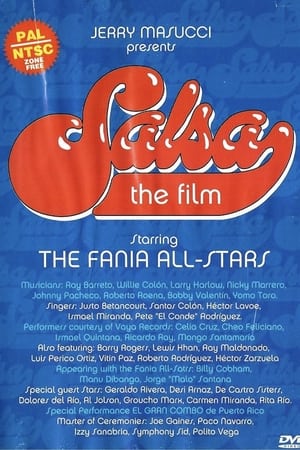
The Fania All Stars perform for 44,000 fans at Yankee stadium in New York. Besides concert footage, there's also included a history of Salsa, and vintage film clips of Hollywood's portrayal of Latinos in movies during the 1930's and 40's.
To some, Doña Cecilia is an invisible, elderly woman. For others, her presence validates their existence. This movie on children's civil rights shows how borders are transformed into bridges by the power of unconditional love and music.
Cruz Quinal, "the mandolin king," lives near Cumana in a mountain valley surrounded by sugarcane fields. Perpetuating 16th century Spanish traditions of guitar-making, Cruz fashions such musical instruments as cuatros, marimba, escarpandola, and his own creation, a mandolin with two fretboards. He is an accomplished musician as well. In this moving portrait, Cruz compares himself to a decaying colonial church across the street: revered yet neglected, the village altar stands, paint peeling, under the open sky.
In this Concert he focuses on the star and most important defender of bachata, the Dominican singer and songwriter Romeo Santos, and his concert on September 21, 2019 at MetLife Stadium in East Rutherford, New Jersey, which broke attendance record . Romeo took advantage of this event to bring together, for the first time live, all the legendary bachateros with whom he collaborated on his acclaimed album Utopia (2019), to the delight of the public who sang his favorite hits.
A coming-of-age story set in the Dominican Republic, where a group of young aspiring bachata musicians seek answers to love and life through their music. Filmed at the Academia de Bachata, the world's first bachata music school. Featuring maestro Martires de Leon, guitarist and arranger for Romeo Santos.
On the iconic sands of Rio de Janeiro, Brazil, Shakira sets Copacabana Beach ablaze in the third edition of “Todo Mundo no Rio”. Before a historic crowd of 2 million people, the Colombian superstar celebrates three decades of hits in an electrifying performance that bridges her new album, “Las Mujeres Ya No Lloran,” with the timeless classics that defined her career. Featuring guest appearances by Brazilian music icons and a high-tech visual spectacle, the night transforms the coastline into the stage for an epic celebration of power, music, and the artist’s unbreakable connection with Brazil.
It’s the final school year, and with it comes the long-awaited graduation trip to Uruguay, the last chance for everyone to be together before each one goes their own way. The story follows six teenage friends as they experience the first sparks of love and heartbreak, all while expressing a passion for music, tropical vibes, and Latin culture.
María Becerra - Estadio River Plate
This is a story set on the future Caribbean coast, which is almost uninhabitable due to pollution and climate change. Amidst the gloomy landscape of the new world order OHM, we find Ivy, our protagonist, who, after a heartbreaking breakup, is left in a very delicate emotional state.
Documentary portrait of the poet Karla Erbová is a confession of a creative personality who, despite many twists and turns in life, remains true to her ideals and moral values. We witness the final year of the author's life, during which, even at the age of ninety, she continues to engage in public appearances and, above all, actively works on her craft. Through letters that Erbová wrote to her friend, the film offers an intimate, often self-deprecating reflection on old age, solitude, and relationships with loved ones, as well as an indomitable faith in poetry. The film "Ulita" not only highlights the pivotal moments of her life but also serves as a sociological exploration of the lives of the oldest generation.
In the gritty streets of 1945 Philadelphia, aspiring jazz musician and street hustler, Trip, dreams of a life-changing opportunity awaiting him in the vibrant world of Harlem. With three days until the audition, his journey takes an unexpected turn as he finds himself entangled in a web of corruption, vengeful gangsters, and the ominous presence of a mysterious figure.
Emma Dabiri looks at racism in Britain via the world of modern dating, love apps, and a national survey suggesting that young Britons could be more segregated than ever.
In an era of activism, filmmaker Connor Luke Simpson enters the world of Fat Acceptance, a provocative social movement that is seeking to change the negative perception of obesity. Is everything we know about obesity wrong, or, will this movement just become a footnote in the history books?
A collection of Warner Brothers short cartoon features, "starring" the likes of Daffy Duck, Porky Pig and Wile.E.Coyote. These animations are interspersed by Bugs Bunny reminiscing on past events and providing links between the individual animations which are otherwise unconnected. This 1979 feature-length compilation includes several of his best cartoons. Among the 11 shorts shown in their entirety are the classics "Robin Hood Daffy," "What's Opera, Doc?," "Bully for Bugs," and "Duck Amuck". The Bugs Bunny Road Runner Movie provides a showcase not only for Jones's razor-sharp timing, but for the work of his exceptional crew, which included designer Maurice Noble, writer Mike Maltese, composers Carl Stalling and Milt Franklyn, and voice actor Mel Blanc.
A film about Maija Isola, the designer of Finland’s most beloved fabrics. Her bold designs, which include classics like Unikko, Kivet, Kaivo and Melooni, were essential in creating Marimekko’s lifestyle universe. The film shows the secrets to the success of Maija Isola’s fabrics, the values at the heart of Isola’s globetrotter lifestyle, and the legacy she left us. The film is narrated by Maija Isola, as well as her daughter Kristina Isola. It takes us close to Maija as a person, artist, thinker and visionary through her letters. We also hear Armi Ratia’s thoughts on Isola both as an employee and as a friend.
The fate of women against the backdrop of Transcarpathian history. The author's grandmother, Maria Fedorivna, recounts her life: how, as a 15-year-old girl, she had to marry into a second village because "the Russians were evicting the kulaks," how "the Russians" destroyed their family's house, the largest in the village, which had been built with money earned by migrant workers, took all their livestock and supplies, and sentenced her brother to seven years in prison. The wealthiest family was forced into poverty. The film also tells about the consequences of the 2015 earthquake in Okruha. When the tremors shook the village, Maria Fedorivna was in the hospital. Before she returned home, her relatives repaired the cracks in the house to protect Grandma Maria from anxiety.
In 2022, 92% of those affected encountered aggression or violence. Frans Bromet portrays six influences who encounter violence while carrying out their work. The violence with which the actual consequences are, leaves personal physical, especially mental, traces.
Alela Diane à la Salle Rameau
Za život radostný