Valery Gergiev conducts Mariusz Trelinski’s thrilling new production of these rarely heard one-act operas. Anna Netrebko stars as the blind princess of the title in Tchaikovsky’s lyrical work, opposite Piotr Beczala as Vaudémont, the man who wins her love—and wakes her desire to be able to see. Nadja Michael and Mikhail Petrenko are Judith and Bluebeard in Bartók’s gripping psychological thriller about a woman discovering her new husband’s murderous past.
Stage director Emilio Sagi's production of the legendary Barber of Seville is enriched by a bright distribution. Maria Bayo returns to one of her signature role as Rosina, opposite Juan Diego Florez, the Rossini expert tenor. The title role is embodied by the Italian baritone Pietro Spagnoli, while Ruggero Raimondi and Bruno Pratico reconcile the audience with Don Basilio and Don Bartolo.
Die Walküre (The Valkyrie), WWV 86B, is an opera in three acts by Richard Wagner with a German libretto by the composer. It is the second of the four operas that form Wagner's cycle Der Ring des Nibelungen (The Ring of the Nibelung). The story of the opera is based on the Norse mythology told in the Volsunga Saga and the Poetic Edda.[1][2] In Norse mythology, a valkyrie is one in a group of female figures who decide which soldiers die in battle and which live. Die Walküre's best-known excerpt is the "Ride of the Valkyries". DVD release June 2009.
An Egyptian military commander, Radamès, struggles to choose between his love for the enslaved Ethiopian princess Aida, and his loyalty to the Pharaoh. To complicate the story further, the Pharaoh's daughter Amneris is in love with Radamès, although he does not return her feelings.
Simon Keenlyside smolders dangerously in the title role of Mozart’s version of the legend of Don Juan, creating a vivid portrait of a man who is a law unto himself, and all the more dangerous for his eternally seductive allure. Adam Plachetka is his occasionally unruly servant Leporello. It’s when Giovanni tangles with Donna Anna (Hibla Gerzmava) that things start to unravel, aided by the reappearance of Donna Elvira (Malin Byström), who is determined not to let her seducer go. With Paul Appleby as Don Ottavio, Donna Anna’s eternally steadfast fiancé. Principal Conductor Fabio Luisi leads the Met Orchestra and Chorus.
Captain's daughter Josephine and common sailor Ralph Rackstraw are in love. However, their relationship is complicated by her arranged marriage to the high-ranking Sir Joseph Porter. A secret about the characters' true identities revealed by Little Buttercup, which leads to a farcical resolution.
The gorgeous and evocative Otto Schenk/Günther Schneider-Siemssen production continues with this second opera in Wagner’s Ring cycle. Hildegard Behrens brings deep empathy to Brünnhilde, the favorite daughter of the god Wotan (James Morris) who nevertheless defies him. Morris’s portrayal of Wotan is deservedly legendary, as is Christa Ludwig, as Fricka. Jessye Norman and Gary Lakes are Sieglinde and Siegmund, and Kurt Moll is the threatening Hunding. James Levine and the Met orchestra provide astonishing color and drama. (Performed April 8, 1989)
Siegfried is the third of the four operas that constitute Der Ring des Nibelungen (The Ring of the Nibelung), by Richard Wagner.
The Met’s spectacular production of Verdi’s Egyptian epic captures both the grandeur and the intimacy of this powerful tale of love and politics. Liudmyla Monastyrska is Aida, the Ethiopian princess-turned-slave in love with the Egyptian warrior Radamès, sung by Roberto Alagna. Olga Borodina is her rival, Amneris, daughter of the Pharao, and George Gagnidze sings Aida’s father, Amonasro, the King of Ethiopia. Principal Conductor Fabio Luisi is on the podium.
Richard Strauss's opera, from the Royal Opera House, Covent Garden.
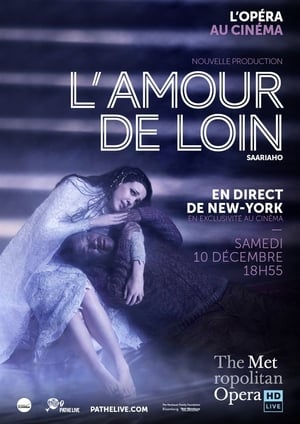
Robert Lepage’s dreamlike production, with its thousands of twinkling LED lights stretching across the stage to represent the sea, encapsulates the mystic feeling of L’Amour de Loin, Saariaho’s haunting opera of distant love. Eric Owens is Jaufré Rudel, a troubadour in 12th century France who has become tired of his hedonistic life and longs for an idealized love. Enter the Pilgrim (Tamara Mumford) who tells him his perfect love does, in fact, exist, far across the sea. She is Clémence, Countess of Tripoli (Susanna Phillips). The magic of the characters’ inner lives as they explore the meaning of love, longing, life, and death is heightened by Saariaho’s hypnotic and bewitching score, conducted by Susanna Mälkki.
Captain's daughter Josephine and common sailor Ralph Rackstraw are in love. However, their relationship is complicated by her arranged marriage to the high-ranking Sir Joseph Porter. A secret about the characters' true identities revealed by Little Buttercup, which leads to a farcical resolution. Performed by the D'Oyly Carte Company for Opera Australia.
The Franco Zeffirelli production of Puccini's "Turandot", recorded live at the Metropolitan Opera in April, 1987. Éva Marton stars as Turandot, with Plácido Domingo as Calaf, Leona Mitchell as Liù, Paul Plishka as Timur, and Hugues Cuenod as L'Imperatore Altoum. James Levine conducts.
A musical adaptation of Victor Hugo's novel "Notre Dame de Paris" which follows the gypsy dancer Esmeralda and the three men who vie for her love: the kind hunchback Quadimodo, the twisted priest Frollo, and the unfaithful soldier Phoebus.
"Manon", wrote Puccini to his publisher Giulio Ricordi in 1889, "is a heroine I believe in and therefore she cannot fail to win the heart of the public." This turned out to be a truly prophetic statement since none of Puccinis other world successes were received on their first nights as rapturously as Manon Lescaut. The popularity of Puccinis great masterpiece has never waned and the highly acclaimed Götz Friedrich production at Covent Garden was hailed as an operatic milestone. Two of the worlds leading stars--Kiri Te Kanawa and Placido Domingo--head a strong cast conducted by the brilliant Italian conductor Giuseppe Sinopoli.
“In a world that often demands certainty, Dialogues des Carmélites invites us to sit with profound questions that have no easy answers: What makes a life worthy? How can we be truly prepared for our inevitable end? What does security mean when everything familiar is threatened? What sustains us when our institutions crumble? … Rather than imposing answers, the opera creates room for reflection on how faith manifests not as abstract doctrine, but as lived experience under extraordinary pressure.” — Louisa Muller, Director’s Note. Juilliard Opera directed by Louisa Muller. Matthew Aucoin conducts the Juilliard Orchestra. Performed and recorded on April 26, 2025 at the Peter Jay Sharp Theater. Dialogues des Carmélites, an opera by Francis Poulenc. Libretto adapted by the composer.
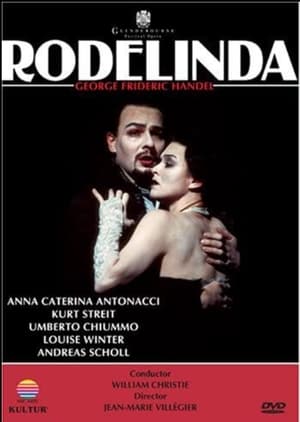
Jean-Marie Villegier's modern interpretation of Handel's "Rodelinda" – filmed live at the world-renowned Glyndebourne Opera House in the United Kingdom, sets the timeless tale of jealousy and treachery in the black-and-white world of the silent-movie era. Soprano Anna Caterina Antonacci sings the title role of Rodelinda, with tenor Kurt Streit and bass Umberto Chiummo performing the parts of Grimoaldo and Garibaldo, respectively.
In a small Japanese town, Ko-Ko is appointed to the unenviable position of executioner. Knowing he must successfully perform before the appearance of the Mikado in a month's time, Ko-Ko finds a suitable victim in Nanki-Poo, who is distraught over his unrequited love for the maiden Yum-Yum. Nanki-Poo agrees to sacrifice his life if he is allowed to spend his remaining days with Yum-Yum, who is betrothed to Ko-Ko. Filmed live from the 1982 Stratford Festival in Ontario.
Renée Fleming stars in the title role of one of Handel’s greatest dramas, seen in Stephen Wadsworth’s 2004 Met premiere production. Rodelinda is faced with an impossible dilemma: With her husband Bertarido believed dead, she either has to marry the despised Grimoaldo (the elegant Joseph Kaiser), who has usurped her husband’s throne, or see him murder her son. But Bertarido (leading countertenor Andreas Scholl) is alive and eventually reclaims both throne and wife—and makes peace with his enemies. Stephanie Blythe is marvelous as Eduige, Bertarido’s sister, who is betrothed to Grimoaldo but turns against him. Baroque authority Harry Bicket conducts.
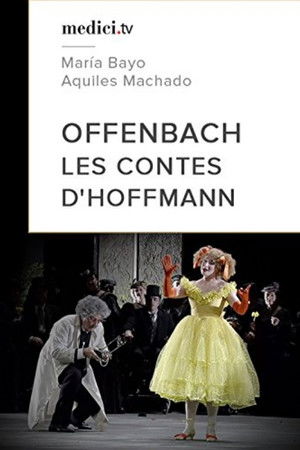
Giancarlo Del Monaco's passionate and intelligent production of Jacques Offenbach's magnum opus creates a climactic kaleidoscope of deep and convincing emotions. A highly credible incarnation of the pitiable Kleinzach he sings about, Aquiles Machado is the poet who loses his romantic idealism, his reflection and finally his soul to a 'trio of charming enchantresses'.