Tehran Is the Capital of Iran (1966-79) documents life in a deprived district in the south of Tehran. The images of destitution in Tehran's poor areas is accompanied by a variety of spoken accounts: the official viewpoint on the district's living conditions, what the inhabitants have to say, and occasional extracts read out of school manuals. The key element in Shirdel's film is the counterpoint effect he creates with image and sound. His impressively powerful portrayal of social unease helps reinforce the impact of his astonishing documentary images and social themes.
A triumph of film art, creating on the screen a vast, awe-inspiring picture of the universe as it would appear to a voyager through space, this film was among the sources of inspiration used by Stanley Kubrick for his 2001: A Space Odyssey. Realistic animation takes you into far regions of space, beyond the reach of the strongest telescope, past Moon, Sun, and Milky Way, into galaxies yet unfathomed.
The opening of the Kiel Canal in Germany by Kaiser Wilhelm II on 20 June 1895.
The film uses stop-frame animation to create maps on the screen, and showed the then-current military situation in the Dardanelles, using various maps to assist understanding. Small cardboard cut-outs show the deployment of men and ships. Intertitles explain tactics, and shelling explosions are illustrated by clouds of cotton wool.
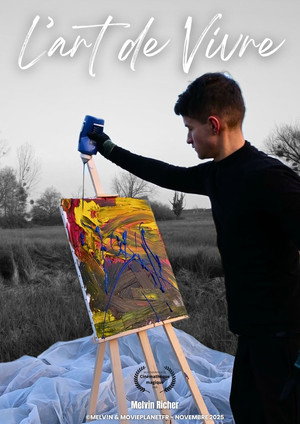
L'Art de Vivre
Documentary about the life of the indigenous people in the Andes and in the slums of Lima, and of their religiosity.
Tattooed hands gently glide over a rock face, probing it with the tips of the fingers. Three women, arms raised to a high boulder, appear to be in prayer. Hidden in a cave, two others stare at their bloody palms. Touching Rocks depicts bouldering as a pagan ritual.
The Italian architect Giancarlo De Carlo (Genoa 1919 - Milan 2005), inspires generations of architects all over the world. His philosophy still remain a school subject. The film, inspired by Franco Buncuga's book “Conversations with Giancarlo de Carlo”, recalls an imaginary trip from Genoa to Urbino, guiding the audience through the historical town center, the Palazzo Ducale and the masterpieces of the Italian Renaissance architect Francesco di Giorgio Martini, which made the Urbino so great.
As one of his generation's quintessential Mad Men, television commercial director Joe Sedelmaier's work was iconic, dynamic, and instantly recognizable--some twenty to thirty years later, people are still wondering 'Where's the beef?” He turned the advertising world on its brain-damaged head by casting offbeat non-actors in still-unforgettable spots. His brilliant, frequently hysterical commercials for Wendy's, Alaska Airlines, Federal Express and others were snappy slices of cultural quirk that tapped into the Cold War-fearing, corporate workaholic zeitgeist of the '70s and '80s with a sense of humor that cracked billions of smiles, sold billions of burgers, and sped up the default rhythm of time-based media.
The story behind the making of the 1985 Chicago Bears' rap anthem and video that became a cultural phenomenon, redefined sports entertainment, and cemented the team's larger-than-life legacy.
Heimat in der Fremde?
An experiment with three dimensions in a moment of clarity: the focus of the camera's lens towards the present, the speed of the train and the material world distorted by the movements of the train.
The life and work of Halle-born Georg Friedrich Händel, the Händel Museum, and the Händel Festival in Halle are presented.
Vito is a sweet little boy with Down syndrome, and this short documentary puts his energetic, jolly personality on full display as he interacts with his loving family. By showing Vito’s dignity and inherent value, Vito-Man tackles the difficult conversation that is the eradication of people with Down syndrome, proving that an extra chromosome should not be a death sentence.
Wild West performer Pedro Leon is the highlight of this three-minute film that shows how cowboys make rope and various other items. Within the three-minutes we learn that horsehair is the best thing to use so we see a couple men, including Leon, put the hair together and from here we see how they get it prepared to use for rope and other items.
MORENA tells the uplifting story of the Philippine National Surf Athlete Ikit Agudo, who overcame the pressure to blend into a society obsessed with skin whitening. Within the ocean, she found happiness, strength, and pride in her roots. Inspiring young girls around the world to embrace who they truly are. In the Philippines, skin-whitening remains a billion-peso industry, a legacy of colonial beauty ideals that for generations have led many to neglect their true identity and natural beauty.
The film uses a collection of post-World War II black & white photographs to portray the dockworkers of Marseilles, many of whom were of African descent. Set in and around a 1947 strike protesting weapons shipments to the French in Indochina, the images evoke the life and work of Senegalese filmmaker, Ousmane Sembène, a former dockworker, and one of the founding figures of the New African Cinema of the 1960s.
Several prohibition agents display cans and bottles of seized liquor for the camera. They are then shown dumping the goods at a junk yard.
This film takes a candid, inside look at the world of juvenile delinquency. We are shown the tough existence on the streets of Montreal, but it could be any city in North America. Some boys as young as ten years of age talk about their lives of crime, the things that are important to them, and the hopes they hold for the future.
Estonia's first ethnographic film. Made by Johannes Pääsuke in 1913 on his expedition to Setomaa, the South-Eastern region in Estonia.