In the present work, the artists appears lying on his back, his eyes mostly closed, dreamingly listening to a walkman that plays, a recording of 'The Best of Lou Reed and the Velvet Underground'. The artist can hear the music through his earphones, but as viewers we are only privy to the sound of his voice that whispers the melody. As we listen to the hypnotic interpretion of the familiar songs - as emblematic for pop music history as 'Psycho' is for film - we are forced to mentally 'reconstruct' the remaining orchestration, instrumentation and vocals. We must attempt to reassemble something we already know to be a fact by negotiating the sticky mess of interpretation, meaning, and memory.
Video art by Vibeke Sorensen made at Calarts in 1989
Abstract video art created in 1979. Video and audio by Dean Winkler, Glenn Van Alstyne, Tom Lucke, Elaine Lewis, and Brian Aitchison. Chirp-1 / Quantel was created in two separate effects passes: At the RPI Video Synthesizer Lab an old porno tape (on stock that was donated to us) was processed using an analog Serge modular music synthesizer to sequence the sounds and control the colorization of an analog Hern video synthesizer. The sounds are also inserted into the video, which are the stripes you see, changing with frequency. The tape from the first pass was taken to EUE Video and used to seed an analog feedback loop around a Quantel 5000 digital effects device.
TECHNICOLOR DREAM is a video art of vivid imagery and symbolic scenarios. It is a portrayal of passion,agony,memories and melancholy through unorthodox fusion of sight and sound.
U B(ON) IN MY EYES
After concluding the now-legendary public access TV series, The Pain Factory, Michael Nine embarked on a new and more subversive public access endeavor: a collaboration with Scott Arford called Fuck TV. Whereas The Pain Factory predominantly revolved around experimental music performances, Fuck TV was a comprehensive and experiential audio-visual presentation. Aired to a passive and unsuspecting audience on San Francisco’s public access channel from 1997 to 1998, each episode of Fuck TV was dedicated to a specific topic, combining video collage and cut-up techniques set to a harsh electronic soundtrack. The resultant overload of processed imagery and visceral sound was unlike anything presented on television before or since. EPISODES: Yule Bible, Cults, Riots, Animals, Executions, Static, Media, Haterella (edited version), Self Annihilation Live, Electricity.
This isn’t a film. It’s a leaked ritual. Somewhere between analog prayer and digital disease, a collection of gestures tried to become human again. They failed. Children orbit the fence like insects around an electric hymn. A figure holds a violin but never plays — his silence is louder than the sound. The man in the branches hasn’t fallen in years. The killer appears, or doesn’t — but you’ll feel him beneath the cuts, mouthing things you’ll wish you didn’t understand. There are bodies, sometimes clothed in flesh, sometimes not. There is scripture, mangled and reversed — not to mock it, but to unlock it. The voice speaks, but only when you stop listening. This is the place where lost footage remembers you. Where noise prays back. CHOKE ECHO was compiled under duress by 0xHamza in 2025 using material never meant to be rearranged. Watch it if you must — but it will keep watching after you close the tab.
A tutorial about guided meditation. Throughout the project, the spectator is invited to follow a series of steps that, if done well, will take them to a calm and tranquility state.
HIDEO, It's Me, Mama is a psychological melodrama that introduces narrative and structural devices that are integral to Idemitsu's work. Exploring the flawed universe of the contemporary Japanese family, she focuses on a woman's identity as mother through mother-child and husband-wife relationships. Hideo, a young man living away from his parents, is kept under constant surveillance by his doting mother via an omnipresent television monitor. In a cogent metaphor for familial relations in the media-saturated culture of contemporary Japan, Mama can only communicate with her beloved, absent son through the video screen. Idemitsu's poignant irony is embodied in the scene in which Mama, blind to her husband's needs, caresses Hideo's video image. (Electronic Arts Intermix)
Jim Moir (aka Vic Reeves) explores Video Art, revealing how different generations ‘hacked’ the tools of television to pioneer new ways of creating art that can be beautiful, bewildering and wildly experimental.
Flooded McDonald's is a new film work in which a convincing life-size replica of the interior of a McDonald's burger bar, without any customers or staff present, gradually floods with water.
Decoherence is an audiovisual composition made with sound waves, water, and granular and spectral processing. A 60 cycle drone from a speaker cone below creates subtle patterns on the liquid surface, which grows increasingly turbulent. This piece explores interference patterns, the interplay of macro and microscopic patterns, chaos and continuua.
Proximities focuses on the trope of the Malay Boy found in the works of Singaporean artist Cheong Soo Pieng (b. 1917-1983). It attempts to locate the Malay male in art history while unpacking underlying systems of power that have shaped and naturalised the understanding of difference.
Anémona and Pisces live a capicua experience: they are at the same time the woman who looks, the woman who is looked at, and the very act of looking. Between fractal scenes and images multiplied in reference to Man Ray, Anémona assumes the will to, through the state of trance, always be a foreigner within herself, while Pisces goes in search of an alien vision, to assume herself as the self and otherness to understand the world.
A kinetic prayer and structuralist intervention. Shot entirely on an iPhone 11 in a desolate Midwest laundromat, 108 spin documents the mechanics of impermanence. The film shifts from heavy turbulence to suspended repetition—not as a path to completion, but as a study of the loop itself. Featuring a layered soundscape, the work asks the viewer to stare into the rotation until the noise becomes a mantra.
In Junior War, a throng of highschoolers congregate at night for a party in the woods sometime in the year 2000. A band plays, the kids get drunk, the boys and girls tepidly flirt, and groups deploy into cars for the purpose of destroying mailboxes, tee-peeing houses, breaking lawn ornaments, and sparring with the police. The film is composed entirely of footage Trecartin took during his senior year of high school in exurban Ohio; as such, it baits the viewer with genealogical significance.
Dirt
A person rides a bicycle while simultaneously projecting visuals of a distant place
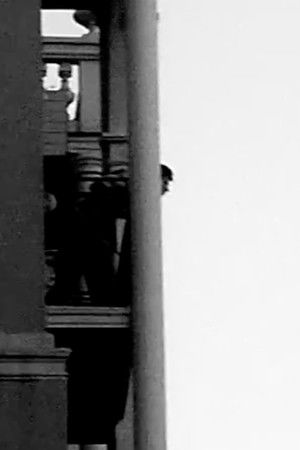
An odd man on a balcony
Minotavr II