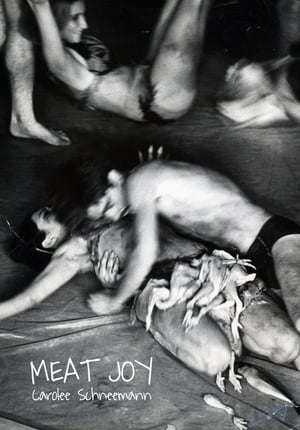
"Meat Joy is an erotic rite — excessive, indulgent, a celebration of flesh as material: raw fish, chicken, sausages, wet paint, transparent plastic, ropes, brushes, paper scrap. Its propulsion is towards the ecstatic — shifting and turning among tenderness, wildness, precision, abandon; qualities that could at any moment be sensual, comic, joyous, repellent. Physical equivalences are enacted as a psychic imagistic stream, in which the layered elements mesh and gain intensity by the energy complement of the audience. The original performances became notorious and introduced a vision of the 'sacred erotic.' This video was converted from original film footage of three 1964 performances of Meat Joy at its first staged performance at the Festival de la Libre Expression, Paris, Dennison Hall, London, and Judson Church, New York City."
Confronting a meter-high red cordon, Anna Uddenberg questions our social consensus: "How can a fragile piece of red fabric so easily direct the flow of human movement?" Anna Uddenberg is a Berlin-based contemporary artist. This film offers a glimpse into her first solo exhibition in China, held at Tank Shanghai. Structured in three parts—Casting, Rehearsal, and Performance—the film offers a stylised, non-linear response to Uddenberg’s sculptural language, exploring themes of bodily discipline, synthetic femininity, and ritualised consumerism.
A ritual of grids, reflections and chasms; a complete state of entropy; a space that devours itself; a vertigo that destroys the gravity of the Earth; a trap that captures us inside the voids of the screen of light: «That blank arena wherein converge at once the hundred spaces» (Hollis Frampton).
The video revolution of the 1970s offered unprecedented access to the moving image for artists and performers. This Is Not a Dream explores the legacies of this revolution and its continued impact on contemporary art and performance. Charting a path across four decades of avant-garde experiment and radical escapism, This Is Not a Dream traces the influences of Andy Warhol, John Waters and Jack Smith to the perverted frontiers of YouTube and Chatroulette, taking in subverted talk shows and soap operas, streetwalker fashions and glittery magic penises along the way.
A remarkable walk through the life and work of the French artist Marcel Duchamp (1887-1968), one of the most important creators of the 20th century, revolutionary of arts, aesthetics and pop culture.
Actors/singers Billkin & PP Krit, who have been gaining momentum, not only in Thailand but all over the world, present their first worldwide digital performance designed for Moment House Japan.
IN 1988, rising star Kenneth Branagh tackled the role of Shakespeare’s prince of Denmark for the first time in his professional career under the guidance of celebrated actor Derek Jacobi. Narrated by Patrick Stewart, this hour-long film documents how Kenneth Branagh and Derek Jacobi, two intelligent and passionate men, found new depths in Shakespeare’s classic drama, Hamlet. Filmmakers Mark Olshaker and Larry Klein follow the company through four weeks of rehearsals, from the first read-throughs to opening night.
In 2012 two members of anarchistic female band Pussy Riot were sentenced to two years in a Mordovian labor camp for "hooliganism motivated by religious hatred". Russian film collective Gogol’s Wives follow each step of the feminist punk band’s battle against Putin including their first disruptive performances on a trolley bus, shooting a video about transparent elections, a controversial performance in a Red Square cathedral, and footage shot in a jail cell. Support comes from many corners including Madonna who painted the words "Pussy Riot" on her back and wore a balaclava during her Moscow show. The documentary portrays the grim state of present-day Russia, a country starkly divided between conservatism and anarchy. Pussy Riot believes that art has to be free and they're willing to take it to extremes. "Pussycat made a mess in the house," they say, and the house is Russia. The filmmakers do not seek to moralize, they simply edit events and leave viewers to draw their own conclusions.
Moving Together is a celebratory love letter to music and dance that brims with kinetic life and energy. This documentary explores the intricate collaboration between dancers and musicians, moving seamlessly between Flamenco, Modern, and New Orleans Second Line.
Dismissed by those around her, a young woman begins performing as a living statue, finding strange power in stillness, until she reclaims the spotlight on her own terms.
Everyone wants a piece of her. She just wants to understand her.
Bas Jan Ader's first fall film shows him seated on a chair, tumbling from the roof of his two-storey house in the Inland Empire.
Bas Jan Ader rides his bike into a canal in Amsterdam.
This short film is part of a mixed media artwork of the same name, which also included postcards of Ader crying, sent to friends of his, with the title of the work as a caption. The film was initially ten minutes long, and included Ader rubbing his eyes to produce the tears, but was cut down to three and a half minutes. This shorter version captures Ader at his most anguished. His face is framed closely. There is no introduction or conclusion, no reason given and no relief from the anguish that is presented.
Bas Jan Ader hangs from the branch of a tall tree, until he loses his grip and falls into a river below.
Shot in his garage-studio, the camera records Ader painstakingly hoisting a large brick over his shoulder. His figure is harshly lit by two tangles of light bulbs. He drops the brick, crushing one strand of lights. He again lifts the brick, allowing tension to accrue. The climax inevitable—the brick falls and crushes the second set of lights. Here the film abruptly ends, all illumination extinguished.
A loner artist with a history of abuse meets a beautiful woman who takes an interest in his life and work; leading to a chilling path of tragedy.
A mockumentary following an ambitious TV network executive trying to produce a controversial reality show where contestants play Russian Roulette.
A silent experimental film, originally made in accompaniment to Josephine Zwaan's '1/4' album release presentation in 2016. The film sees musician Josephine Zwaan persist through a test of endurance, with the foundation of the film being a one-take of her staring deeply into the lens of the camera, haphazardly overlayed and re-framed by graphical elements color-matched to the album's artwork.
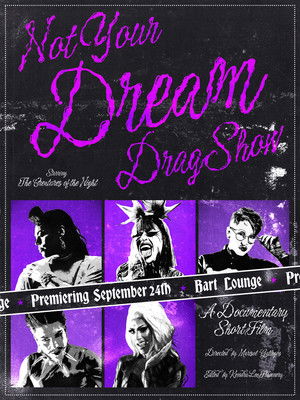
A documentary short film capturing the world of The Creatures of the Night, an up and coming group of alternative drag artists in the Coachella Valley.