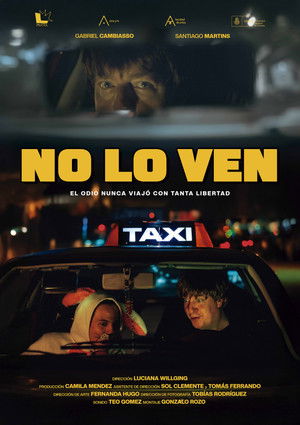
Mendizábal, a hit man, its ordered by his anonymous clients to murder a man. But in the precise and obsessive persecution, he will discover that he is only part of a game that doesn't belong to him, a web at the service of greater interests.
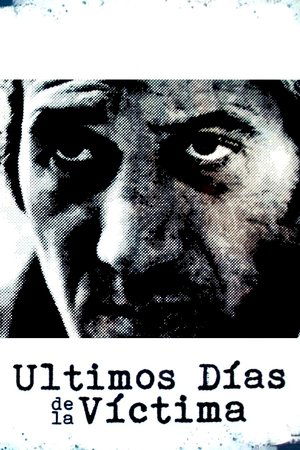
A chronicle on the days without Jorge Julio López, key witness and complainant on the first trial on genocide in Argentina, dated in 2006. López, who had survived through concentration camps on the late seventies argentinian dictatorship, disappeared for the second time the day the court decision meant to condemn his kidnappers was about to be read.
The closed community of a private neighborhood of high-priced houses, is moved by the discovery of three corpses that appear floating in a pool and rushes to frame it as an accident.
Documentary about the Football World Cup held in Argentina in 1978, focusing on the competition and behind the scenes of the most important soccer competition in the world. Two versions of the 1978 official film exist, the first "Copa 78 - O Poder do Futebol" was made by Brazilian directors Maurício Sherman and Victor di Mello in 1979 but was later withdrawn by FIFA because of its controversial content. The film includes an interview with Rodolfo Galimberti, one of the leaders of the Montoneros guerrilla group and also made accusations that the Argentinian competition organisation committee had deliberately hindered Brazilian chances of success by tampering with the pitch at Mar del Plata.
After the fall of the military dictatorship in 1983, successive democratic governments launched a series of reforms purporting to turn Argentina into the world's most liberal and prosperous economy. Less than twenty years later, the Argentinians have lost literally everything: major national companies have been sold well below value to foreign corporations; the proceeds of privatizations have been diverted into the pockets of corrupt officials; revised labour laws have taken away all rights from employees; in a country that is traditionally an important exporter of foodstuffs, malnutrition is widespread; millions of people are unemployed and sinking into poverty; and their savings have disappeared in a final banking collapse. The film highlights numerous political, financial, social and judicial aspects that mark out Argentina's road to ruin.
Jose is an elderly rebel who, after being refused a withdrawal at a bank, returns with a gun and threatens to shoot himself if he doesn't get his cash. Pedro, a young teller, is disillusioned with his life and sees Jose's stunt as a way out when he pretends to be taken hostage, leaving the bank with the old man and a hefty amount of money. The unlikely duo become friends, picking up tough-girl Ana along the way, while avoiding the police.
Two coworkers decide to blackmail the corrupt demolition company they work for by setting up a fake accident.
Joaquín Góñez, a novelist in his sixties recalls his emotions, his wild years in Buenos Aires, the memories of old friends, the meaning of loyalty and the intimate relationship with his mother, Roma.
The story—in which an American heiress on holiday in South America falls in love with an Argentine horse breeder against the wishes of their families—takes a backseat to the spectacular location shooting and parade of extravagant musical numbers, which include the larger-than-life Carmen Miranda singing the hit “South American Way” and a showstopping dance routine by the always amazing Nicholas Brothers.
A hostage situation gone bad. Jesús, an amateur thief, holds prisoner a group of clients, but nothing is what it seems. How far are we willing to go to survive?
Through testimonies and images, the crude reality of human rights in Argentina in democracy is portrayed and the role of the hegemonic means of communication to make causes and protests invisible ...
Patagonia, Argentina. A mechanic who dreams of a different life begins to think big after his adopted puppy Bombón wins first prize at a local dog show.
A Hollywood actor grows tired of making the same corporate movies, so he moves to Argentina to find more experimental and meaningful work.
A documentary following the day life of fans in Brazil on July 13, 2014: the day when Germany and Argentina met up in the finals of FIFA World Cup.
The film does not describe, rather it observes, in a distant manner, the world of Martin, a seventeen year old who feels he doesn’t belong anywhere, not at home, school, nor with his friends or members of his rock band. In search of some happiness, Martin takes off to the coastal town of Mar de Plata, where his older brother lives. Unglamorous, yet enchantingly addictive and refreshingly genuine, Acuña paints a confused and uncomfortable world, and makes us want revisit it over and over again.
In Argentina, one daughter of patriarch Madariaga is married to a Frenchman while the other is married to a German thus leading to a crisis when Nazi Germany occupies France and some Madariaga family members fight on opposite sides.
A transgender girl runs away from home and is invited to live with a strange photographer who pushes her to help him pay his debts.
Sebastian, a man in his thirties, works a series of temporary jobs and embraces love at every opportunity. He transforms, through a series of short encounters, as the world flirts with possible apocalypse.
A woman from the country moves into to the big city of Buenos Aires to start a new life. Things are not going very easy and she soon finds herself working as a prostitute.
In a small town, a police officer goes to the house of a teacher friend to question him about the sudden disappearance of one of his students, who had been responsible for a car accident that claimed the lives of a family of four.