When it comes to 'what Mother Nature intended', it turns out she was pretty open-minded. In this vivid, funny and eye-opening one-off doc we take the audience on a journey to explore the rich diversity of animal sexuality.
A pride of lionesses reigns supreme on the banks of a river in Tanzania. They are merciless hunters, unrivalled in their fearlessness and strength. These killers are feared by all the local wildlife. But for the past few years, this region has been hit by drought, and a dam being constructed upstream has dried up the river’s flow. Whereas prey was once abundant, it has now fled the area, and the lionesses are struggling for survival. They resort to attacking the giraffes for food
David Attenborough narrates the natural history of hummingbirds.
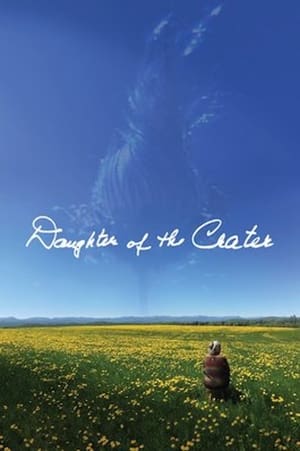
A woman with a deep love of the land, Yolande Simard Perrault sees her life as having been shaped by a planetary upheaval in Charlevoix, Quebec, millions of years ago. As enduring as the Canadian Shield, she’s a woman of strength and spirit, a child of the crater left by the meteor’s impact. This documentary portrays a determined woman who’s the reflection of a land created on an immense scale. She was the creative and life partner of filmmaker Pierre Perrault, who gave up everything to be by her side. The film charts the influence of her unquenchable dreams and her contribution to the building of a people’s collective memory. In a stream of images and words, Simard Perrault recounts the splendours of the landscape and the people who shaped it. Generous and boundless, she embarks on a quest for identity that nurtures and perpetuates the oeuvre of the man who breathed new life into Quebec cinema.
Bienheureuses : La véritable histoire des Carmélites martyres de Compiègne
A holiday at home. A holiday with an end in sight. A birthday to start it all.
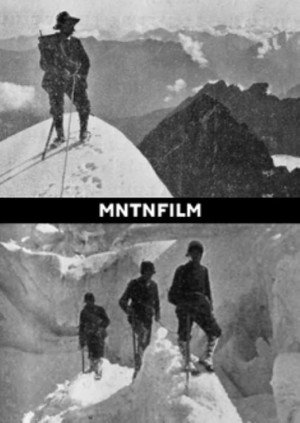
Distributed under the title of ‘Switzerland’ or ‘Playground of Europe’, the film consists of a collection of scenes filmed in the Alps by Frank Ormiston-Smith between 1903 and 1905. The scenes belong to concrete moments in different ascents and treks in the Alps and are presented together without the intention to narrate a concrete ascent. These are some of the scenes: Snow avalanche on the Shreckhorn, Difficult ascent of a Rock Peak, A close call - Dangerous climbing, Descent of steep snow drift, Crossing a dangerous snow bridge, Fusillade of rocks on the Alps, Descending a steep rock-faced mountain side, Capt. Spelterini's balloon trip across the Jungfrau, Surmounting the summit of the Finsteraar-joch.
Few beings have lived to see a 500-year sweep of history at a time of such unprecedented change. This is the remarkable biography of a noble Scots pine tree—ancient, gnarled, and weather worn. It stands in the Scottish Highlands, exactly where it landed as a tiny seed some five centuries ago, and where it greeted a young Mary, Queen of Scots, who was then just a child herself. It becomes the heart of a magnificent highland wilderness, home to eagles, wolves, strutting capercaillies, and feisty red squirrels.
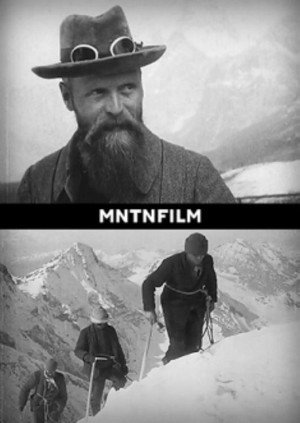
The ascent of the Wetterhorn by Frank Ormiston-Smith accompanied by the guide Christian Bergener, Rev. H. J. Heard, Mr. E Burchell-Rodway from the Alpine Club, and the hotelier Herr Fritz Boss from Grindelwald. The film consists of 24 scenes including a final scene of the team on the summit. The film starts with the climbers and the guide leaving the Bear Hotel, at Grindelwald. Later the party arrives at the Wetterhorn Hotel, at the mountain base. They climb the Milchbach Ladders to gain the top of the glacier, cross the Seebach Platte and the upper glacier, and pass the night at the Mountain Inn. Next morning they overcome the Great Coulvu and gain the arete to finally reach the summit. Sections of the film are tinted to give the effects of dawn, sunset and rose-glow actually experienced during the climb.
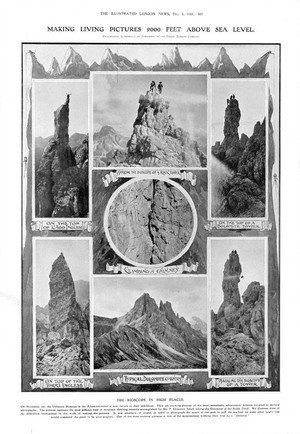
Frank Ormiston-Smith, the pioneer mountaineering photograher and filmmaker, filmed in 1906 the ascent to several towers in the Cinque Torri area in the Dolomites, acomppanied by Bortolo Barbaria, Baldessare Verzi and Damiano Dibona, three well-known Ampezzo mountain guides. Among others, the team ascended Torri Inglese, and placed the camera on top of some of the towers by pulling it with a rope. The film, produced by the Urban Trading Company, was presented at the Alhambra Theater in London in November 1906. Ormiston-Smith is considered the father of mountain cinema. In 1902 he filmed the first major mountain film shown widely in cinemas: "The Ascent of Mont Blanc". The success of his films encouraged the production of alpine films in which mountaineering feats were shown, and inspired other pioneer filmmakers.
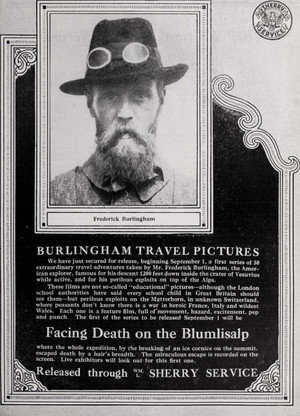
A record of the ascent of the Jungfrau by Frederick Burlingham accompanied by four mountain guides. The film starts with panoramics of the Eiger North Face from Kleine Scheidegg. The party begin the climb from the Jungfraujoch Station crossing the Jungfrau Firn and reaching the summit of the Jungfrau by the steep Roththal Sattel. Frederick Burlingham was a traveller cinematographer and one of the mountain film pioneers. Continuing the mountain film tradition established by Ormiston-Smith, Burlingham filmed several mountaineering films largely in Switzerland, taking mountain film in a new direction of immediacy and perceived peril. In the early history of factual filmmaking, Burlingham played a substantial role in developing the related genres of the mountaineering and the exploration film.
Где обедал воробей
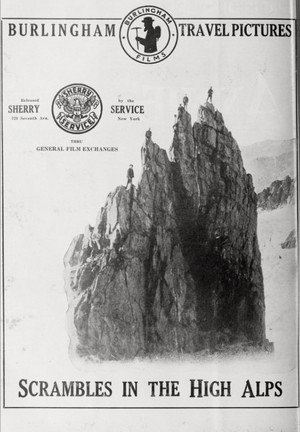
Released in 1923, produced by Frederick Burlingham.
The ascent of the Zinalrothorn filmed by Frederick Burlingham in September 1916. Burlingham, known at the time as 'The man who kinematographed the Matterhorn', was a traveller, cinematographer, and one of the mountain film pioneers. Continuing the mountain film tradition established by Ormiston-Smith, Burlingham filmed several mountaineering films largely in Switzerland, taking mountain film in a new direction of immediacy and perceived peril. In the early history of factual filmmaking, Burlingham played a substantial role in developing the related genres of the mountaineering and the exploration film.
Documentary on mountain climbing in the Swiss and Italian Alps.
...where the whole expedition, by the breaking of an ice cornice on the summit, escaped death by a hair's breadth. The miraculous escape is recorded on the screen.
The two guides Adrien and Félix Veillon with the customer Rotschild climb the Argentine ridge in the Swiss canton of Valais. The film was so successful that it encouraged director Emile Gos, the legendary mountain filmmaker, to make what probably was one of the firsts mountaineering feature films 'La Croix du Cervin'.
A man and a woman climbing the Grinnell Point in Glacier National Park. They start from the Many Glacier Hotel and progress on an easy terrain first to keep climbing on difficult and vertical rocks later. Finally the summit is reached and a panorama of the Swiftcurrent Lake and the hotel from the top is shown. The film belongs to a series of two films made to promote tourism travel to the Glacier National Park. The couple in the film are Dorothy Pilley, the prominent British mountaineer, and her husband Ivor Armstrong Richards, who traveled to the Glacier National Park in 1926 where they scaled 25 peaks in 19 days, together with Hans Reiss from Norway and Count Rinkie Donnersmark from Germany.
A man and a woman in a mountaineering tour on the Blackfoot Glacier in the Glacier National Park. They cross the glacier, negotiating big crevasses and progressing by cutting steps using the ice axe. The two finally reach reach the summit of a rocky peak. The film belongs to a series of two films made to promote tourism travel to the Glacier National Park. The couple in the film are Dorothy Pilley, the prominent British mountaineer, and her husband Ivor Armstrong Richards, who traveled to the Glacier National Park in 1926 where they scaled 25 peaks in 19 days, together with Hans Reiss from Norway and Count Rinkie Donnersmark from Germany.
Chahinaz is a young Algerian woman who dreams of freedom and who cannot understand why her life is being dictated to her. A student in Constantine, this young sparkling woman loves her country but is suffocated by the weight of tradition and religion. How can you change society in a country where the law officially sanctions inequality between men and women? How can women’s rights be advanced on a global level? In order to find answers to her questions, we have travelled to her country and across several continents, comparing her situation with that of other women. And also to inform those who have the power to change what Chahinaz does not accept. Chahinaz asks questions without blinkers, and seeks answers that are not just black and white. She brings a fresh and intelligent view to the condition of women in the North and the South, and in the process challenges some widely prevalent clichés about Muslim women.