David McVicar's exhilarating new production, with Anne Sofie von Otter in the title role, restores the Opera Comique to Bizet's masterpiece. Philippe Jordan, in his Glyndebourne debut, conducts the London Philharmonic Orchestra, the Glyndebourne Chorus, and a cast which includes Marcus Haddock, Laurent Naouri, and Lisa Milne.
An Egyptian military commander, Radamès, struggles to choose between his love for the enslaved Ethiopian princess Aida, and his loyalty to the Pharaoh. To complicate the story further, the Pharaoh's daughter Amneris is in love with Radamès, although he does not return her feelings.
Simon Keenlyside smolders dangerously in the title role of Mozart’s version of the legend of Don Juan, creating a vivid portrait of a man who is a law unto himself, and all the more dangerous for his eternally seductive allure. Adam Plachetka is his occasionally unruly servant Leporello. It’s when Giovanni tangles with Donna Anna (Hibla Gerzmava) that things start to unravel, aided by the reappearance of Donna Elvira (Malin Byström), who is determined not to let her seducer go. With Paul Appleby as Don Ottavio, Donna Anna’s eternally steadfast fiancé. Principal Conductor Fabio Luisi leads the Met Orchestra and Chorus.
The Met’s spectacular production of Verdi’s Egyptian epic captures both the grandeur and the intimacy of this powerful tale of love and politics. Liudmyla Monastyrska is Aida, the Ethiopian princess-turned-slave in love with the Egyptian warrior Radamès, sung by Roberto Alagna. Olga Borodina is her rival, Amneris, daughter of the Pharao, and George Gagnidze sings Aida’s father, Amonasro, the King of Ethiopia. Principal Conductor Fabio Luisi is on the podium.
Stage director Emilio Sagi's production of the legendary Barber of Seville is enriched by a bright distribution. Maria Bayo returns to one of her signature role as Rosina, opposite Juan Diego Florez, the Rossini expert tenor. The title role is embodied by the Italian baritone Pietro Spagnoli, while Ruggero Raimondi and Bruno Pratico reconcile the audience with Don Basilio and Don Bartolo.
Die Walküre (The Valkyrie), WWV 86B, is an opera in three acts by Richard Wagner with a German libretto by the composer. It is the second of the four operas that form Wagner's cycle Der Ring des Nibelungen (The Ring of the Nibelung). The story of the opera is based on the Norse mythology told in the Volsunga Saga and the Poetic Edda.[1][2] In Norse mythology, a valkyrie is one in a group of female figures who decide which soldiers die in battle and which live. Die Walküre's best-known excerpt is the "Ride of the Valkyries". DVD release June 2009.
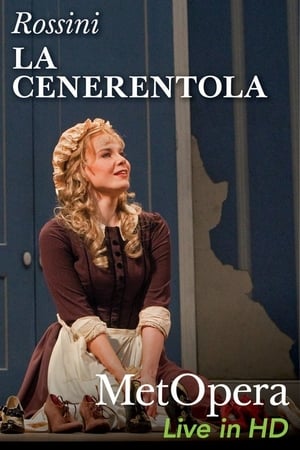
In late 18th-century Italy, in the mansion of Don Magnifico, the young and pretty Angelina works as a maid. Teased by her two frivolous half-sisters, Clorinda and Tisby, Angelina believes she is in love with a young valet and goes to the ball. Dressed in her finest finery, she meets the man who is in fact the Prince and flees from him after giving him a bracelet that will allow him to recognise her a little later. The masks come off, and kindness and love triumph! ‘La Cenerentola’ is the last opera buffa composed by Gioachino Rossini for an Italian audience. A dramma giocoso in two acts, with a libretto by Jacopo Ferretti, freely adapted from Charles Perrault’s fairy tale ‘Cinderella’ (1697), omitting the magic in favour of a realism tinged with humour and social criticism. Premiered for the Rome Carnival at the Teatro Valle in Rome on 28 January 1817. Recorded live at Glyndebourne Opera, Lewes, East Sussex, on 2 and 4 June 2005.
The writer Dario Fo applies his inventive genius to Rossini's comic opera in its premiere DVD release. Recorded in 2005 under the musical direction of Maurizio Barbacini, Fo's production brings fresh vitality and colour to the story of Lisetta, and of her father Don Pomponio's increasingly ridiculous attempts to find a husband for her through an advertisement in the newspaper LA GAZZETTA. Filmed using high definition cameras with multitrack sound.
Robert Lepage’s dreamlike production, with its thousands of twinkling LED lights stretching across the stage to represent the sea, encapsulates the mystic feeling of L’Amour de Loin, Saariaho’s haunting opera of distant love. Eric Owens is Jaufré Rudel, a troubadour in 12th century France who has become tired of his hedonistic life and longs for an idealized love. Enter the Pilgrim (Tamara Mumford) who tells him his perfect love does, in fact, exist, far across the sea. She is Clémence, Countess of Tripoli (Susanna Phillips). The magic of the characters’ inner lives as they explore the meaning of love, longing, life, and death is heightened by Saariaho’s hypnotic and bewitching score, conducted by Susanna Mälkki.
Richard Strauss's opera, from the Royal Opera House, Covent Garden.
Live performance at the Metropolitan Opera in 2000.
Live performance from the Opéra National de Paris, 2003.
The Semperoper caused a sensation in November 2007 when it visited Japan for the first time in twenty-six years. The demand for tickets and the audience's enthusiasm were unprecedented, not least because the company was staging a piece that is performed more authentically in Dresden than anywhere else in the world: Richard Strauss' Der Rosenkavalier, which received its first performance in Dresden in 1911. Leading the ensemble was the radiant-voiced and profoundly thoughtful Marschallin of Anne Schwanewilms.
Recorded at the Musiektheater, Amsterdam on 21 & 25 January 2008. Performed by De Nederlandse Opera, composer Jean-Philippe Rameau's renowned tragedy "Castor et Pollux" tells the myth-based story of the selfless love between two brothers: Castor, who is mortal, and the immortal Pollux. When Castor dies trying to prevent the kidnapping of the woman he loves, Pollux decides to become mortal and replace his brother in the Underworld. Finnur Bjarnason, Henk Neven and Anna Maria Panzarella star.
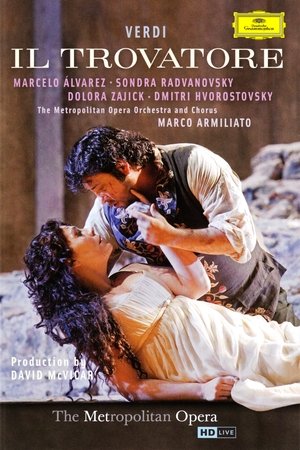
Verdi’s IL TROVATORE again storms the Met stage in a star-studded, anvil-wielding cast , including Sondra Radvanovsky, Dolora Zajick and Dmitri Hvorostovsky. Marcelo Álvarez sings Manrico, the troubadour of the title. The story is well-known already: The gypsy Azucena has harbored a grudge for thirty years, but she is about to have revenge at last. Meanwhile, her son Manrico is in love with Leonora, but so is his arch-enemy, the Count Di Luna. A pot-boiler, where every tune is a hit.
Jean-Marie Villegier's modern interpretation of Handel's "Rodelinda" – filmed live at the world-renowned Glyndebourne Opera House in the United Kingdom, sets the timeless tale of jealousy and treachery in the black-and-white world of the silent-movie era. Soprano Anna Caterina Antonacci sings the title role of Rodelinda, with tenor Kurt Streit and bass Umberto Chiummo performing the parts of Grimoaldo and Garibaldo, respectively.
“In a world that often demands certainty, Dialogues des Carmélites invites us to sit with profound questions that have no easy answers: What makes a life worthy? How can we be truly prepared for our inevitable end? What does security mean when everything familiar is threatened? What sustains us when our institutions crumble? … Rather than imposing answers, the opera creates room for reflection on how faith manifests not as abstract doctrine, but as lived experience under extraordinary pressure.” — Louisa Muller, Director’s Note. Juilliard Opera directed by Louisa Muller. Matthew Aucoin conducts the Juilliard Orchestra. Performed and recorded on April 26, 2025 at the Peter Jay Sharp Theater. Dialogues des Carmélites, an opera by Francis Poulenc. Libretto adapted by the composer.
A Victor Hugo play, haunting and scandalous, provided the inspiration for Verdi’s mid-career masterpiece. A vengeful but misguided court jester strives to save his daughter from a duke’s licentious clutches, but can't part with the feeling that a curse looms over all of his actions. In Rigoletto, the composer introduces several of his most iconic arias and duets—as well as an 11th-hour quartet that counts among the finest moments in opera.
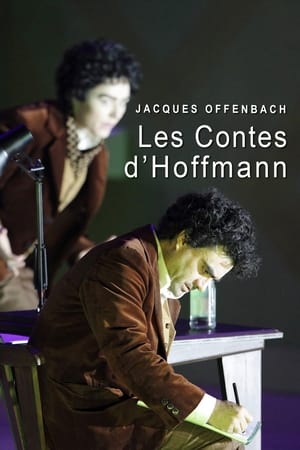
Live performance, Bayerische Staatsoper, 2011. The Tales of Hoffmann (French: LES CONTES D'HOFFMANN) is an opéra fantastique by Jacques Offenbach that combines three short stories by E.T.A. Hoffmann into a haunting whole: a melancholy poet reflects on three women he loved and lost in the past: a mechanical performing doll, a Venetian courtesan, and the consumptive daughter of a celebrated composer. One of the questions this opera poses for any director is how to link the 'tales' of Hoffmann's three lost loves together and knit them satisfactorily into the Prologue and Epilogue. In this production, Richard Jones solves the puzzle by turning it into an autobiographical journey which ends with a grand meet-up of all the characters Hoffmann has encountered: for once, Hoffmann is not presented as a rollicking kind of drunken story-spinner, but rather a sad-eyed, sobered-up depressive, who reaches for the bottle only because his disastrous love life has gone wrong yet again.
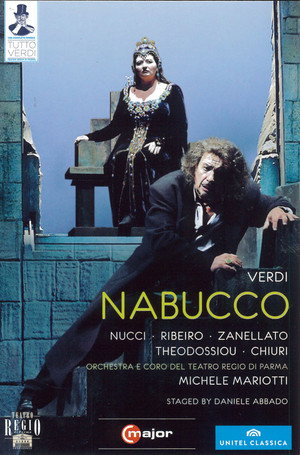
‘Nabucco’, or ‘Nebuchadnezzar’ (Italian: Nabucco), is an opera by Giuseppe Verdi with a libretto by T. Solera, based on events described in the Bible. (Nabucco is a shortened Italian rendering of the name of King Nebuchadnezzar II). It was this opera, the third in Verdi’s oeuvre, that brought him true fame. It tells of the tribulations of the Jews, their captivity by the Babylonians, and their subsequent release to their homeland by Nebuchadnezzar, King of Babylon. Giuseppe Verdi’s opera ‘Nabucco’, is a monumental work that tells the story of the enslavement of the Hebrew people by the Babylonian king Nebuchadnezzar (Nabucco) and their journey towards redemption. The premiere took place on 9 March 1842 at La Scala in Milan. The first performance of the final version was held at the Teatro San Giacomo in Corfu in September 1844. From the box set of 27 Verdi operas, ‘Tutto Verdi’. Recorded live at the Teatro Regio in Parma, 12–14 October 2009.