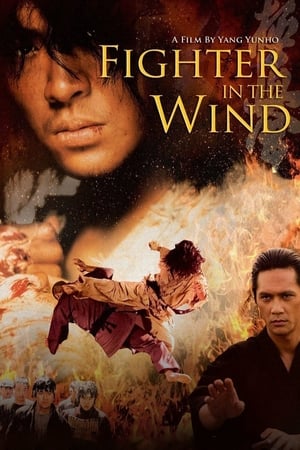
The story is about the Japanese occupation of Korea during World War II. A Korean patriot played by Carter Wong gets into a fight with some Japanese people and is chased into a church. The priest there is captured and tortured. Trying to secure his release, the leader of the resistance, Jhoon Rhee is himself captured and tortured by the Japanese. Carter Wong, Angela Mao and Anne Winton have to now try and rescue him. This leads to an explosive climax with the heroes having to fight the likes of Wong In Sik (Hwang In-Shik), Sammo Hung and Kenji Kazama.
During the Japanese colonial rule of Korea, while people are in despair, Jae-ho tries to raise morale by winning cycle championship. Bok-dong, who started cycling with Jae-ho just to make a forture, becomes a symbol of hope for Koreans by defeating Japanese cyclists.
During the Japanese occupation of Korea, the Japanese Empire seeks to eradicate the Korean language and identity. In retaliation, a small group of Korean patriots try to protect their language by compiling the first Korean language dictionary.
After the Japanese kidnap two Korean teenagers and take them to a comfort station to join other girls who are serving as sex slaves, only one of them survives. Decades later, the elderly woman tries to reunite with her friend's spirit.
During the country's occupation Choi was only allowed to make Japan-friendly films, but the plot of Hurrah! For Freedom is distinctly different, telling the story of a Korean resistance fighter in 1945.
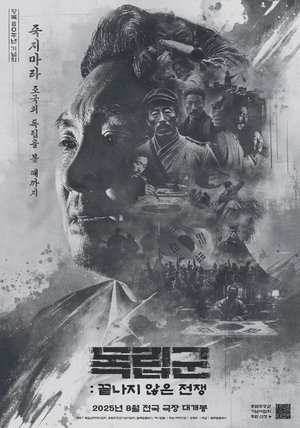
Over a 4 day period, a fierce battle takes place between Korean independence militias and imperialist Japanese forces in Manchuria, China. The militia includes a master swordsman and an expert marksman.
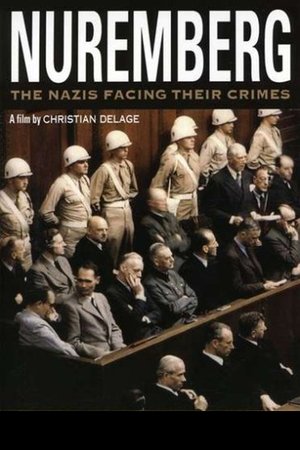
In 1945, two young American soldiers, brothers Budd and Stuart Schulberg, are commissioned to collect filmed and recorded evidence of the horrors committed by the infamous Third Reich in order to prove Nazi war crimes during the Nuremberg trials (1945-46). The story of the making of Nuremberg: Its Lesson for Today, a paramount historic documentary, released in 1948.
Jung So-yul and Seo Yeon-hee are aspiring singers who wish to gain success. However, their friendship crumbles after Jung So-yul becomes jealous of Seo Yeon-hee's relationship with their manager.
Under the oppressive Japanese colonial rule, Deok-hye, the last Princess of the declining Joseon Dynasty, is forced to move to Japan. She spends her days missing home, while struggling to maintain dignity as a princess. After a series of failed tries, Deok-hye makes her final attempt to return home with help of her childhood sweetheart, Jang-han.
Jazz and decolonization are intertwined in a powerful narrative that recounts one of the tensest episodes of the Cold War.
Syngman Rhee, the founding president of the Republic of Korea spent a total of thirty years in Hawaii. The first 25 years occurred before he was elected the founding president and five years were after he resigned from the presidency. What is the significance of 30 years in one’s life span?
Movie based on a book by Kakou Senda about the use of women as sexual slaves by the Japanese Army during WW2.
20 years later, the recreation of the trial of a simple man that confesses himself as a war criminal, Carl Emmanuel Jung.
Francesca, tormented by her past, breaks the silence to talk about surviving the horrors of the comfort stations of Imperial Japan.
The story of the International Military Tribunal for the Far East, known as the Tokyo Trial, which, just after the Second World War, was established in Japan as a special jurisdiction in 1946 (it was closed in 1948) to judge the war crimes of the Japanese leaders; and how and why officials in Washington prevented Emperor Hirohito to be seen sat on the bench.
A Japanese-American director digs deep into the controversial 'comfort women' issue to settle the debate on whether the women were paid prostitutes or sex slaves, and reveals the motivations and intentions of the main actors pushing to revise history in Japan.
Park Kyung-won, who aspired to become a pilot since a young age, enrolls at an aviation academy in Japan. There she meets a charming exchange student from Korea who she is destined to be with.
An Jung-geun fights for Korea's independence from the Japanese Empire and sparks a movement. In 1909, he assassinates Itō Hirobumi, the first prime minister of Japan and resident-general of Korea.
A former war photographer tries to ward off his personal ghosts by taking pictures of trees only. He lives alone among olive trees in southern Italy. One day he decides to cross the sea. Once in Albania, he goes near the location where he had made his last war picture, as if he was retracing his steps. He finds a tree he wants to photograph. He is just about to do so, when he discovers a runaway girl hiding in it with the sole objective of crossing the sea and getting to the other side. The man has no choice. He has to flee with her, follow her and guide her along until a storm separates them.
Summer of 1939. Zosia is a young Polish girl who is deeply in love with Ukrainian Petro. Their great love will be put to the test when her father decides to marry her to a wealthy widower Skiba. Right after wedding she is left alone because her husband is drafted to the Polish army for the war with Germany. Meanwhile, tensions grow due to Jews, Poles, and Ukrainians living side by side.