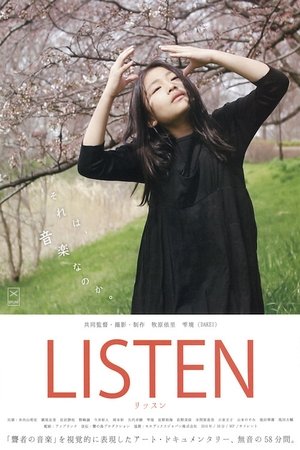
Documentary without audio produced by deaf people. Music is depicted visually with the complete absence of musical instruments or voices. Directed by Makihara Eri and choreographer Dakei. With a diverse lineup including ordinary deaf people with zero acting experience and a choreographer who performs in Japan and abroad, this film pulls out all the tops to give visual expression to music through the physical body. An aging man uses multiple sign language poems to convey the four seasons, and a girl expresses the wind amidst the rustling trees.
A quickfire portrait of the New York City ballroom scene in the ‘80s.
Released on DVD as part of The Criterion Collection's "Martha Graham: Dance on Film" collection.
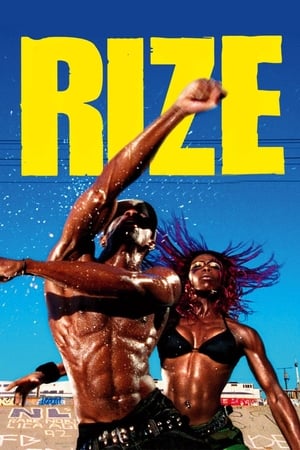
A documentary film that highlights two street derived dance styles, Clowning and Krumping, that came out of the low income neighborhoods of L.A.. Director David LaChapelle interviews each dance crew about how their unique dances evolved. A new and positive activity away from the drugs, guns, and gangs that ruled their neighborhood. A raw film about a growing sub-culture movements in America.
A documentary following the conscious evolution of electronic music culture and the spiritual movement that has awakened within.
From the rains of Japan, through threats of arrest for 'public indecency' in Canada, and a birthday tribute to her father in Detroit, this documentary follows Madonna on her 1990 'Blond Ambition' concert tour. Filmed in black and white, with the concert pieces in glittering MTV color, it is an intimate look at the work of the icon, from a prayer circle before each performance to bed games with the dance troupe afterwards.
Dance educator LIN Ssu-tuan is the first professional nude model in Taiwan in the 1950s and the 1960s, the muse for painters and sculptors in the art world, and the face for photographers’ salons around the world; in the end, she reversed the dynamics of the subject vs. the object and went on to perform her first solo modern dance in 1975, turning herself from the state of passiveness to an active educator of the art of dance. LIN is over 80 years old, but she still fervently pursues her ideals and passions with her body; her path of life is indeed a book of female art history that communicates with the society in Taiwan.
The first woman to appear in front of an Edison motion picture camera and possibly the first woman to appear in a motion picture within the United States. In the film, Carmencita is recorded going through a routine she had been performing at Koster & Bial's in New York since February 1890.
Maurice Hines -- actor, director, singer, and choreographer -- navigates the complications of show business while grieving the loss of his more famous, often estranged younger brother, tap dance legend Gregory Hines.
About the sensuality in Swedish folk dance and folk music. A film that blends dance, fiction and documentary material into a heated, rough and skin-like expression.
How do humans and animals see each other? Dominique Loreau captures astonishing exchanges of “views” between people and animals who coexist in the city, in farms, slaughterhouses, zoos, museums, or in a dance rehearsal room. In The Eyes Of A Beast questions the permeable boundary between man and animal.
Actors from Warsaw's garden theatres dance a traditional Polish dance, cracovienne.
While most of Ken Russell's documentaries for the BBC's Monitor arts strand focused on a single creative figure, he would also occasionally make more wide-ranging surveys of the state of a particular art. The Light Fantastic (BBC, tx. 18/12/1960) was written and presented by Ron Hitchins, a Cockney barrow boy who has long been interested in a great many dance forms, and who has recently taken up Spanish dancing. Hitchins participates in some of the dance sequences, but his main contribution is an enthusiastic commentary that helps personalise what could have been simply a disparate collection of dance footage. He's not shy about expressing likes and dislikes, being none too keen on ballroom dancing (too choreographed), rock'n'roll (too monotonous) and Morris dancing (just doesn't like it), though anything genuinely spontaneous gets a thumbs up, even if it's a room full of people dressed in black swaying to the sound of a gong.
A document of Tatsumi Hijikata's Butoh dance with Kazuo Ohno as the guest dancer shot in Hijikata's early period when he was emerging as the originator of Butoh. All of the male dancers are dressed up with evening suits and move gracefully, yet an intruder breaks up the whole scene abruptly. The film is worth seeing, even if just to see a memorable gay duet of Hijikata and Ohno. Overexposed, washed out images are sandwiched among normal ones.
This short documentary profiles the traditional music and pageantry of Polish-Canadians in Manitoba. The heritage and national traditions of Poland were brought to Canada by immigrants and sustained across generations. The colourful traditional dress and lively music of Polish-Canadians is captured by ethnomusicologist Laura Boulton, a pioneering woman in the educational documentary film movement whose goal was to “capture, absorb, and bring back the world’s music.”
An overdressed girl tries her luck in dance events that are for Finnish tourists in a small Estonian health resort town, Pärnu.
Ida, Olympe, Jeanne and Marie dance to the music of pianos, symphonies, contemporary pieces… in ballet school studios, in the streets, even in their bedrooms. They are between 6 and 11 years old. Very fond of each other, they film themselves, comparing and giving one another support. They also tend to annoy one another, are at times envious, even rejecting each other. What is it like for a little girl to grow up in a world of intense professional and competitive dancing? Closely following the emotions and dilemmas experienced by our young characters, this film explores and probes into a territory that we’ve all navigated, though many of us have forgotten: childhood.
In this revealing documentary, burlesque star Immodesty Blaize examines the world of British burlesque and the resurgence in its popularity.
A documentary on the surviving syncretic pagan midwinter customs of the British Isles, focusing on nine ritual celebrations ranging from the Moray Firth in the north, the Somerset Levels in the south, Humberside in the east, and County Kerry in the west. Featuring music by the Albion Band and narration by John Tams.
A unique hybrid of documentary, silent film, drama and dance, 'Breaking Plates' puts revolutionary women of the past on the screen with present day filmmakers. Contemporary women talk to characters from 100 years ago, reanimate their antics and emulate their mayhem moves. As early 21st century performers step into the clothes of their early 20th century counterparts, battling their haywire machines, exploding gags, and eruptive bodies, they learn to wield humour as a weapon against the structures that contain them today.