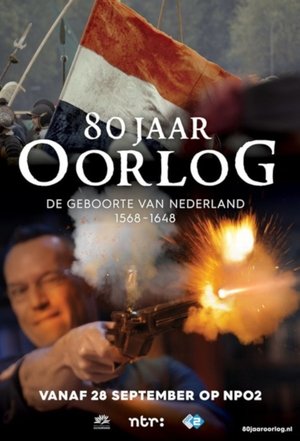
At the end of the 16th century, Dutch subjects revolted against legitimate Spanish rule. What starts with the discontent of a minority grows into a war that will last more than a lifetime. From Groningen to Brussels, from Den Briel to Groenlo, the battle erupts everywhere. And often that struggle has a strangely modern appearance. Terrorism, propaganda, executions, radicalization, shock and awe; all themes that can easily be found in the war that was fought from 1568 to 1648. In a 7-part television series, the NTR will bring the stories about the 80-year war that can be found all over the country from September 28, every Friday at 9.05 pm on NPO 2. And Hans Goedkoop oversees the battlefield with experts.
From dangerous explosives and deadly curses that put everyday people at risk, to treasures found in the unlikeliest of ways, each episode digs into the people, the places and historical significance of these discoveries. And sometimes just being in the right place at the right time can make history…because nothing stays hidden forever.
Afrique(s), une autre histoire du XXème siècle
From wagon trains crossing the untamed frontier to man's first steps on the moon, this series offers a compelling look at the people, inventions and events that helped forge the United States of America.
A historical exploration about the eruption of Vesuvius in 79 A.D. and the preserved Roman city it left behind.
Martin Clunes: Islands Of Britain
The history of mankind is a never-ending story of change, revolution, and evolution, but surely no span of a hundred years can claim to have changed the world so dramatically as the Twentieth Century. In this series we examine the 101 Events which, in the judgment of experts, including those who contribute to the series, most influentially shaped the century, our world, and our way of life.
Invented 2700 years ago, closely linked to the destiny of empires and wars, money has changed the course of civilizations. From ancient Greece to contemporary America via ancient China and the French Revolution up to today's dematerialization of money initiated by Bitcoin, this documentary series deciphers the place it has played for millennia.
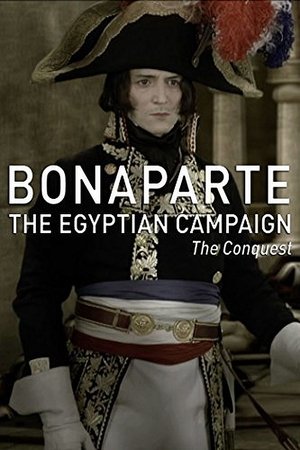
In the spring of 1798, Napoleon set out with 38,000 men and 10,000 sailors to conquer Egypt.
In the aftermath of the Second World War, relations between the former allied eastern and western powers deteriorated fast. Suddenly, the small island nation found itself in the midst of the ensuing “cold-war”, which it used to its full benefit to catapult into the modern world. A founding member of the NATO alliance, Iceland provided an important base for forward operations in protection of NATO’s northern flank and Scandinavia and the approaches to North America by U.S. and allied forces.
David Dimbleby examines the power, wealth and survival of the institution at the heart of our national life: the monarchy.
Historian James Burke continues his journey through random historical connections that together have shaped our world and provide important clues to our future.
2005 : État d'urgence
Renowned author and journalist David Lagerkrantz, along with historians, forensic scientists and investigators, sheds new light on Swedish murders in the past.
In this documentary series, interspersed with historical reconstructions, Tom Waes investigates what has happened since the arrival of the first Homo sapiens, on the 14,000 square kilometers that we today call Flanders.
1942, Great Patriotic War. Returning from a mission, experienced snipers brothers Alexey and Yegor Broshin encounter the German high-class sniper Wengler. As a result of the duel, Yegor dies, and Alexey is seriously wounded and ends up in the hospital. Having barely recovered, he rushes to the front, but the medical board declares him unfit. Instead of returning to the front line, the command entrusts Alexey with an unusual task - to teach young female cadets how to be a sniper. Alexey undertakes to train his players harshly, sometimes even cruelly.
Through interviews with historians, architects, archaeologists and local organizations, this documentary series describes the history of Casablanca, from its origins to the present day.
The series covers the life and work of leading science fiction authors of the last couple of centuries. It depicts how they predicted and, accordingly, influenced the development of scientific advancements by inspiring many readers to assist in transforming those futuristic visions into everyday reality.
The great story of our country. About the people and forces that shaped it - from the Ice Age to the present day. Simon J Berger is the narrator of the series. The program series consists of ten parts and is based on reconstructions of historical events and people. Over 300 experts have contributed to the content and 100 of them appear in the series. The series' signature melody is composed by Ludwig Göransson and Per-Gunnar Juliusson.
How did a small island once rule over a quarter of the world's population? This shared history still shapes us today - and billions of people are part of its story.