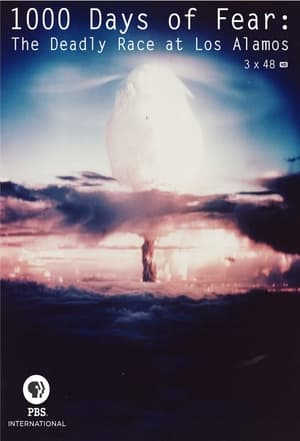
The triumphs and failures of the men and women who created the world's first atomic bomb as part of the Manhattan Project at Los Alamos. This the story of the men and women who worked on a research and development project that produced the first nuclear weapons during the Second World War with First-hand accounts from the men and women who worked on the Manhattan Project and developed the atomic bomb at Los Alamos during the Second World War.
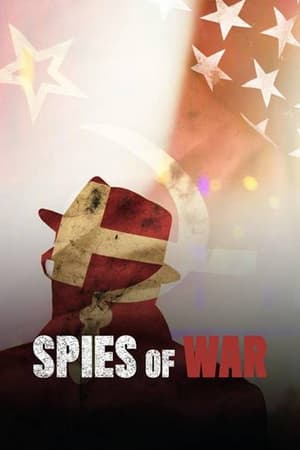
Montagu, Garbo, Fuchs, Penkovsky... they were the greatest spies of the twentieth century. Through analysis of declassified documents, archives, reconstructions, and interviews, “Spies of War” offers you a glimpse into the minds and methods of undercover operatives. Discover the tactics for transmitting top secret information. See how one man assumed 24 identities to simulate the existence of a spy ring. Witness how scientists provided the USSR with ultra-confidential plans for the atomic bomb.
When the Nazis secure a heavy water plant to realize their plan to create an atomic bomb, the Norwegian Allies struggle to sabotage the operation.
Set against the backdrop of the greatest clandestine race against time in the history of science with the mission to build the world's first atomic bomb in Los Alamos, New Mexico. Flawed scientists and their families attempt to co-exist in a world where secrets and lies infiltrate every aspect of their lives.
End of Innocence is a two-part television film that focuses on the work of the German Uranium Association during World War II. At Farm Hall in England, the ten German nuclear scientists interned there as part of Operation Epsilon learn of the dropping of the first atomic bomb on Hiroshima in August 1945. In flashbacks, the development of the German uranium project is recapitulated chronologically from the discovery of nuclear fission by Otto Hahn to the work of Kurt Diebner at the Heereswaffenamt to the experiments of the Kaiser Wilhelm Institute for Physics under Werner Heisenberg and Carl Friedrich von Weizsäcker at the Haigerloch research reactor in spring 1945.
With firsthand accounts and access to prominent figures around the world, this comprehensive docuseries explores the Cold War and its aftermath.
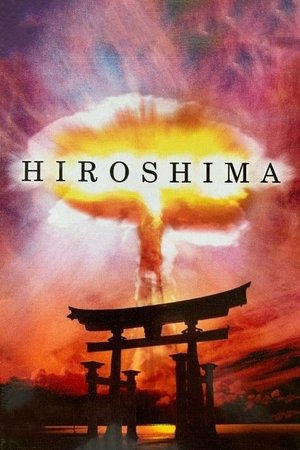
Hiroshima is a 1995 Japanese / Canadian film directed by Koreyoshi Kurahara and Roger Spottiswoode about the decision-making processes that led to the dropping of the atomic bombs by the United States on the Japanese cities of Hiroshima and Nagasaki toward the end of World War II. A combination of dramatisation, historical footage, and eyewitness interviews, the film alternates between documentary footage and the dramatic recreations.
Die Bombe
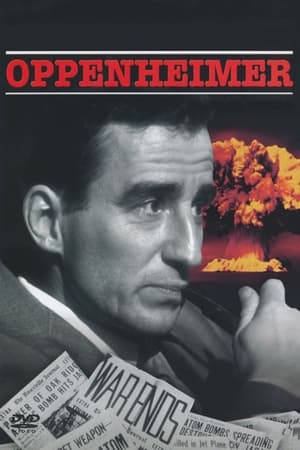
This seven-part series highlights scientist J. Robert Oppenheimer from 1938 to 1953 as he develops the Atomic bomb.
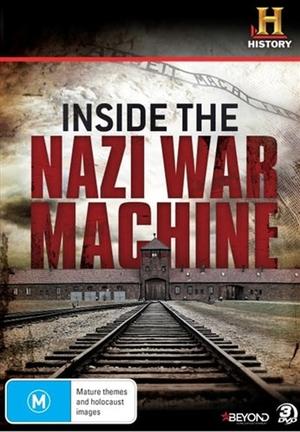
Discover the terrifying truth behind one of the most sinister yet effective organisations of the past century, as we take an in-depth look inside the Nazi war machine. Examine the technology that enabled Hitler's Nazi regime to spread death and destruction across Europe and far beyond, from the airborne Luftwaffe, aggressors in the infamous Blitz bombing campaign, to the Panzer tanks that dominated Europe's battlefields and the 'Wolf Packs' of U-boats that terrorised international waters. Explore the rigorous training, tactics and equipment available to Hitler's elite fighting forces through unique footage of these highly accomplished units in action. Learn how the Nazi plan to develop an atomic bomb could have drastically altered the course of the war, and of all human history, before witnessing perhaps the most chilling artefact of all: the blueprints and diagrams for the Auschwitz Concentration Camp.
Tells the story of Cornelia Titko, a brave scientist with remarkable memory, whose childhood was destroyed by the premature death of her parents and older sister. Cornelia's mother, Teresa Titko, was an outstanding nuclear physicist; in the Gierek nuclear program, she played the role of the right hand of its creator, general-professor Grzegorz Giedrowicz. Years later, a mysterious man appears in Cornelia's life, claiming that he was once accused of murdering her sister. The heroine begins a private investigation. Who is the mysterious man and what really connects him with the death of Cornelia's two closest women? What price will she be charged for trespassing into forbidden territories? What role in this history were played by the officers of the PRL counterintelligence - Captain Ewa Wolańska and Second Lieutenant Tadeusz Mróz? Who wanted Poland not to join the small group of countries that counted in the nuclear race?
Everybody is well into the apps, socials, videos, streams and games. All those online tools often seem to be free, but aren't. You not only pay with money, but also with data. How does that actually work? What happens with that data? Jard Struik investigates this.
樱之味
Hit the hardwood in East Los Angeles as a coach with strong convictions leads young men who hope to fulfill major college potential.
神枪之倒刺
Slovenský panteón
Host Brendan Moar dives into the process of what it takes to bring down some of the biggest structures from around the world.
"Open up, the Police" is the first Russian documentary series about the police. This is a cycle of 26 films about the "harsh working days" of real policemen, employees of the Moscow Department of Internal Affairs "Airport". They perform operational and investigative actions, which are immediately removed by the film group. Among the heroes are a district inspector, an operational officer, an investigator, an inspector for minors and the head of the Department of Internal Affairs. Each episode is dedicated to one crime. The viewer sees with his own eyes how operas work - starting from a call to the police station, ending with the detention of a criminal and his interrogations. The Laurels Award nominees were three series - "Trunk", "Step from the roof", "Snow was falling Quietly".
Today, a series of hockey matches in 1972 between the national teams of Canada and the USSR is remembered only with the prefix super. They call it a milestone in the history of the development of world hockey, and not only hockey. The meeting of Soviet hockey players with Canadian professionals has become the main topic of world news. One Canadian journalist promised to eat the newspaper in which it is printed if the Russians win. The Russians won. And the journalist Dick Beddoes had to fulfill his promise and eat a report in the newspaper with borscht. What happened then, 30 years ago in the USSR, Canada, how the games were held in Canada and Moscow, the intensity of the political confrontation around hockey, life before and after the super series - about all this in five episodes.
"We propose to look at the history and the present day of the Kremlin through the eyes of people who have been serving the Kremlin for years... The film consists of five episodes. The first is the preparation of the Kremlin for the New Year, the second is dedicated to the Kremlin as a presidential residence, then - the Arsenal and military history, the fourth - symbols, the fifth - the Kremlin as a museum.