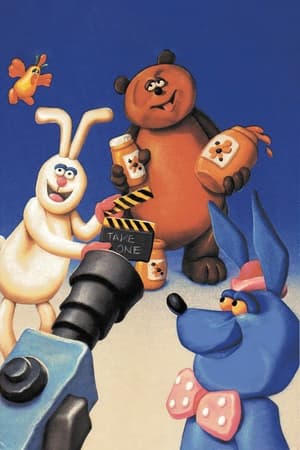
Foxy Fables is an animated television series produced by the leading Israeli animator Rony Oren. All the characters were made from moulded plasticine modelling clay on metal armatures, and filmed with stop motion clay animation. The plot of the series was based on fables by Aesop, La Fontaine, and others that features forest animals acting out the famous stories. The situations always based on the less stronger animal succeed in outsmarting the stronger one who tries to let him down. Every episode would end with a valuable moral. The program was originally created in Israel. 13 episodes were produced.
まんがイソップ物語
Tiswas was a Saturday morning children's British television series which ran from 5 January 1974 to 3 April 1982 and was produced for the ITV network by ATV Network Limited. It was created by ATV continuity announcer Peter Tomlinson following a test period in 1973 when he tried out a few competitions and daft stuff between the programmes.
The Kids of Degrassi Street is a Canadian children's TV show that aired from 1979 to 1986, and is the first in the Degrassi series, about the lives of a group of children living on Degrassi Street in Toronto, Canada. It grew out of four short films: Ida Makes a Movie, Cookie Goes to the Hospital, Irene Moves In and Noel Buys a Suit, which originally aired as after-school specials on CBC Television in 1979, 1980, 1981 and 1982, respectively. The show was acclaimed for its realistic depiction of every day children's lives and tribulations, and remains memorable to many Canadians because of this. Kids of Degrassi Street featured many of the same actors who would later appear on Degrassi Junior High and Degrassi High, including Stacie Mistysyn, Neil Hope, Anais Granofsky, Sarah Charlesworth and others. However, their character names and families were different, so this series cannot technically be seen as an immediate precursor to the later shows.
Vision On was a British children's television programme, shown on BBC1 from 1964 to 1976 and designed specifically for deaf children.
The Flintstone Comedy Hour is a one-hour Saturday morning cartoon anthology series produced by Hanna-Barbera Productions. The program originally aired on CBS as an hour-long show from September 9, 1972 to September 1, 1973 on CBS. The show's first half-hour included new segments featuring Fred & Barney, short gags, vignettes by the cast of Pebbles and Bamm-Bamm and songs performed by the new Pebbles and Bamm-Bamm band called "The Bedrock Rockers" followed by four new episodes and reruns of The Pebbles and Bamm-Bamm Show in the second half-hour. The show also featured bad-luck Schleprock, Moonrock, Penny, Wiggy and the Bronto Bunch from The Pebbles and Bamm Bamm Show. Mickey Stevens replaced Sally Struthers as the voice of Pebbles in four new episodes of The Pebbles and Bamm-Bamm Show and in brief in-between segments, Struthers at the time being fully committed to her role as Gloria Stivic on All in the Family. And this was the final spin-off to feature Alan Reed as the voice of Fred Flintstone because he died in 1977 four months before Fred Flintstone and Friends began to air on October 3, 1977 and he was replaced by Henry Corden who would voice Fred until his own death in 2005.
Five lion robots and their pilots defend the planet Arus and the galaxy from evil King Zarkon.
Laff-A-Lympics is the co-headlining segment, with Scooby-Doo, of the package Saturday morning cartoon series Scooby's All-Star Laff-A-Lympics, produced by Hanna-Barbera Productions beginning in 1977. The show was a spoof of the Olympics and the ABC television series Battle of the Network Stars, which debuted one year earlier. It featured 45 Hanna-Barbera characters organized into the teams which would compete each week for gold, silver, and bronze medals. One season of 16 episodes was produced in 1977–78, and eight new episodes combined with reruns for the 1978–79 season as Scooby's All-Stars. Unlike most cartoon series' produced by Hanna-Barbera in the 1970s, Laff-A-Lympics did not contain a laugh track.
The High-Sierra adventures of Ben Cartwright and his sons as they run and defend their ranch while helping the surrounding community.
This action-packed half-hour lets kids loose in a fantasy sports landscape filled with crazy obstacles. Basketball is taken to its limits in Slam Dunk while rock climbing reaches new heights on the Aggro Crag.
A variety show, with the main feature being the serialized adventures of the two title characters, the anthropomorphic moose Bullwinkle and flying squirrel Rocky. The main adversaries in most of their adventures are the Russian-like spies Boris Badenov and Natasha Fatale. Supporting segments include Dudley Do-Right, Peabody's Improbable History, and Fractured Fairy Tales, among others.
A truly amazing, fantastical, science fiction, funny and odd, and sometimes scary, sad and endearing anthology series presented by Steven Spielberg with guest appearances by many famous actors, actresses, and directors.
The Carol Burnett Show is an American variety/sketch comedy television show starring Carol Burnett, Harvey Korman, Vicki Lawrence, Lyle Waggoner, and Tim Conway. It originally ran on CBS from September 11, 1967, to March 29, 1978, for 278 episodes and originated from CBS Television City's Studio 33. The series won 25 prime time Emmy Awards, was ranked No. 16 on TV Guide's 50 Greatest TV Shows of All Time in 2002 and in 2007 was listed as one of Time magazine's "100 Best TV Shows of All Time."
Granted the power and wings of an eagle by high priests, Birdman defends the rights of mankind across the universe accompanied by his constant companion, an eagle named Avenger.
Action League Now! is a stop motion children's television series that was originally part of All That and then KaBlam! on Nickelodeon, and was later spun off into its own short-lived show. It was made using "chuckimation". The series follows the adventures of a superhero league, composed of various action figures, toys, and dolls. The show was created by Tim Hill. Most episodes took place in a house of an unseen resident. Many of the characters were voiced by radio personalities from Pittsburgh.
Mireille Bouquet is a professional assassin, and a very good one at that. But when she follows up an E-mail from a young Japanese girl named Kirika Yumura, inviting her to take "a pilgrimage to the past", her life becomes even more dangerous than it already is. Now, with a haunting melody invoking the memory of an event long past, Mireille and Kirika decide to work together to find the truth about a thousand-year-old organization that has controlled both of their lives since before they were born. And the only clue in their search, the only thing Kirika remembers about herself, becomes their working codename: a name designating an ancient fate, of two maidens who reign over death—Noir.
"Never lose that strength or nobility, even when you grow up." When Utena was just a child and in the depths of sorrow, she found salvation in those words. They were the words of a prince, who bestowed upon her both a ring and the promise that it would lead her to him again. She never forgot the encounter. Now a teenager, Utena attends the prestigious Ohtori Academy; however, her strong sense of chivalry soon places her at odds with the student council and thrusts her into a series of mysterious and dangerous duels against its members.
New student Haruhi stumbles on the Ouran High School Host Club, an all-male group that makes money by entertaining the girls of the school.
The Bob Hope Show hosted by Bob Hope, debuted on April 9, 1950. During the 1952-1953 season, NBC rotated with other variety shows in a Sunday night block known as "The Colgate Comedy Hour" (Sept. 1950 to Dec. 1955). Also known as, "The Chevy Show with Bob Hope." When the first special debuted in October of 1950 it was the most expensive television program made up to that point - costing an astronomical $1,500 a minute to produce. Bob Hope had his own television show and radio show at the same time. For the next three seasons, The Bob Hope Show was broadcast once a month on Tuesday nights, giving Milton Berle a week off. Bob ended his radio show in April, 1956. Bob Hope also had another show by a similar name, "The Bob Hope Show (All Star Revue)". In addition, he performed in "Specials" for many years. It is the longest running variety program in television's history with a record of 45 years of televised entertainment.
Break-dancing but fierce warrior Mugen has to deal with the cold-blooded and conceited Jin, a samurai who believes he is above all. These sworn enemies are brought together by Fuu for a special task.