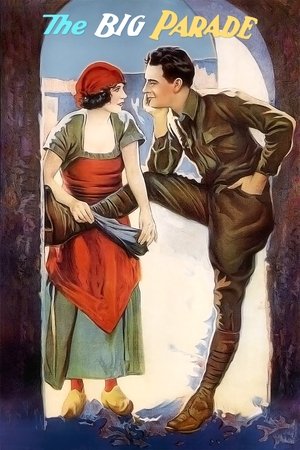
This picture story is a series of stirring war scenes occurring in 1865, at the homestead of Captain Warren, Confederate officer, near St. Petersburg, Va., at that time headquarters of General Logan.
An entire city has lost its voice. Mr. TV, the owner of the city's only television channel, is carrying out a sinister plan to control all of the city's inhabitants.
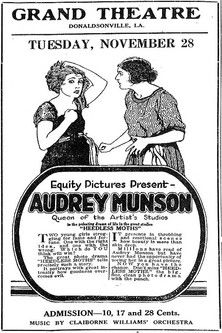
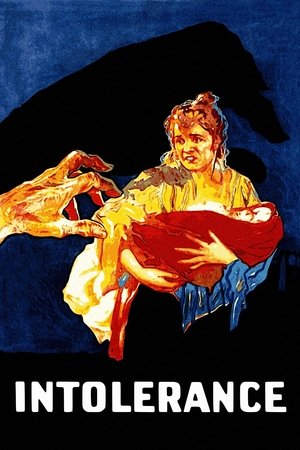
Vera Knight is hired to assist a biologist, Madame Bartlett. Since Vera is a naive girl from the country, she falls prey to the charms of Madame Bartlett's secretary and bookkeeper, Paul Chilton. The inevitable happens, and she goes home to give birth to a little boy while Chilton makes excuses for not marrying her.
A 1919 film directed by Sidney Franklin.
A 1919 film directed by Edward José.
A 1920 film directed by Roy William Neill.
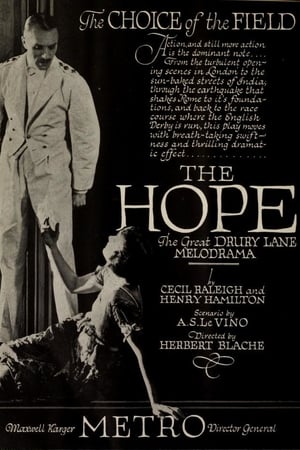
In a provincial Spanish town, during the mid-nineteenth century, Manuela is sold as a dancing girl to a strolling musician. In their wanderings, she meets Don Bartolome, who left his poor father Don Luis to become a highwayman. Bartolome falls in love with Manuela and takes her with him after killing the musician. When they meet Osmund Manvers, an English squire, Bartolome wants to use Manuela to rob him, but Manvers rescues Manuela from a gang of drifters and carries her into the country. Later, Manuela stabs and kills Bartolome after he threatens her. Manuela flees and Manvers searches for her. When Don Luis learns about Bartolome's death, he challenges Manvers to a duel.
Jimmy Martin, king of the motorcycle speedsters, visits the Kingdom of Mandavia for a race. There he is persuaded to impersonate the king by a traitor, Rodolph D'Henri, who intends to annex part of Mandavia for neighboring Selmarnia. The real king is in jail. D'Henri's plot is successful until Martin falls in love with Princess Margaret of Alvernia. Then he discloses his true identity, releases the real king, exposes the traitor, earns knighthood, and marries Margaret.
Nina, mid 20’s, is a visual artist whose art depicts the feminine beauty of all women but struggles with self-identity as a multicultural millennial woman. While flipping through social media her frustration leads her to brood over old photos of complex stages in her life. She’s inspired to create a portrait that represents her personal voyage to self confidence and finally see her beautiful self.
Wealthy young sculptor Harold Harcourt has always used his wife Elena as his model and inspiration. But after a few years he aspires to create a magnificent work of art… a statue of "Youth," yet feels Elena lacks that indefinable "something," which spells Youth. Callously disregarding her feelings, he tells her she is too old turning to Ione whom he sees as the perfect model for his greatest work. As the inevitable follows Elena, broken-hearted, turns to former suitor Julian, who offers solace. Tempted to run away with Julian, she instead goes away alone leaving a note for her husband saying she trusts in him to save the situation. Conscience stricken, he smashes the work of art he has created to make amends and secure his wife's forgiveness.
A Greek man falls for an injured French woman. When he is informed of her death, he continues to sing under her hospital window every night.
After graduating from a convent school, Betty travels to New York to visit her relatives, the Hastings. She quickly catches the eye of Jim Denning, a wealthy neighbor who proposes to her, but Betty decides to experience city life before settling down and finds work as a salesclerk. When the floorwalker becomes too familiar, Betty quits and her showgirl friend Maizie Follette helps her get a job as a cabaret dancer, but Betty finds that’s a tough racket too and decides city life on the loose isn’t for her.
Young Frederica Calhoun, naïve to the ways of the world, having grown up on her father’s Montana ranch, is swept off her feet by the arrival of Lord Cecil Grosvenor, a prospective buyer. He opens her eyes to a hitherto undreamed-of world of refinement and he by her unfailing sweet disposition and sunny bubbling good spirits. They are soon engaged, but during a trip to New York to visit his sister Frederica begins to let her doubts get the better of her and disguising herself as a man follows him to the French Ball, but all turns out well in the end.
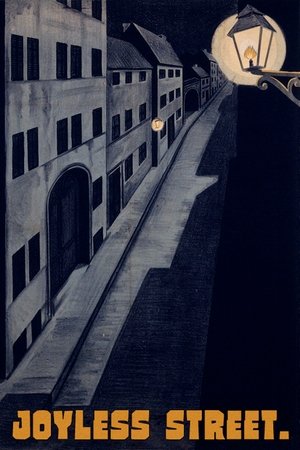
Irked by the success of a brassy nightclub owner. her rivals set out to drive her out of business, and frame her for a murder in the bargain.
Just as Mr. and Mrs. James Randolph Emerson, Jr. are about to depart on their honeymoon, Lucille Emerson discovers her husband gazing at a photograph that bears the inscription, "With love to my husband, Grace." Too proud to question James about the photograph, Lucille is tormented by the image of the woman for many years. Finally Lucille becomes involved in a flirtation with another man, and when her husband learns of her infatuation, he becomes insanely jealous. Enraged, he is choking her when a small boy rushes into the room and collapses. James leaves Lucille, who returns the boy to his tenement home. While there, Lucille discovers that the child is James's son, born to a woman who died in childbirth.
Hell Hath No Fury is a silent drama.
Ivan Mussak, the head of the Russian secret police, is responsible for the murders of thousands of Jews and the forced exile of thousands more. Isaac Gruenstein and his infant daughter Miriam are the only members of his family to survive one of Mussak's massacres, and Isaac is exiled to Siberia. Miriam, however, becomes Mussak's ward and is raised by nuns in a convent. Eighteen years later Isaac dies in Siberia, but before he does he writes a note to his daughter and gives it to fellow prisoner Rachel Shapiro, who manages to escape and, by chance, finds Miriam. However, circumstances have changed in the past 18 years--and Miriam is now Mussak's mistress.
Due to an unfortunate mistake with laboratory samples, a young husband is diagnosed as suffering from the terrible disease of leprosy. In his distress he decides to leave home.
Not everything that grows will bloom. Some stories end halfway, yet leave traces that time can never erase. This is a quiet tale about love that arrived too late, about moments that slipped away before they could be held, and about the kind of loss that teaches us what it truly means to care even when it’s already too late
The Count sets out to make a private room for him and his Countess, built in such a way no one can see, hear, and most importantly, disturb them. But unbeknownst to the Count, his wife has set her eyes on the court minstrel. Based on Edgar Allan Poe's “The Cask of Amontillado” and Honoré de Balzac's “La Grande Breteche”.