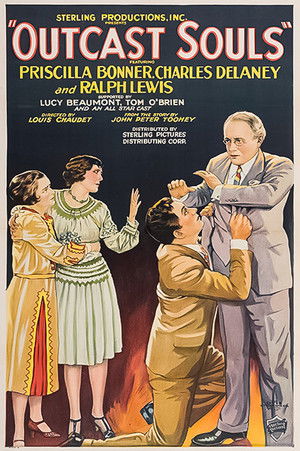
This silent mystery is considered a lost film.
Against the backdrop of New York City of the early 1850s, a young woman -- naively seeking to win the love she reads about in the romance novels she devours -- finds one prospect in an earnest denizen of the Bowery, and another in an elegant young aristocrat. Focusing on the bygone era's fashions, the novelty of the bicycle-built-for-two, and an inventor's quest for the horseless carriage, the film gently stirs the audiences' nostalgia for simpler times.
Pinku distributed by Xces / Nikkatsu
A family suffers greatly during the First World War.
A propagandistic view of the First World War, showing the political greed of the German Kaiser Wilhelm, the resistance of some of his own soldiers, and fanciful prediction of the nature of the war's end.
Henry Warner (Herbert Rawlinson) is so broke that he has sold his overcoat and now his landlady won't leave him alone about the rent. When he sees a wallet sticking out of a rich man's pocket, he's desperate enough to steal it. The police give pursuit, and Henry winds up in someone's study. The man who lives there, Middleton (Alfred Allen) has been looking for someone with Henry's nerve and offers him a job (along with an overcoat and some cash): He must steal back a will that Middleton's nephew, Craig (Harry Carter) stole from him.
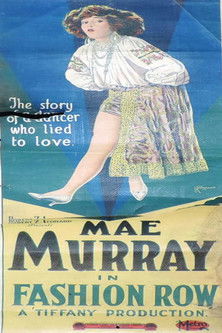
Abby Hopkins, the eldest of a small-town newspaper-owner's five daughters, is urged by her family to marry the wealthy, twice-widowed J.B. Hanks. Abby leaves Hank on the night of the wedding and goes to New York, where she supports herself as a waitress and shares an apartment with a co-worker. At the restaurant, Abby meets J. Booth Hunter, a heavy-drinking "ham" actor, and tries to convince him to give up liquor. Hanks shows up one day and during a battle with his estranged wife, Hunter comes to Abby's rescue. Abby finally gets a divorce from Hanks, Hunter conquers his drinking habit, and Abby marries him.
A girl from Paris' underworld fights for love and survival during a time of international turmoil.
Silent adaptation of the Victor Hugo classic focusing on the character of Esmeralda rather than Quasimodo.
Crusoe, defying his parents, goes to sea, gets shipwrecked, becomes the sole survivor on a deserted island, and builds a new life by salvaging supplies from the wreck, including a dog and cat, creating a fortified home, and learning to survive through hard work and faith, all while battling fear and isolation before eventually encountering 'Friday' and dealing with the intrusion of civilization.
A foppish Londoner joins the Royal Canadian Mounties and tries to break a smuggling ring.
After graduating from an Indian school where he has acquired an education and schooling in the ways of the white man. Ta-wa-wa, a young Indian, returns to his native territory and far western home. On the way to the tribe's encampment he stops at Vail's ranch, meets Kawista, his boyhood sweetheart, who greets him cordially and with a frank admiration for his gentlemanly appearance. While they are exchanging greetings the postman enters and hands a letter to Mr. Vail from Col. Leigh, an Englishman, stating that he will visit the ranch with Lord Wyndham, an English lord who expresses a desire to see a real Indian powwow.
He has fought his last fight and the prize-ring will know the old pugilist no more. Knocked out by an organic disease, he is in a bad way not only physically but financially. He has an interesting daughter, a bright boy and a good wife who are well thought of by the people of the neighborhood in which they live, among whom is a young minister. The doctor who attends the old boxer sees that nothing but a complete change to some warmer climate will benefit the patient and also recognizes that under the circumstances the change would be impossible unless someone comes to his assistance with the necessary money to defray the expense. The physician writes a note to the young clergyman telling him of his diagnosis of the case and his conclusions. The young divine hastens to see the sick man.
A young corporal in the United States Cavalry in the Black Hills is very much in love with a young ranchman's daughter who lives near the military barracks. He asks her to marry him and she promises to do so when he has won his third stripe, making him sergeant. It is not long before he receives an assignment from his superior officer to carry an important dispatch to the commanding general at Fort Darrow. In the successful fulfillment of his mission he would be promoted to the office of sergeant, secure his third stripe and his girl.
Denton, a young easterner, arrives in the gold-fields, looks about for a "find" and a partner. Entering a saloon, he partakes of some refreshment, watches the patrons of the place and studies their characters, while thus engaged a young miner, named Harper, somewhat prejudiced against easterners, engages in a quarrel with a Mexican who is about to plunge a knife into the miner when Denton seizes his wrist and wrenches the weapon from his grasp. Harper thanks Denton, and after learning the eastern man's desire to find a prospecting partner, Denton loins forces with him and they start in to work a lead and strike paying dirt.
A short silent film produced by Gaston Mèliès in San Antonio.
Lorna is a woman and she is all business when it comes to running the "L.L." Ranch and she has no trouble in handling it and the "boys" who work for her, especially "Jeff," her foreman, who gives her a hand. She evidently appreciates his services and thinks him a handy and pleasant fellow to have around, her "Runs" are the best in Texas. There is a question of title to her land. Finally the Supreme Court decides against her and she is obliged to turn the "L.L." Ranch over to Sir Reginald Coutts-Harcourt, in whose favor the decision has been made.
It is a beautiful morning in Indian Summer, and White Doe is out in her birch bark canoe, engaged in a fishing expedition for food. She paddles home under the overhanging trees and vines, lights the small fire in front of her tepee and cooks her primitive breakfast. The air is bracing, the birds are singing, life is free and good. Also White Doe is happy for she had caught a gleam of admiration in the eyes of a stalwart cowboy, when she visited a ranch a few days before with her offering of plaited baskets and the famous blankets of her Navajo tribe. She begins her work of basket weaving, dreaming the love dreams of her people and her heart singing with coquetry and the happiness of conquest, for she is also loved by a brave of her tribe, a wealthy son of a chief with a hundred horses.
Tony Valero, a lusty young vaquero, is enamored of Clarita Montes, whose father is fairly well off, as the middle class Mexicans figure. Clarita prefers Tony to her numerous admirers, but the father has selected, for his future son-in-law, a young dandy called Jose Rodreguis, who has a certain amount of money which allows him more ease than his neighbors. Jose trades upon this fact and presses his attentions upon Clarita. He bitterly resents her preference for Tony and does all in his power to belittle his rival.
The cowboys and gamblers of Curzon are very much interested in a placard which appears one day in the saloon, giving the information that the Rev. A.B. Cole is due to arrive from Glue Gulch, and that services will be held in the schoolhouse. The cowboys plan to give the preacher a warm reception, but are surprised and chagrined when the new minister turns out to be a pretty woman. The immediately apologize and agree that religion must be a good thing if taught by such a charming woman. The attendance at the schoolhouse is large, and the barroom is almost deserted. The bartender is in despair and is on the point of closing out his business. He is urged against this, however, by one steady patron, Joe Lane, who tries his best to bring the deserters back into camp.